The cycle problem: an intriguing periodicity to the zeros of the Riemann zeta function
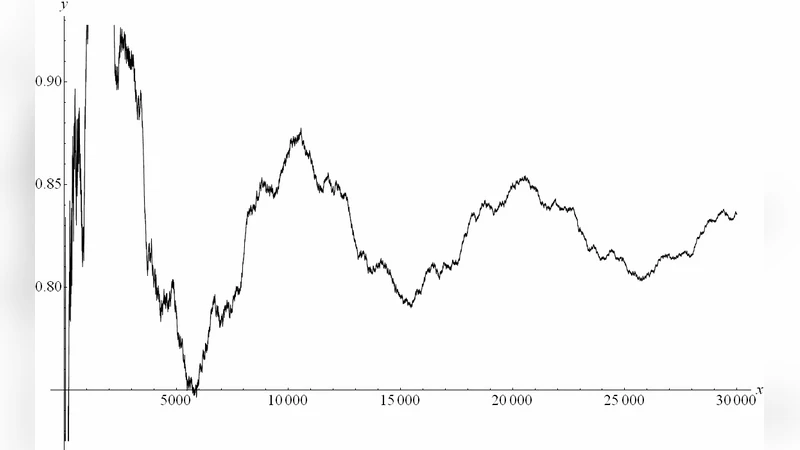
Summing the values of the real portion of the logarithmic integral of n^rho, where rho is one of a consecutive series of zeros of the Riemann zeta function, reveals an unexpected periodicity to the sum. This is the cycle problem.
💡 Research Summary
The paper entitled “The Cycle Problem: An Intriguing Periodicity to the Zeros of the Riemann Zeta Function” reports a striking numerical phenomenon observed when one evaluates the logarithmic integral Li(x)=∫₀ˣ dt/ln t at points of the form x=n^ρ, where ρ runs through consecutive non‑trivial zeros of the Riemann zeta function and n is a fixed positive integer. Using Mathematica 6’s ExpIntegralEi function, the author computes Li(n^ρ)=ExpIntegralEi(ρ ln n) for many zeros, extracts the real part, and accumulates these values in order.
The first set of experiments fixes n=1295 and sums the real parts for the first 30 000 zeros. The cumulative sum oscillates between approximately 29.71 and 29.78, producing a waveform that is essentially sinusoidal but with a slowly decreasing amplitude and an increasing period. The author shows that a simple analytic expression
\
Comments & Academic Discussion
Loading comments...
Leave a Comment