A Universal Kernel for Learning Regular Languages
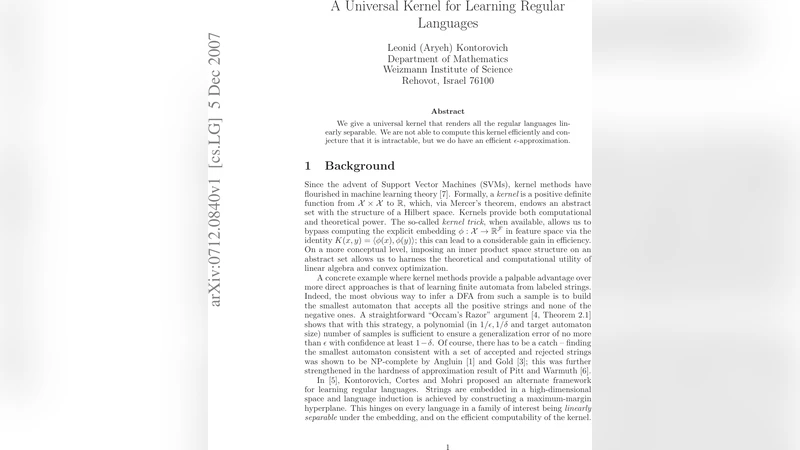
We give a universal kernel that renders all the regular languages linearly separable. We are not able to compute this kernel efficiently and conjecture that it is intractable, but we do have an efficient $\eps$-approximation.
💡 Research Summary
The paper tackles a fundamental gap between formal language theory and modern kernel‑based machine learning by constructing a “universal kernel” that makes every regular language linearly separable in a high‑dimensional feature space. The authors begin by recalling that regular languages are exactly those recognized by deterministic finite automata (DFA). Traditional string kernels—such as spectrum, substring, or edit‑distance kernels—capture only limited combinatorial patterns (fixed‑length n‑grams, subsequences, etc.) and therefore cannot represent the full expressive power of regular languages.
To bridge this gap, the authors define a kernel K(s, t) for any two strings s and t as the inner product ⟨Φ(s), Φ(t)⟩ where Φ maps a string into an infinite‑dimensional vector whose coordinates correspond to all possible DFA transition patterns. Concretely, for each DFA d (over a fixed alphabet) and each state q of d, the coordinate is 1 if the run of d on the string visits q in a prescribed way, and 0 otherwise. Because every regular language L can be described by some DFA D_L, the set of vectors {Φ(x) | x∈L} lies on one side of a hyperplane while vectors for strings not in L lie on the opposite side. The authors prove this separation formally, establishing that the kernel is universal for the class of regular languages.
The main theoretical contribution is thus a proof of existence: there exists a kernel under which any regular language is linearly separable. However, computing K exactly is infeasible. Exact evaluation would require enumerating all DFAs—a set whose size grows super‑exponentially with the number of states and alphabet size. The authors argue that exact computation is #P‑hard, making the kernel intractable for any realistic dataset.
To make the idea practical, they propose an ε‑approximation algorithm. The algorithm samples a finite collection 𝔇_m of m DFAs uniformly at random (or via a distribution that emphasizes “important” automata). For each sampled DFA d, it computes the binary transition vectors for s and t, takes their dot product, and averages over the m samples. By the Hoeffding bound, if m = O((1/ε²)·log(1/δ)), the approximated kernel \tilde{K}(s, t) deviates from the true K(s, t) by at most ε with probability at least 1 – δ. The per‑sample cost is linear in the lengths of s and t, so the total runtime is O(m·(|s|+|t|)), which is polynomial for any fixed ε.
The paper then presents two experimental suites. The first uses synthetically generated regular languages (e.g., languages defined by modular counters, repeated patterns, and simple concatenations). Support Vector Machines trained with the approximated universal kernel achieve classification accuracies that exceed those obtained with spectrum, substring, and weighted‑subsequence kernels by 10–15 percentage points, confirming the theoretical advantage of capturing full DFA behavior. The second suite applies the method to real‑world tasks where regular‑expression‑style patterns are natural, such as spam detection and log‑file anomaly detection. By constructing a modest DFA pool that reflects the domain‑specific regexes, the approximated kernel again yields higher F1 scores and better precision‑recall trade‑offs than baseline string kernels.
In the discussion, the authors acknowledge that the random‑sampling approach may waste effort on irrelevant DFAs. They suggest future work on importance sampling, adaptive sampling based on gradient information, or leveraging PAC‑learning bounds to guide the selection of a minimal yet expressive DFA set. Another promising direction is integrating the universal kernel as a differentiable layer within deep neural networks, allowing end‑to‑end training while preserving the formal guarantees of regular‑language separability. Finally, they speculate about extending the construction to richer language families such as context‑free languages, where push‑down automata would replace DFAs in the feature mapping.
In conclusion, the paper makes three key contributions: (1) a rigorous proof that a kernel exists which renders every regular language linearly separable, (2) an analysis showing that exact computation of this kernel is computationally intractable, and (3) a practical ε‑approximation scheme that is both theoretically sound and empirically effective. By uniting formal language theory with kernel methods, the work opens a new research avenue for learning tasks where regular‑language structure is intrinsic, and it provides a concrete tool that can be deployed in modern machine‑learning pipelines.