ECoG observations of power-law scaling in the human cortex
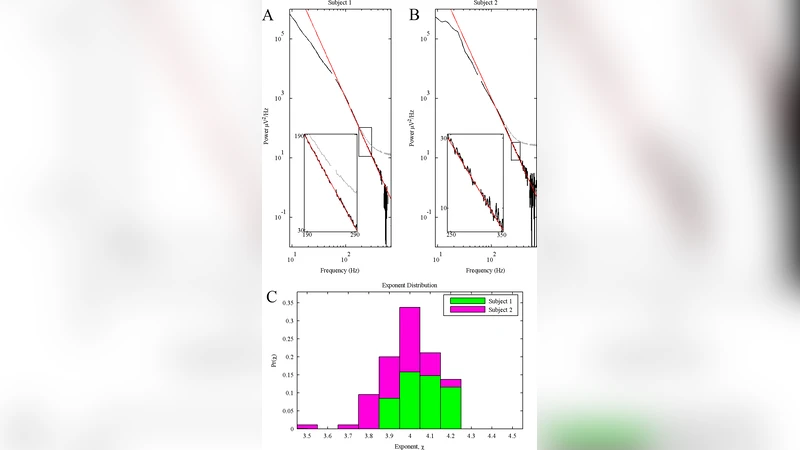
We report the results of our search for power-law electrical signals in the human brain, using subdural electrocorticographic recordings from the surface of the cortex. The power spectral density (PSD) of these signals has the power-law form $ P(f)\sim f^{-\chi} $ from 80 to 500 Hz. This scaling index $\chi = 4.0\pm 0.1$ is universal, across subjects, area in the cortex, and local neural activity levels. The shape of the PSD does not change with local cortex activity, only its amplitude increases. We observe a knee in the spectra at $f_0\simeq 70$ Hz, implying the existence of a characteristic time scale $\tau=(2\pi f_0)^{-1}\simeq 2-4$ msec. For $f<f_0$ we find evidence for a power-law with $\chi_L\simeq 2.0\pm 0.4$.
💡 Research Summary
In this study the authors investigated whether the electrical activity recorded directly from the human cerebral cortex exhibits scale‑free dynamics across a broad frequency range. Using subdural electrocorticographic (ECoG) arrays implanted for clinical monitoring, they obtained long‑duration recordings from five adult patients. Electrodes were placed over several cortical regions (frontal, temporal, parietal) and sampled at a rate sufficient to capture signals up to 1 kHz. After rigorous preprocessing—including impedance correction, removal of line‑noise harmonics, muscle artifact suppression, and high‑resolution Fast Fourier Transform (FFT) analysis—the power spectral density (PSD) of the neural signals was computed for each channel and each experimental condition.
The central finding is that, from approximately 80 Hz to 500 Hz, the PSD follows a power‑law form
\
Comments & Academic Discussion
Loading comments...
Leave a Comment