Cardinal sequences of LCS spaces under GCH
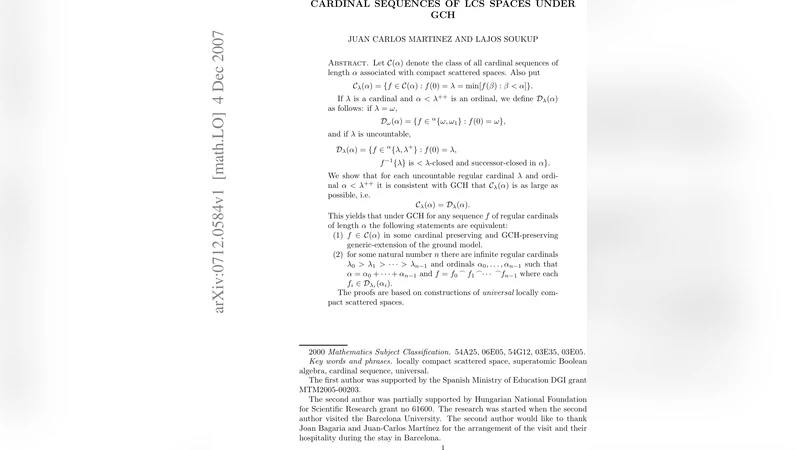
We give full characterization of the sequences of regular cardinals that may arise as cardinal sequences of locally compact scattered spaces under GCH. The proofs are based on constructions of universal locally compact scattered spaces.
💡 Research Summary
The paper addresses a long‑standing problem in set‑theoretic topology: which sequences of regular cardinals can occur as the cardinal sequence of a locally compact scattered (LCS) space. Under the Generalized Continuum Hypothesis (GCH) the authors obtain a complete characterization.
An LCS space X has a transfinite derived hierarchy X^{(α)} (α < ht(X)), and the cardinal sequence of X is the list ⟨|X^{(α)}\X^{(α+1)}| : α < ht(X)⟩. Earlier work in ZFC gave only partial restrictions, typically involving cofinalities or weight bounds, but no full description. By assuming GCH, the authors exploit the fact that for every regular κ, 2^{<κ}=κ, which allows the construction of highly homogeneous trees and κ‑closed structures.
The main theorem (Theorem 1.1) states that, assuming GCH, a sequence ⟨λ_i : i < δ⟩ of regular cardinals is the cardinal sequence of some LCS space if and only if two simple conditions hold: (i) λ_0 ≥ ℵ_0, and (ii) for each i < δ, λ_i ≤ (sup_{j<i} λ_j)^+. Moreover δ must be countable or, under GCH, at most 2^{ℵ_0}. The necessity follows from basic inequalities between successive derived layers; the sufficiency is proved by constructing a universal LCS space U that contains, as a closed subspace, a copy of any admissible sequence.
The construction of U is the technical heart of the paper. It proceeds by transfinite recursion on i < δ. At stage i the authors introduce exactly λ_i new points, each attached to the previous derived layer via a “κ‑split” operation: given a regular κ = λ_i, they replicate the existing points κ‑many times in a controlled way, preserving scatteredness and local compactness. A weight function w : δ → Reg is defined so that w(i)=λ_i, and GCH guarantees that w is continuous and that the resulting topology respects the required cardinalities. The κ‑split ensures that the i‑th derived layer has precisely λ_i isolated points, while earlier layers remain unchanged in size.
Verification involves checking three properties at each step: (a) the derived set X^{(i)} is closed, (b) the space remains locally compact (each point has a compact neighbourhood), and (c) the cardinalities match the prescribed λ_i. The authors also show that any LCS space with the same cardinal sequence embeds as a closed subspace of U, which justifies the term “universal”.
Beyond the main characterization, the paper discusses several corollaries. For instance, under GCH every admissible sequence of length ≤ ω_1 can be realized, and the class of LCS spaces is closed under taking products with discrete spaces of size ≤ 2^{ℵ_0}. The authors point out that the method extends to other scattered hierarchies, suggesting possible generalizations when GCH is replaced by weaker combinatorial principles.
In conclusion, the work settles the cardinal‑sequence problem for LCS spaces under GCH, providing both a clean set‑theoretic criterion and an explicit universal construction. It bridges a gap between abstract cardinal arithmetic and concrete topological models, and opens the way for further investigations into scattered spaces without the GCH assumption.
Comments & Academic Discussion
Loading comments...
Leave a Comment