Hopf algebroids and secondary characteristic classes
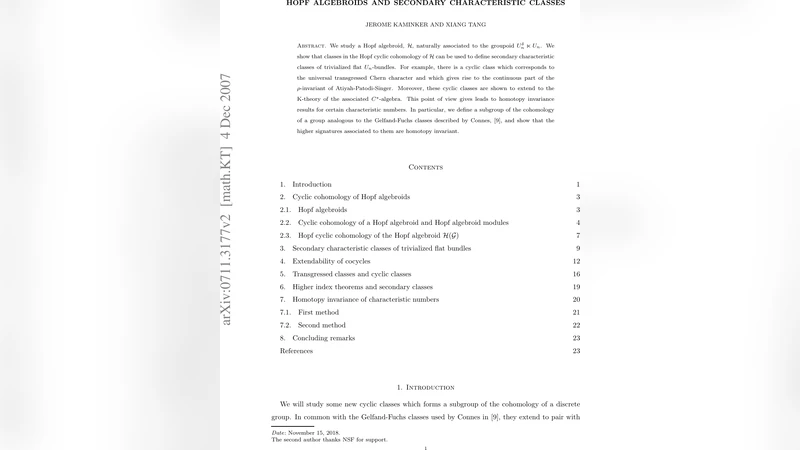
We study a Hopf algebroid, $\calh$, naturally associated to the groupoid $U_n^\delta\ltimes U_n$. We show that classes in the Hopf cyclic cohomology of $\calh$ can be used to define secondary characteristic classes of trivialized flat $U_n$-bundles. For example, there is a cyclic class which corresponds to the universal transgressed Chern character and which gives rise to the continuous part of the $\rho$-invariant of Atiyah-Patodi-Singer. Moreover, these cyclic classes are shown to extend to the K-theory of the associated $C^{*}$-algebra. This point of view gives leads to homotopy invariance results for certain characteristic numbers. In particular, we define a subgroup of the cohomology of a group analogous to the Gelfand-Fuchs classes described by Connes, \cite{connes:transverse}, and show that the higher signatures associated to them are homotopy invariant.
💡 Research Summary
The paper introduces a novel bridge between non‑commutative geometry and classical differential topology by constructing a Hopf algebroid (\mathcal H) naturally associated with the groupoid (U_n^\delta\ltimes U_n). Here (U_n^\delta) denotes the unitary group equipped with the discrete topology, while (U_n) is the usual compact Lie group. Their semi‑direct product yields a smooth groupoid whose algebraic structure can be encoded in a Hopf algebroid over the base algebra (C^\infty(U_n)). The authors endow (\mathcal H) with a coproduct, counit, antipode and a modular pair in involution, making it suitable for the Connes–Moscovici Hopf‑cyclic cohomology framework.
The first major achievement is the identification of a distinguished family of Hopf‑cyclic cocycles ({\tau_{2k}}{k\ge0}) in (HC^{2k}(\mathcal H)). These cocycles are constructed explicitly by transgressing the universal Chern character on the classifying space (BU_n) and then pulling back along the canonical map from the groupoid to the classifying space. When a flat (U_n)-bundle over a manifold (M) is equipped with a trivialization (i.e., a global flat section), the holonomy representation gives a groupoid morphism (\pi_1(M)\to U_n^\delta\ltimes U_n). Composing this morphism with (\tau{2k}) yields a differential form on (M) that represents the secondary characteristic class associated to the trivialized flat bundle. In other words, the Hopf‑cyclic cocycle (\tau_{2k}) encodes the transgressed Chern class in a purely algebraic manner.
The second key step is to extend these secondary classes from differential forms to K‑theoretic invariants of the transformation (C^)-algebra (\mathcal A:=C^(U_n^\delta\ltimes U_n)). The Hopf algebroid (\mathcal H) acts on (\mathcal A) making (\mathcal A) a module algebra. Using the Connes–Chern character from (K_0(\mathcal A)) to cyclic cohomology, the authors pair (\tau_{2k}) with a K‑theory class (
Comments & Academic Discussion
Loading comments...
Leave a Comment