RNA-LEGO: Combinatorial Design of Pseudoknot RNA
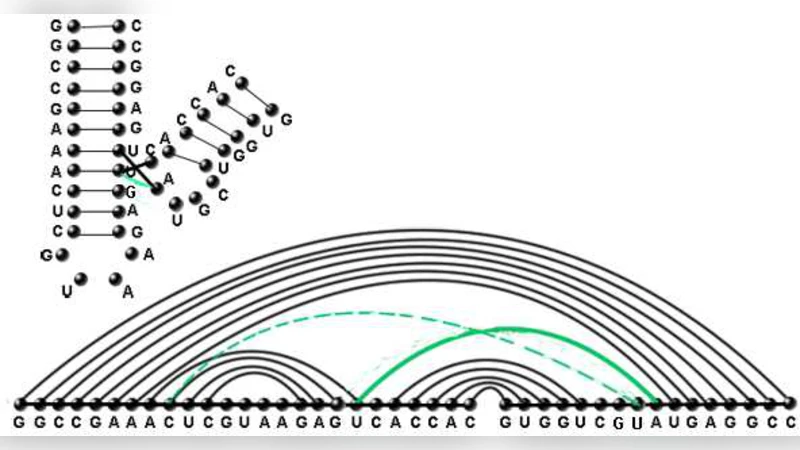
In this paper we enumerate $k$-noncrossing RNA pseudoknot structures with given minimum stack-length. We show that the numbers of $k$-noncrossing structures without isolated base pairs are significantly smaller than the number of all $k$-noncrossing structures. In particular we prove that the number of 3- and 4-noncrossing RNA structures with stack-length $\ge 2$ is for large $n$ given by $311.2470 \frac{4!}{n(n-1)…(n-4)}2.5881^n$ and $1.217\cdot 10^{7} n^{-{21/2}} 3.0382^n$, respectively. We furthermore show that for $k$-noncrossing RNA structures the drop in exponential growth rates between the number of all structures and the number of all structures with stack-size $\ge 2$ increases significantly. Our results are of importance for prediction algorithms for pseudoknot-RNA and provide evidence that there exist neutral networks of RNA pseudoknot structures.
💡 Research Summary
The paper addresses the combinatorial enumeration of RNA pseudoknot structures that are k-noncrossing and satisfy a minimum stack‑length constraint. A stack is defined as a consecutive series of base‑pair arcs; requiring a stack length of at least two reflects the biological observation that isolated base pairs are rarely stable in functional RNAs. The authors model RNA secondary structures as matchings on a set of nucleotides and extend the classic noncrossing (planar) model to k-noncrossing diagrams, where no more than k arcs mutually cross.
Using generating‑function techniques, they derive functional equations that capture the decomposition of a k-noncrossing diagram into irreducible “core blocks” and “insertion blocks”. By applying singularity analysis to these generating functions, the authors obtain precise asymptotic formulas for the number of structures of length n both with and without the stack‑size restriction. The key finding is that imposing a minimum stack length dramatically reduces the exponential growth rate of the structure class.
For k = 3 (3‑noncrossing) they prove
\
Comments & Academic Discussion
Loading comments...
Leave a Comment