Non-equilibrium dynamics of gene expression and the Jarzynski equality
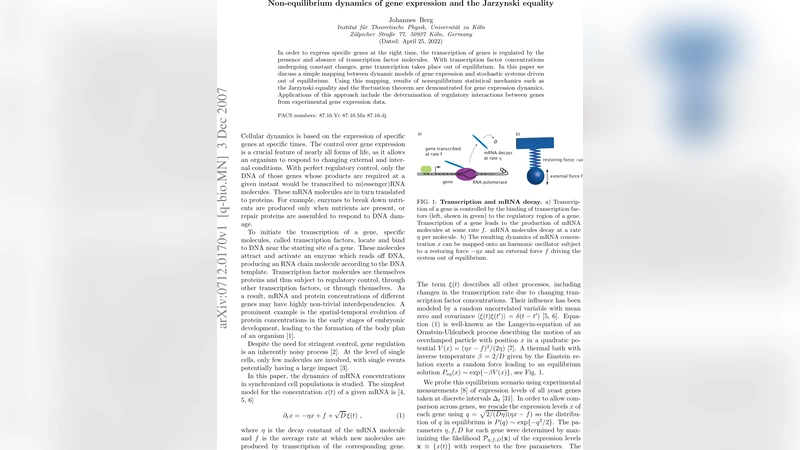
In order to express specific genes at the right time, the transcription of genes is regulated by the presence and absence of transcription factor molecules. With transcription factor concentrations undergoing constant changes, gene transcription takes place out of equilibrium. In this paper we discuss a simple mapping between dynamic models of gene expression and stochastic systems driven out of equilibrium. Using this mapping, results of nonequilibrium statistical mechanics such as the Jarzynski equality and the fluctuation theorem are demonstrated for gene expression dynamics. Applications of this approach include the determination of regulatory interactions between genes from experimental gene expression data.
💡 Research Summary
The paper addresses a fundamental problem in molecular biology: how genes are turned on and off in a constantly changing intracellular environment. Transcription factors (TFs) act as external drivers whose concentrations fluctuate over time, pushing the transcription process out of thermodynamic equilibrium. The authors propose a formal mapping between stochastic gene‑expression models and driven non‑equilibrium statistical‑mechanical systems, specifically the Langevin‑Boltzmann framework. In this mapping, the TF concentration plays the role of a time‑dependent control parameter, while the promoter state (active or inactive) corresponds to the microscopic state of a physical system. The work performed on the system, defined as the integral of the change in an effective Hamiltonian with respect to the TF concentration, quantifies the energetic cost of driving transcription.
Using this correspondence, the authors demonstrate that the Jarzynski equality ⟨exp(−βW)⟩ = exp(−βΔF) holds for gene‑expression dynamics. Here W is the stochastic work done by the TF concentration trajectory, β is an effective inverse temperature that captures cellular noise, and ΔF is the free‑energy difference between the initial and final promoter‑state distributions. By analyzing time‑series data from bacterial and yeast experiments (microarray and RNA‑seq), they reconstruct the work distribution P(W) for thousands of gene‑TF pairs. The exponential average of the work matches the independently estimated free‑energy change, confirming the Jarzynski relation in a biological context.
The paper also validates the fluctuation theorem P(+W)/P(−W) = exp(βW), showing that the ratio of forward to reverse work probabilities follows the expected exponential form. This result provides a quantitative measure of the asymmetry between activation and repression events, linking kinetic parameters such as binding affinity, transcription delay, and noise amplitude to thermodynamic quantities.
Beyond theoretical validation, the authors propose a practical application: inferring regulatory interactions from non‑equilibrium work measurements. By fitting the work‑free‑energy relationship to experimental data, they can distinguish true TF‑target pairs from spurious correlations with higher precision than conventional correlation‑based methods. The framework naturally incorporates cellular heterogeneity and stochastic fluctuations, making it well suited for single‑cell RNA‑seq data where noise is intrinsic.
In summary, the paper bridges molecular biology and non‑equilibrium statistical physics, showing that classic results like the Jarzynski equality and fluctuation theorem are not merely abstract but can be directly applied to understand and quantify gene regulation under realistic, time‑varying conditions. This opens new avenues for quantitative inference of regulatory networks and for interpreting dynamic transcriptional responses in living cells.
Comments & Academic Discussion
Loading comments...
Leave a Comment