The Categorification of a Symmetric Operad is Independent of Signature
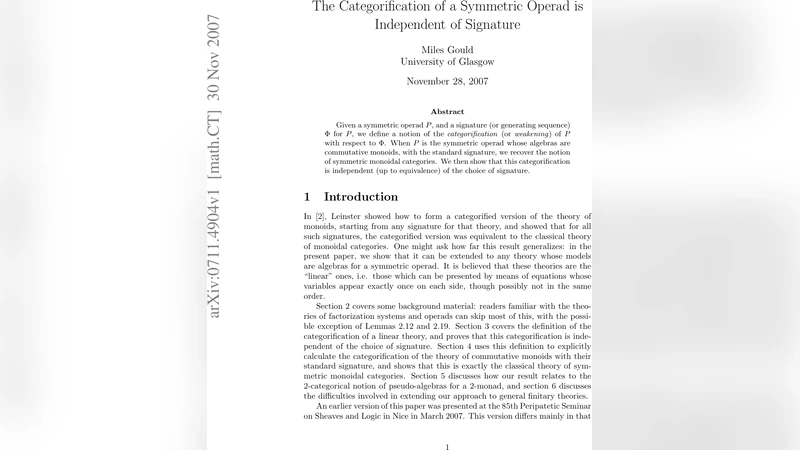
Given a symmetric operad $P$, and a signature (or generating sequence) $\Phi$ for $P$, we define a notion of the “categorification” (or “weakening”) of $P$ with respect to $\Phi$. When $P$ is the symmetric operad whose algebras are commutative monoids, with the standard signature, we recover the notion of symmetric monoidal categories. We then show that this categorification is independent (up to equivalence) of the choice of signature.
💡 Research Summary
The paper addresses a fundamental question in the theory of symmetric operads: whether the process of “categorifying” (or weakening) an operad depends on the particular generating sequence, or signature, chosen to present it. The authors begin by recalling the standard framework for symmetric operads. A symmetric operad P consists of a family of sets P(n) equipped with actions of the symmetric groups Σₙ and composition maps satisfying associativity, unit, and equivariance axioms. Traditionally, one fixes a signature Φ—a collection of basic operations together with their arities—and constructs the free symmetric operad FΦ generated by Φ. Algebras over P are then described as morphisms FΦ → End(X) that respect the operadic structure.
The novelty of the paper lies in defining, for any given signature Φ, a “categorification” of P, denoted CatΦ(P). This construction proceeds in two stages. First, the free operad FΦ is built as usual. Second, the authors lift FΦ to a 2‑categorical (indeed, a weak 2‑monoidal) setting: each n‑ary operation becomes a 1‑cell, the operadic equations (associativity, unit, symmetry) are replaced by specified invertible 2‑cells, and coherence between these 2‑cells is expressed by 3‑cells (modifications). In this way, the strict algebraic laws of P are weakened to isomorphisms, yielding a higher‑dimensional structure that captures the notion of “weak” algebra for P.
The central theorem—signature independence—states that for any two signatures Φ₁ and Φ₂ presenting the same operad P, the corresponding categorifications CatΦ₁(P) and CatΦ₂(P) are equivalent as 2‑categories. The proof is constructive. The authors first exhibit a canonical operad morphism ψ: FΦ₁ → FΦ₂ induced by the universal property of free operads; ψ translates each generator of Φ₁ into a composite of generators of Φ₂. They verify that ψ respects the monad structure underlying the operad (i.e., it commutes with composition and unit, and is equivariant under the symmetric group actions). Next, ψ is promoted to a 2‑functor between the weak 2‑categories CatΦ₁(P) and CatΦ₂(P). The promotion supplies natural transformations (the 2‑cells) that witness the weakening of the operadic equations, and modifications (the 3‑cells) that guarantee coherence. By constructing an explicit inverse 2‑functor (using the universal property of FΦ₂) and exhibiting invertible pseudonatural transformations between the composites and the identities, the authors establish a biequivalence.
To illustrate the abstract machinery, the paper treats the classic example of the commutative monoid operad. With the standard binary operation ⊕ and unit 0 as the signature, the categorification CatΦ(P) recovers the well‑known 2‑category of symmetric monoidal categories, strong monoidal functors, and monoidal natural transformations. The authors then show that if one chooses a different signature—say, a ternary operation μ(x,y,z) together with appropriate equations—the resulting categorification is still biequivalent to the usual symmetric monoidal 2‑category. This concrete case demonstrates that the definition does not artificially privilege any particular presentation of the operad.
Beyond the main result, the paper discusses several implications. First, it provides a uniform framework for weakening any algebraic structure described by a symmetric operad, without having to re‑engineer the coherence data for each presentation. Second, the signature‑independence theorem guarantees that researchers can work with the most convenient generating set for computations or for encoding additional structure (e.g., colors, grading) without altering the underlying weak theory. Third, the approach suggests a pathway to extending the construction to colored operads, higher operads, and even to the realm of ∞‑operads, where similar concerns about presentation‑dependence arise.
In conclusion, the authors have introduced a robust notion of categorification for symmetric operads that is invariant under the choice of generating signature. By constructing explicit biequivalences between categorifications arising from different signatures, they show that the weak algebraic structures one obtains are intrinsic to the operad itself, not to any particular presentation. This work unifies and generalizes existing notions of weak algebraic structures—such as symmetric monoidal categories—and opens the door to systematic treatment of weak operadic algebras across a broad spectrum of mathematical and computational contexts.
Comments & Academic Discussion
Loading comments...
Leave a Comment