The generalized Abel-Plana formula with applications to Bessel functions and Casimir effect
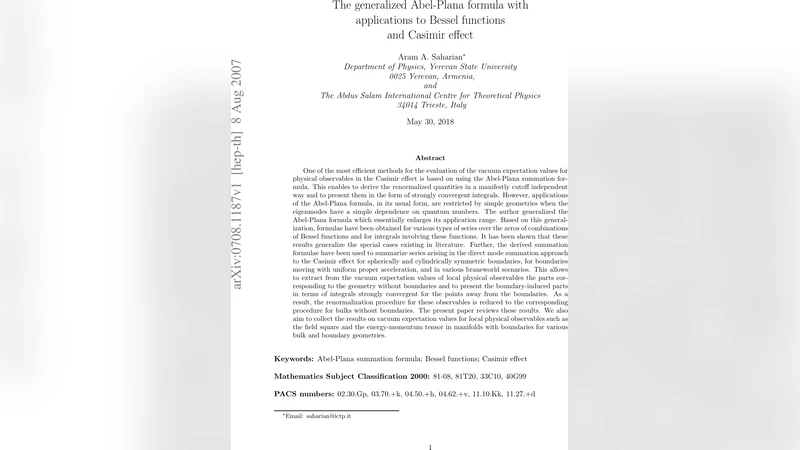
One of the most efficient methods for the evaluation of the vacuum expectation values for physical observables in the Casimir effect is based on using the Abel-Plana summation formula. This enables to derive the renormalized quantities in a manifestly cutoff independent way and to present them in the form of strongly convergent integrals. However, applications of the Abel-Plana formula, in its usual form, are restricted by simple geometries when the eigenmodes have a simple dependence on quantum numbers. The author generalized the Abel-Plana formula which essentially enlarges its application range. Based on this generalization, formulae have been obtained for various types of series over the zeros of combinations of Bessel functions and for integrals involving these functions. It has been shown that these results generalize the special cases existing in literature. Further, the derived summation formulae have been used to summarize series arising in the direct mode summation approach to the Casimir effect for spherically and cylindrically symmetric boundaries, for boundaries moving with uniform proper acceleration, and in various braneworld scenarios. This allows to extract from the vacuum expectation values of local physical observables the parts corresponding to the geometry without boundaries and to present the boundary-induced parts in terms of integrals strongly convergent for the points away from the boundaries. As a result, the renormalization procedure for these observables is reduced to the corresponding procedure for bulks without boundaries. The present paper reviews these results. We also aim to collect the results on vacuum expectation values for local physical observables such as the field square and the energy-momentum tensor in manifolds with boundaries for various bulk and boundary geometries.
💡 Research Summary
The paper presents a comprehensive generalization of the Abel‑Plana summation formula (APF) and demonstrates its powerful applications to problems involving Bessel‑function spectra, especially in the context of Casimir‑type vacuum effects. The traditional APF is an elegant tool for converting discrete mode sums into contour integrals, thereby allowing the extraction of finite, renormalized physical quantities without invoking an explicit cutoff. However, its standard form is limited to situations where the eigenfrequencies depend linearly or simply on integer quantum numbers, such as parallel‑plate geometries. To overcome this restriction, the author introduces a “generalized Abel‑Plana formula” (GAPF) that works for arbitrary meromorphic functions whose zeros and poles encode the spectral information of the system. By constructing two auxiliary functions (f(z)) and (g(z)) and applying Cauchy’s residue theorem, the GAPF expresses a sum over the real axis as a sum of residues at the complex zeros plus an integral along the imaginary axis. This representation is valid for any set of zeros that can be described as solutions of equations involving linear combinations of Bessel functions (J_\nu) and (Y_\nu) (or their modified counterparts (I_\nu), (K_\nu)).
The core technical achievement is the derivation of two families of summation identities. The first family treats the simple zeros of a single Bessel function, (J_\nu(\alpha_n)=0). The second family handles the more general linear combination (A,J_\nu(\alpha_n)+B,Y_\nu(\alpha_n)=0) with complex coefficients (A,B). Both identities contain a bulk term (the integral over the imaginary axis) that is strongly convergent for all points away from the physical boundaries, and a boundary term that reproduces the contribution of the geometry. Importantly, the formulas reduce to all previously known special cases (e.g., the classic APF for planar geometries, the Watson‑Kober summation for spherical shells) when the coefficients are chosen appropriately.
Armed with these identities, the author tackles a broad spectrum of Casimir‑type problems. For spherically symmetric boundaries, the mode frequencies of scalar and electromagnetic fields are determined by the zeros of spherical Bessel functions. Using the GAPF, the vacuum expectation value of the field square (\langle\phi^2\rangle) and the energy‑momentum tensor (\langle T_{\mu\nu}\rangle) are decomposed into two parts: (i) a bulk contribution identical to that of the corresponding boundary‑free space, which can be renormalized by standard techniques (zeta‑function, dimensional regularization, etc.), and (ii) a boundary‑induced part expressed as a single, rapidly convergent integral. The same strategy is applied to cylindrical shells, where the transverse momentum quantization involves ordinary Bessel functions of integer order.
The paper further extends the method to non‑static configurations. For uniformly accelerated mirrors (Rindler‑type boundaries) the relevant mode functions are modified Bessel functions with arguments proportional to the proper acceleration. The GAPF again yields a clean separation of bulk and boundary contributions, allowing the derivation of the Unruh‑Davies effect in a manifestly finite form. In braneworld scenarios, where a thin three‑dimensional brane is embedded in a higher‑dimensional bulk, the Kaluza‑Klein mass spectrum is governed by the zeros of combinations of (I_\nu) and (K_\nu). The generalized summation formulas provide a compact integral representation of the induced vacuum stresses on the brane, facilitating the analysis of radion stabilization and the back‑reaction of quantum fields on the brane geometry.
A significant practical outcome of the GAPF is the ability to write the boundary‑induced vacuum energy density as an integral of the type
\
Comments & Academic Discussion
Loading comments...
Leave a Comment