By assuming that a particle of energy hbar.omega is actually a dissipative system maintained in a nonequilibrium steady state by a constant throughput of energy (heat flow), the exact Schroedinger equation is derived, both for conservative and nonconservative systems. Thereby, only universal properties of oscillators and nonequilibrium thermostatting are used, such that a maximal model independence of the hypothesised sub-quantum physics is guaranteed. It is claimed that this represents the shortest derivation of the Schroedinger equation from (modern) classical physics in the literature, and the only exact one, too. Moreover, a "vacuum fluctuation theorem" is presented, with particular emphasis on possible applications for a better understanding of quantum mechanical nonlocal effects.
Deep Dive into The Vacuum Fluctuation Theorem: Exact Schroedinger Equation via Nonequilibrium Thermodynamics.
By assuming that a particle of energy hbar.omega is actually a dissipative system maintained in a nonequilibrium steady state by a constant throughput of energy (heat flow), the exact Schroedinger equation is derived, both for conservative and nonconservative systems. Thereby, only universal properties of oscillators and nonequilibrium thermostatting are used, such that a maximal model independence of the hypothesised sub-quantum physics is guaranteed. It is claimed that this represents the shortest derivation of the Schroedinger equation from (modern) classical physics in the literature, and the only exact one, too. Moreover, a “vacuum fluctuation theorem” is presented, with particular emphasis on possible applications for a better understanding of quantum mechanical nonlocal effects.
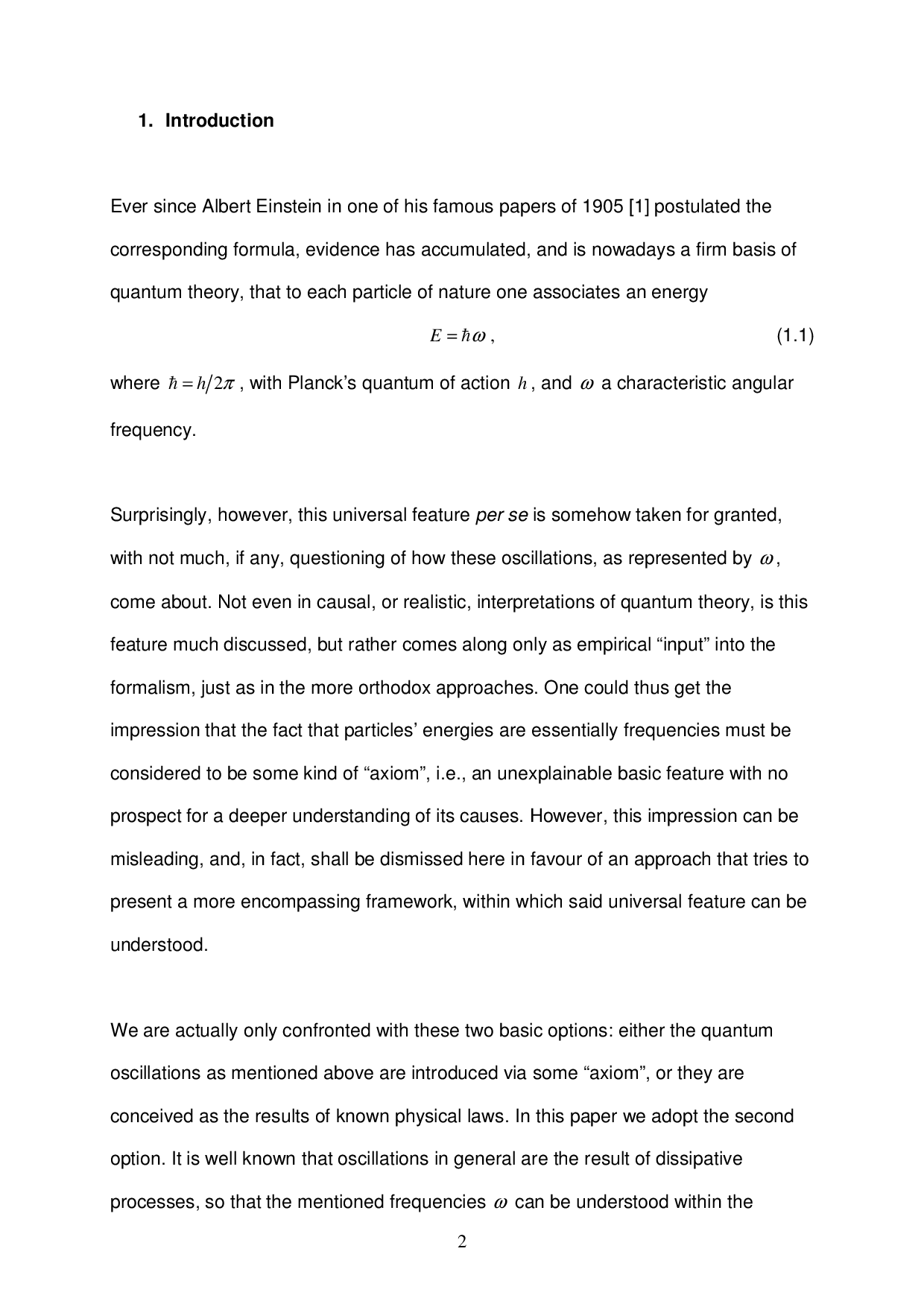
Ever since Albert Einstein in one of his famous papers of 1905 [1] postulated the corresponding formula, evidence has accumulated, and is nowadays a firm basis of quantum theory, that to each particle of nature one associates an energy
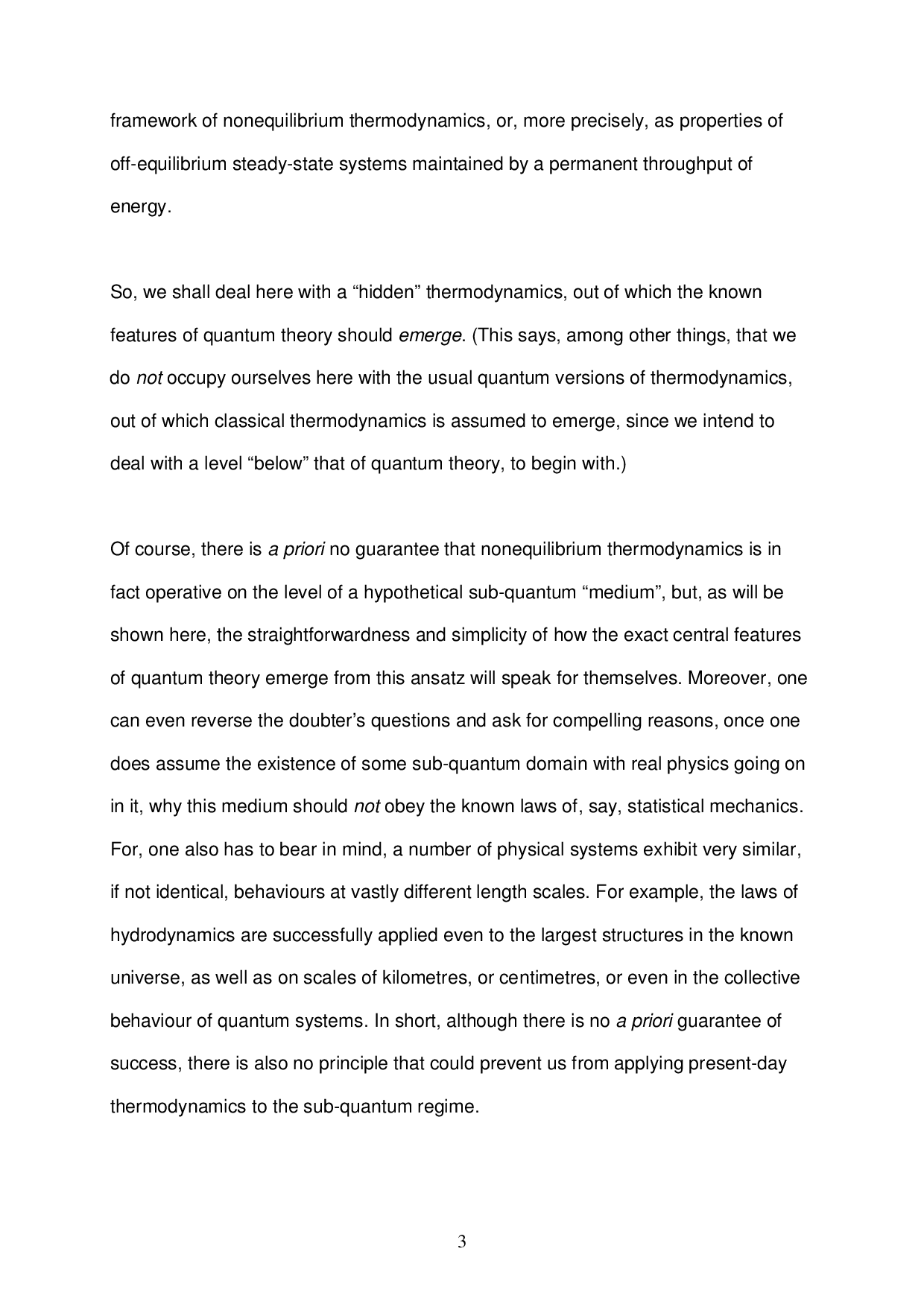
where 2
, with Planck’s quantum of action h , and ω a characteristic angular frequency.
Surprisingly, however, this universal feature per se is somehow taken for granted, with not much, if any, questioning of how these oscillations, as represented by ω , come about. Not even in causal, or realistic, interpretations of quantum theory, is this feature much discussed, but rather comes along only as empirical “input” into the formalism, just as in the more orthodox approaches. One could thus get the impression that the fact that particles’ energies are essentially frequencies must be considered to be some kind of “axiom”, i.e., an unexplainable basic feature with no prospect for a deeper understanding of its causes. However, this impression can be misleading, and, in fact, shall be dismissed here in favour of an approach that tries to present a more encompassing framework, within which said universal feature can be understood.
We are actually only confronted with these two basic options: either the quantum oscillations as mentioned above are introduced via some “axiom”, or they are conceived as the results of known physical laws. In this paper we adopt the second option. It is well known that oscillations in general are the result of dissipative processes, so that the mentioned frequencies ω can be understood within the framework of nonequilibrium thermodynamics, or, more precisely, as properties of off-equilibrium steady-state systems maintained by a permanent throughput of energy.
So, we shall deal here with a “hidden” thermodynamics, out of which the known features of quantum theory should emerge. (This says, among other things, that we do not occupy ourselves here with the usual quantum versions of thermodynamics, out of which classical thermodynamics is assumed to emerge, since we intend to deal with a level “below” that of quantum theory, to begin with.)
Of course, there is a priori no guarantee that nonequilibrium thermodynamics is in fact operative on the level of a hypothetical sub-quantum “medium”, but, as will be shown here, the straightforwardness and simplicity of how the exact central features of quantum theory emerge from this ansatz will speak for themselves. Moreover, one can even reverse the doubter’s questions and ask for compelling reasons, once one does assume the existence of some sub-quantum domain with real physics going on in it, why this medium should not obey the known laws of, say, statistical mechanics.
For, one also has to bear in mind, a number of physical systems exhibit very similar, if not identical, behaviours at vastly different length scales. For example, the laws of hydrodynamics are successfully applied even to the largest structures in the known universe, as well as on scales of kilometres, or centimetres, or even in the collective behaviour of quantum systems. In short, although there is no a priori guarantee of success, there is also no principle that could prevent us from applying present-day thermodynamics to the sub-quantum regime.
In fact, this is the program of the present paper: We, too, take equation (1.1) as the (only) empirical input to our approach, but we also try to understand how this can come about. For this, we study nonequilibrium thermodynamics. That is all we need in order to arrive at quite astounding results. In other words, what is proposed here can be considered also as a gedanken experiment: what if our knowledge of classical physics (including wave mechanics and nonequilibrium thermodynamics) of today had been available 100 years ago? The answer is as follows: One could have thus, without any further assumptions or any ad hoc choices of constants, derived the exact Schrödinger equation, both for conservative and nonconservative systems, using only universal properties of oscillators and nonequilibrium thermostatting. It is particularly the latter feature which is rather appealing, since the use of universality properties guarantees model independence. That is, it will turn out unnecessary to have much knowledge about the detailed sub-quantum mechanisms, as the universal properties of the systems in question will be shown to suffice to obtain the results looked for. Moreover, the approach to be presented here not only re-produces the Schrödinger equation, but also puts forward some new results, such as the subquantum fluctuation theorem, which can thus help shed light on problems not properly understood today within the known quantum formalism.
The paper is structured as follows. In Chapter 2, a short review is given of some results from nonequilibrium thermodynamics, which are particularly useful for our purposes. Chapter 3 then presents the application of the corresponding sub-quantum modelling of conserv
…(Full text truncated)…
This content is AI-processed based on ArXiv data.