Local independence of fractional Brownian motion
Let S(t,t') be the sigma-algebra generated by the differences X(s)-X(s) with s,s' in the interval(t,t'), where (X_t) is the fractional Brownian motion process with Hurst index H between 0 and 1. We prove that for any two distinct t and t' the sigma-a…
Authors: Ilkka Norros, Eero Saksman
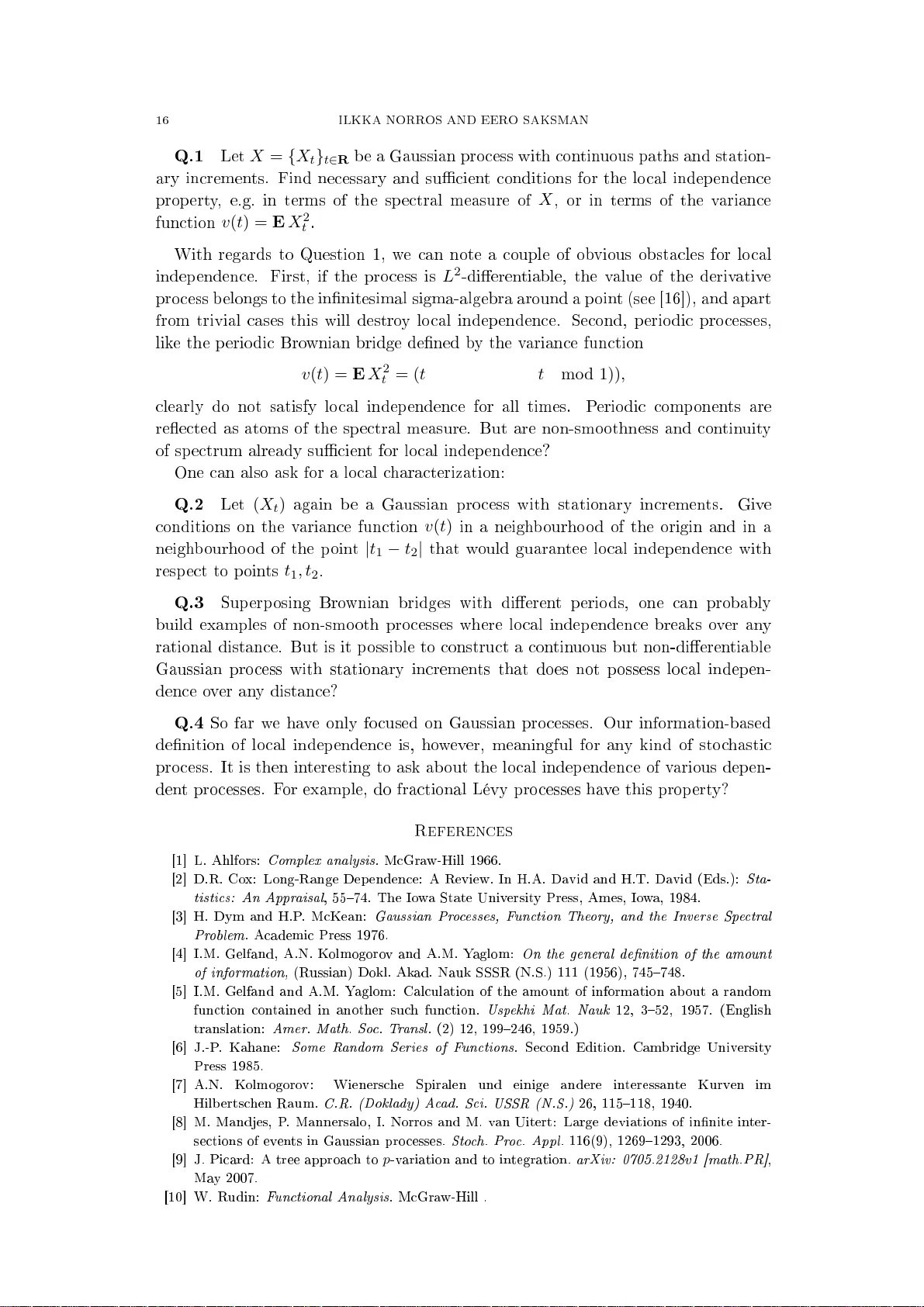
LOCAL INDEPENDENCE OF FRA CTIONAL BR O WNIAN MOTION ILKKA NORR OS AND EER O SAKSMAN Abstra t. Let σ ( t,t ′ ) b e the sigma-algebra generated b y the dierenes X s − X s ′ with s, s ′ ∈ ( t, t ′ ) , where ( X t ) −∞ 1 2 . Moreo v er, when H > 1 2 , the sequene X 1 , X 2 − X 1 , X 3 − X 2 , . . . is long-range dep enden t. i.e. P ∞ i =1 E X 1 ( X i +1 − X i ) = ∞ (see [2, 11℄). FBMs with H > 1 2 are often used in appliations as a mathematial mo del for far-rea hing dep endene. Ho w ev er, as w e sho w in this pap er, `small and distan t' ev en ts in FBMs are nev- ertheless asymptotially indep enden t. This holds b oth as asymptoti orthogonalit y of the Gaussian subspaes generated b y the pro esses ( X t ) | t | < 1 and ( X n + t − X n ) | t | < 1 as n → ∞ , and in the stronger sense that the m utual (Shannon) information I (( X t ) | t | < 1 : ( X n + t − X n ) | t | < 1 ) is nite and dea ys to zero as n → ∞ . By self- similarit y , this is equiv alen t to onsidering the inremen t pro esses around t w o xed timep oin ts, ( X s + u − X s ) | u | <ε and ( X t + u − X t ) | u | <ε , as ε ց 0 . W e prop ose to all this latter prop ert y lo al indep enden e . Our pap er w as motiv ated b y [8℄, where FBM's lo al indep endene prop ert y w as needed, but attempts to nd this result from literature w ere unsuessful. V ery reen tly , ho w ev er, J. Piard [9℄ has pro v en the asymptoti orthogonalit y result using a dieren t te hnique. The more funtional analyti approa h of the presen t note has the adv an tage of giving v ery preise estimates b oth for the rate of asymptoti orthogonalit y , and for the m u h stronger prop ert y of asymptotially v anishing m utual information. Date : Otob er 23, 2018. 2000 Mathematis Subje t Classi ation. 60G15 (60G18,94A99,60H99). Key wor ds and phr ases. frational Bro wnial motion, asymptoti, indep endene, lo al. 1 2 ILKKA NORR OS AND EER O SAKSMAN The struture of the pap er is as follo ws: in the rst setion w e briey reall ertain fats ab out Sob olev spaes with frational smo othness index these spaes are the main to ol in our approa h. W e ha v e tried to mak e the exp osition readable for the readers with no previous kno wledge on these spaes. The seond setion reviews the basi fats on the Gelfand-Y aglom theory of m utual information b et w een Gaussian spaes. The third setion on tains the pro of of our main results. The results are obtained in a quan titativ e form in terms of the relativ e size of the time in terv als in v olv ed. Finally , the fourth setion briey onsiders the higher dimensional ase and states op en questions. 2. Preliminaries I: the fra tional Sobolev sp a es W e shall apply the ommon notation for unin teresting onstan ts. They will all b e denoted b y the letter c , and its v alue an v ary inside a single estimate. The notation a ∼ b means that the ratio of the (p ositiv e) quan tities a and b sta ys b ounded from b elo w and ab o v e as the parameters of in terest v ary . The inner pro dut of elemen ts φ and ψ of a Hilb ert spae H will b e denoted as ( φ, ψ ) H , and the angle ∢ ( A, B ) b et w een subspaes A and B of H is dened b y cos( ∢ ( A, B )) := sup ( U, V ) H k U k H k V H k : U ∈ A, V ∈ B . Suitable referenes for this setion are e.g. [10 , Setion 6℄ or seleted parts of [12℄. V astly more information an b e found in T rieb el's monographs, lik e [15 ℄. A tually only v ery little of the theory of Sob olev spaes is needed, and w e try to b e as self- on tained as p ossible. The F ourier transform of a temp ered distribution f on R n is dened as b f ( ξ ) := (2 π ) − n/ 2 Z R n e − ix · ξ f ( x ) dx. W e shall emplo y the notation h λ, µ i for the distributional pairing, assuming that it is w ell-dened for λ and µ . Reall that the on v olution λ ∗ φ is alw a ys dened if λ is a S h w artz distribution and φ ∈ C ∞ 0 ( R n ) , and its F ourier transform is the pro dut (2 π ) n/ 2 b φ b λ. Moreo v er, b y the denition of the F ourier transform, the P arsev al iden tit y an b e written in the form h λ, φ i = h b λ, b φ i . Let s ∈ R . The Sob olev spae W s, 2 ( R n ) is dened as the Hilb ert spae of tem- p ered distributions f on R n su h that the F ourier transform b f ( ξ ) is a lo ally in te- grable funtion with the prop ert y k f k s, 2 := k f k W s, 2 := Z R n | b f ( ξ ) | 2 (1 + | ξ | 2 ) s 1 / 2 < ∞ . (1) Our normalization onstan t for the F ourier transform mak es sure that W 0 , 2 ( R n ) = L 2 ( R n ) isometrially . In the distributional pairing, the isometri dual of W s, 2 ( R n ) is W − s, 2 ( R n ) . More- o v er, the norm inreases as s inreases, and for in tegers k ∈ N w e ha v e that k f k 2 k , 2 ∼ Z R ( | f ( x ) | 2 + X | α | = k | f ( α ) ( x ) | 2 ) dx. (2) Ob viously all these spaes are translation in v arian t, and one ma y v erify that m ulti- pliation b y an elemen t in C ∞ 0 ( R n ) is on tin uous. LOCAL INDEPENDENCE OF FRA CTIONAL BR O WNIAN MOTION 3 W e next reall the homogeneous Sob olev spaes f W s, 2 ( R n ) .The norm is replaed b y k f k f W s, 2 ( R n ) := Z R n | b f ( ξ ) | 2 | ξ | 2 s dξ 1 / 2 < ∞ . (3) This norm is ertainly w ell-dened at least for all f ∈ C ∞ 0 ( R n ) , although ev en then it ma y tak e the v alue ∞ if s < − n/ 2 . In dening the Hilb ert spae f W s, 2 ( R n ) there indeed arises some ompliations in the denition, due to the fat that the | ξ | 2 s an b e either 'to o big' or 'to o small' near origin. Ho w ev er, for our main result it is enough to onsider the ase n = 1 and | s | < 1 / 2 , and then these diulties disapp ear. F or these v alues of the parameters the homogeneous spaes are simp y dened as the (in v erse) F ourier transform of the w eigh ted spae L 2 µ ( R ) , where the w eigh t is of the form µ ( dξ ) = | ξ | 2 s . By Cau h y-S h w artz an y funtion in this w eigh ted spae is a lo ally in tegrable funtion, and th us denes a distribution in a natural w a y . On the other hand, ev ery S h w artz test funtion b elongs to this w eigh ted spae, whi h an b e used to sho w that C ∞ 0 ( R ) ⊂ f W s, 2 is a dense subset. Moreo v er, the isometri dualit y ( f W s, 2 ( R )) ∗ = f W − s, 2 ( R ) holds via the distributional dualit y h φ, ψ i = Z R φ ( x ) ψ ( x ) dx. The pairing is originally dened only for test funtions, but it extends to elemen ts φ ∈ f W s, 2 ( R ) and ψ ∈ f W − s, 2 ( R ) b y on tin uit y and densit y . W e then x s ∈ ( − 1 / 2 , 1 / 2) together with an op en in terv al I ⊂ R ( I an w ell b e un b ounded) and dene the Sob olev-funtions o v er this in terv al. First of all w e denote b y f W s, 2 0 ( I ) the losure of C ∞ 0 ( I ) in the spae f W s, 2 ( R ) . Clearly all the elemen ts in f W s, 2 0 ( I ) are distributions supp orted on I . W e will also need the spae f W s, 2 ( I ) whi h onsists of restritions of elemen ts of f W s, 2 ( R ) on the in terv al I . Th us f W s, 2 ( I ) = { g | I : g ∈ f W s, 2 ( R ) } . This spae is naturally normed b y the indued quotien t norm k f k f W s, 2 ( I ) := inf {k g k f W s, 2 ( R ) : g | I = f } . In a similar v ain one denes the non-homogeneous spae W s, 2 ( I ) b y setting W s, 2 ( I ) = { g | I : g ∈ W s, 2 ( R ) } and in tro duing the quotien t norm k f k W s, 2 ( I ) := inf {k g k W s, 2 ( R ) : g | I = f } . This denition mak es sense for all s ∈ R . One ma y easily v erify that k f k 2 W 1 , 2 ( I ) ∼ R I ( f ′ 2 ( x ) + f 2 ( x )) dx, where f ′ is the distributional deriv ativ e of f . Sine f W s, 2 0 ( I ) ⊂ f W s, 2 ( R ) is a (losed) subspae, w e dedue b y standard Hilb ert spae theory that isometrially ( f W s, 2 0 ( I )) ′ = f W − s, 2 ( I ) and ( f W s, 2 ( I )) ′ = f W − s, 2 0 ( I ) (4) through the pairing h φ, ψ i = R I φ ( x ) ψ ( x ) dx (extended again b y on tin uit y). There is th us a natural isometry G : f W − s, 2 ( I ) → f W s, 2 0 ( I ) in su h a w a y that ( φ, Gψ ) f W s, 2 0 ( I ) = Z I φ ( x ) ψ ( x ) dx (5) for smo oth elemen ts φ and ψ . Again this extends for an y φ ∈ f W s, 2 0 ( I ) and ψ ∈ f W − s, 2 ( I ) b y on tin uit y . In the Lemma b elo w the assumption | s | < 1 2 is ruial. 4 ILKKA NORR OS AND EER O SAKSMAN Lemma 1. L et s ∈ ( − 1 2 , 1 2 ) and let I ⊂ R b e an op en interval of length 1. (i) Multipli ation by the signum funtion extends to a b ounde d line ar op er ator on f W s, 2 ( R ) . In other wor ds, k χ ( −∞ , 0) f k f W s, 2 ( R ) , k χ (0 , ∞ ) f k f W s, 2 ( R ) ≤ c k f k f W s, 2 ( R ) for al l f ∈ C ∞ 0 ( R ) . The same statement r emains true if f W s, 2 ( R ) is r epla e d by W s, 2 ( R ) . (ii) f W s, 2 0 ( I ) = { f ∈ f W s, 2 ( R ) : supp( f ) ⊂ I } . (iii) W e have f W s, 2 0 ( I ) = f W s, 2 ( I ) = W s, 2 ( I ) with e quivalent norms (the onstant of isomorphism do es not dep end on the lo ation of the interval I ). (iv) Ther e is a ontinuous inlusion W 1 , 2 ( I ) ⊂ f W s, 2 0 ( I ) , and this natur al imb e dding is a Hilb ert-Shmidt op er ator. Pr o of. (i) The statemen t is w ell-kno wn, see [15, First Lemma in Setion 2.10.2.℄. A tually , up to a onstan t the m ultipliation b y the sign um funtion orresp onds to the ation of the Hilb ert transfrom on the F ourier side. Hene the laim follo ws from the fat that | ξ | 2 s is a Mu k enhoupt A 2 -w eigh t on R for an y s ∈ ( − 1 / 2 , 1 / 2) , see [13, Corollary , V.4.2, V.6.6.4℄. In a similar w a y , b y he king that (1 + | ξ | 2 ) s is a Mu k enhoupt w eigh t one obtains the statemen t onerning W s, 2 . (ii) Let f ∈ f W s, 2 ( R ) with supp( f ) ⊂ I . W e will sho w that one ma y appro ximate f in norm b y the elemen ts of C ∞ 0 ( I ) . The dilation λ → f ( λ · ) is a on tin uous map from a neigh b ourho o d of 1 in to f W s, 2 ( R ) . Hene, b y appro ximating f with a suitable dilation w e ma y assume that supp( f ) is on tained in I . Finally , w e then obtain the required appro ximan t b y a standard molliation. (iii) By the translation in v ariane of the spaes, the indep endene on the lo ation of the in terv al I is ob vious. The rst equalit y is an easy onsequene of parts (i) and (ii). T o w ards the seond equalit y , let us rst v erify that C ∞ 0 ( I ) is dense in W s, 2 ( I ) . By part (i), if f ∈ W s, 2 ( I ) then also χ I f ∈ W s, 2 ( R ) , where χ I f stands for the zero on tin uation of f to R . Exatly as in part (ii) w e sho w b y dilation and on v olution appro ximation that χ I f is in the losure of C ∞ 0 ( I ) in W s, 2 ( R ) , whi h learly yields the laim. Hene it remains to sho w that k f k W s, 2 ( R ) ∼ k f k f W s, 2 ( R ) for f ∈ C ∞ 0 ( I ) . (6) W e ma y learly assume that I = (0 , 1) . Let us rst onsider the inequalit y k f k W s, 2 ( R ) ≤ c k f k f W s, 2 ( R ) . (7) This is immediate if s ≤ 0 . If s ∈ (0 , 1 / 2) w e ho ose a ut-o funtion φ ∈ C ∞ 0 ( − 1 , 2) su h that φ = 1 on the in terv al [ − 1 / 2 , 3 / 2] . Let us deomp ose f = φf 1 + φf 2 , where b f 1 = χ [ − 1 , 1] b f , and b f 2 = b f − b f 1 . Then ob viously k φf 2 k W s, 2 ( R ) ≤ c k f 2 k W s, 2 ( R ) ≤ c k f k f W s, 2 ( R ) . Moreo v er, f 1 ( x ) = 1 √ 2 π Z 1 − 1 e ixξ b f ( ξ ) dξ , f ′ 1 ( x ) = i √ 2 π Z 1 − 1 e ixξ ξ b f ( ξ ) dξ , where, b y Cau h y-S h w arz, R 1 − 1 | b f ( ξ ) | dξ ≤ c k f k f W s, 2 ( R ) . Hene k f 1 k ∞ + k f ′ 1 k ∞ ≤ c k f k f W s, 2 ( R ) and w e obtain that k φf 1 k W s, 2 ( R ) ≤ k φf 1 k W 1 , 2 ( R ) ≤ c k f 1 k f W s, 2 ( R ) . By om bining these estimates (7) follo ws. LOCAL INDEPENDENCE OF FRA CTIONAL BR O WNIAN MOTION 5 In turn, the on v erse inequalit y k f k f W s, 2 ( R ) ≤ c k f k W s, 2 ( R ) . (8) is immediate if s ≥ 0 . It learly follo ws for negativ e s ∈ ( − 1 / 2 , 0) if w e v erify that in our situation k b f k L ∞ ( − 1 , 1) ≤ c k f k W s, 2 ( R ) . This is seen b y observing that b f ( ξ ) = 1 √ 2 π h f ( x ) , φ ( x ) e − iξ x i , where sup − 1 ≤ ξ ≤ 1 k φ ( x ) e − iξ x k W − s, 2 ( R ) ≤ c. (iv) By part (iii), the laim is a onsequene of the w ell-kno wn Hilb ert-S hmidt prop ert y of the inlusion W 1 , 2 ( I ) ⊂ W s, 2 ( I ) . Sine w e ha v e not b een able to nd a on v enien t referene, the simple pro of is sk et hed here. W e ma y assume that I = ( − 1 / 2 , 1 / 2) so that I ⊂ ( − π , π ] =: T , where T stands for the 1-dimensional torus. By applying a simple extension one ma y onsider the spaes in question as losed subspaes of the orresp onding Sob olev spaes H 1 ( T ) and H s ( T ) on the torus, where for f = P ∞ n = −∞ a n e inx and u ∈ R one sets k f k 2 H u ( T ) = P ∞ n = −∞ (1 + | n | ) 2 u | a n | 2 (see e.g. [10℄). By onsidering the natural orthogonal basis ((1 + | n | ) − u e inx ) ∞ n = −∞ w e see that the em b edding H 1 ( T ) ⊂ H s ( T ) is equiv alen t to the diagonal op erator with the diagonal elemen ts ((1 + | n | ) s − 1 ) ∞ n = −∞ . This is Hilb ert-S hmidt as P ∞ n = −∞ (1 + | n | ) 2 s − 2 < ∞ . W e shall need the form ula for the F ourier transform of the funtion u α ( x ) := | x | − α , where x ∈ R n and α ∈ (0 , n ) . It is w ell-kno wn, see e.g. [12 , V 1. Lemma 2, p.117℄, that b u α ( ξ ) = d n,α | ξ | α − n , where d n,α := 2 n/ 2 − α Γ(( n − α ) / 2) Γ( α/ 2) . (9) Lemma 2. Assume that s ∈ ( − 1 / 2 , 1 / 2) . (i) L et α > 0 , α 6 = 1 and denote f α ( x ) = (1 + | x | ) − α . Then f α ∈ f W s ( R ) for α > 1 / 2 − s . (ii) L et α > 1 / 2 + s, α 6 = 1 . Then for any k > 0 ther e is a onstant c ( α, s ) > 0 suh that k ( k − · ) − α k f W − s, 2 (( −∞ , 0)) = c ( α, s ) k 1 / 2+ s − α . In other wor ds, sup k φ k f W s, 2 0 (( −∞ , 0)) ≤ 1 Z 0 −∞ ( k − x ) − α φ ( x ) dx = c ( α, s ) k 1 / 2+ s − α . (10) Pr o of. (i) Cho ose a smo oth ut-o funtion φ ∈ C ∞ 0 ( R ) su h that φ = 1 in a neigh b ourho o d of the origin. Comp ose f α ( x ) = φ ( x ) f α ( x )+(1 − φ ( x ))( f α ( x ) −| x | − α )+(1 − φ ( x )) | x | − α =: g 1 ( x )+ g 2 ( x )+ g 3 ( x ) . Ob viously g 1 ∈ L 1 ( R ) ∩ W 1 , 2 ( R ) ⊂ f W s, 2 ( R ) for all | s | < 1 / 2 . An easy eastimate sho ws that the same holds for g 2 . Moreo v er, w e observ e that ( d/dx ) g 3 ∈ L 2 ( R ) . Hene R R | ξ | 2 | b g 3 ( ξ ) | 2 < 1 . Th us the inlusion g 3 ∈ f W s, 2 ( R ) holds if and only if the in tegral R 1 − 1 | ξ | 2 s | b g 3 ( ξ ) | 2 dξ is nite. Consider rst the ase α > 1 . Then g 3 ∈ L 1 ( R ) , so that b g 3 is b ounded and g 3 ∈ f W s, 2 ( R ) for all | s | < 1 / 2 . Assume then that α ∈ (0 , 1) . Then g 3 ( x ) − | x | − α ∈ L 1 ( R ) , so that (9) yields | b g 3 ( ξ ) − d 1 ,α | ξ | α − 1 | ≤ C . Th us R 1 − 1 | ξ | 2 s | b g 3 ( ξ ) | 2 dξ < ∞ exatly for s > 1 / 2 − α. 6 ILKKA NORR OS AND EER O SAKSMAN (ii) The denition of the homogeneous Sob olev norm yields the saling rule k φ ( k · ) k f W s, 2 ( R ) = k s − 1 / 2 k φ ( · ) k f W s, 2 ( R ) . By using this fat, dualit y , and a substitu- tion x = k y in the in tegral w e are redued to sho wing that sup 8 < : φ ∈ C ∞ 0 ( −∞ , 0) k φ k f W s ( R ) ≤ 1 Z 0 −∞ (1 + | x | ) − α φ ( x ) dx < ∞ . By dualit y this follo ws immediately from the fat that (1 + | x | ) − α ∈ f W − s, 2 ( R ) aording to part (i) of the Lemma. W e nally remark that all the results stated in this setion remain v alid with iden tial pro ofs for the Sob olev spaes that on tain only real-v alued funtions. 3. Preliminaries I I: mutual inf orma tion between Ga ussian subsp a es In this setion w e presen t the needed fats from the Gelfand-Y aglom theory of m utual information b et w een Gaussian subspaes. In order to reall the general on- ept of m utual information, let (Ω , F , P ) b e a probabilit y spae, and let A and B b e sub- σ -algebras of F . The m utual (Shannon) information b et w een A and B is dened as [4 ℄ I ( A : B ) := sup { A j }{ B k } X k ,j P ( A j ∩ B k ) log P ( A j ∩ B k ) P ( A j ) P ( B k ) . Here the suprem um is tak en o v er all A -measurable partitions Ω = S n j = 1 A k and B - measurable partitions Ω = S m k =1 B k of the probabilit y spae ( n, m ≥ 1 , P ( A j ) > 0 and P ( B k ) > 0 for all j, k ). F or random v ariables X : Ω → E and Y : Ω → F , where E , F are measurable spaes, w e set I ( X : Y ) := I ( σ ( X ) : σ ( Y )) . Let µ X (resp. µ Y , µ ( X,Y ) ) b e the distribution (measure) of X (resp. Y , ( X, Y ) ) in the spae E (resp. F , E × F ). Then, one ma y he k that I ( X : Y ) = ∞ if the measure µ ( X,Y ) is not absolutely on tin uous with resp et to the pro dut measure µ X ⊗ µ Y . Moreo v er, in the ase where µ ( X,Y ) << µ X ⊗ µ Y w e denote p = dµ ( X,Y ) d ( µ X ⊗ µ Y ) and ha v e the form ula I ( X : Y ) = Z X × Y log( p ) d ( µ X ⊗ µ Y ) . (11) The Kullba k-Leibler information haraterizes the shift from a probabilit y mea- sure µ to another probabilit y measure ν on the same measurable spae, and it is dened as I K L ( µ : ν ) = R log dµ dν dν, if µ << ν , ∞ , otherwise . Shannon's m utual information an b e expressed in terms of the Kullba k-Leibler information as I ( A : B ) = I K L ( P ( A , B ) : P A ⊗ P B ) , (12) where P ( A , B ) denotes the unique probabilit y measure on (Ω × Ω , A × B ) satisfying P ( A , B ) ( A × B ) = P ( A ∩ B ) for A ∈ A , B ∈ B . A tually , this is obtained from (11) b y letting X (resp. Y ) b e the iden tit y map (Ω , F ) → (Ω , A ) (resp. the iden tit y map (Ω , F ) → (Ω , B ) ). The follo wing prop erties of m utual information are most on v enien tly pro v en through the relation (12). LOCAL INDEPENDENCE OF FRA CTIONAL BR O WNIAN MOTION 7 Theorem 1. (i) I ( A : B ) ≥ 0 and e quality holds if and only if A and B ar e inde- p endent. (ii) I ( A : B ) is non-de r e asing with r esp e t to A and B . (iii) If A n ↑ A and B n ↑ B , then I ( A n : B n ) ↑ I ( A : B ) . (iv) If A n ↓ A and B n ↓ B , and if I ( A n : B n ) < ∞ for some n , then I ( A n : B n ) ↓ I ( A : B ) . When X and Y are nite-dimensional random v etors su h that ( X, Y ) is a non- degenerate and en tered m ultiv ariate Gaussian, one ma y easily ompute b y using (11) that I ( X : Y ) = 1 2 log det(Γ X ) d et(Γ Y ) det(Γ ( X,Y ) ) , where Γ Z denotes the o v ariane matrix of a Gaussian v etor Z . In partiular, the information b et w een random v ariables X and Y with biv ariate en tered Gaussian distribution is (13) I ( σ ( X ) : σ ( Y )) = − log sin ∢ ( X , Y ) . The theory of Shannon information b et w een Gaussian pro esses w as dev elop ed b y Gel'fand and Y aglom [5℄. Their fundamen tal diso v ery w as that one ma y express the information b et w een t w o losed subspaes A and B of a Gaussian spae G in terms of the sp etral prop erties of the op erator T := P A P B P A , where P A and P B stand for the orthogonal pro jetions on A and B , resp etiv ely . In order to explain their result, and for later purp oses, w e rst reall some basi notions of op erator theory . Let S : E → F b e a b ounded linear op erator b et w een the separable Hilb ert spaes E and F . Let { e i } i ∈ I b e an orthonormal basis for E . The Hilb ert-S hmidt norm of S is dened as k S k H S ( E ,F ) := X i ∈ I k S e i k 2 F 1 / 2 . This denition do es not dep end on the partiular orthonormal basis used. In ase k S k H S < ∞ w e sa y that S is a Hilb ert-S hmidt op erator. Also it is lear that if E (resp. F ) is a Hilb ert subspae of a larger spae e E (resp. e F ), then k S P E k H S ( e E , e F ) = k S k H S ( E ,F ) . In this sense it is not imp ortan t to k eep exat tra k on the domain of denition and image spaes, and one usually abbreviates k S k H S ( E ,F ) = k S k H S . F or pro duts of b ounded linear op erators b et w een (p erhaps dieren t) Hilb ert spaes w e ha v e k T S k H S ≤ k T k H S k S k and k S T k H S ≤ k S kk T k H S . (14) Let us then assume, in addition, that S : E → E is self-adjoin t and p ositiv e semi-denite, S ∗ = S and S ≥ 0 . Then one ma y alw a ys dene the trae of S b y setting tr ( S ) := X i ∈ I ( e i , S e i ) Th us, tr ( S ) ∈ [0 , ∞ ] . In the ase that tr ( S ) < ∞ w e sa y that S is of trae lass. Ev ery trae lass op erator S is ompat, and sine w e also assume S ≥ 0 , it has a dereasing sequene of p ositiv e eigen v alues λ 1 ≥ λ 2 ≥ . . . ≥ 0 , where ea h eigen v alue is oun ted aording to its m ultipliit y . It follo ws that tr ( S ) = X λ k > 0 λ k . (15) 8 ILKKA NORR OS AND EER O SAKSMAN W e nally observ e that if S : E → F is an y b ounded linear op erator, then S ∗ S ≥ 0 is self-adjoin t, and w e ma y ompute tr ( S ∗ S ) = k S k 2 H S . (16) Let us then go ba k to the situation where A, B are losed subspaes of a Gaussian Hilb ert spae G and state the result of Gelfand and Y aglom. Again P A and P B stand for the orthogonal pro jetions to the subspaes A and B , resp etiv ely , and I ( A : B ) := I ( σ { X : X ∈ A } : σ { Y : Y ∈ B } ) . Theorem 2. [5℄ Denote T := P A P B P A . The mutual information I ( A : B ) is nite if and only if k T k < 1 ( i.e. ∢ ( A, B ) > 0 ) and the op er ator T is of tr a e lass. Mor e over, in this ase I ( A : B ) = 1 2 X k : λ k > 0 log( 1 1 − λ k ) , (17) wher e λ 1 ≥ λ 2 ≥ . . . ar e the eigenvalues of T in the de r e asing or der r ep e ate d a or d- ing to their multipliities. A nie sk et h of the deriv ation of the form ula (17) is inluded in a form of ex- erises in [3 , pp. 6869℄. Assume that T is of trae lass, and let Z 1 , Z 2 , . . . b e an orthonormal basis of T G onsisting of eigen v etors orresp onding to the non-zero eigen v alues λ 1 ≥ λ 2 ≥ . . . . It is not diult to see that { P B Z i } is an orthogonal basis of P B P A P B G , and, moreo v er, these bases are mutual ly orthogonal: ( Z i , P B Z j ) = 0 for i 6 = j . Sine orthogonalit y implies indep endene in the ase of Gaussian random v ariables, it follo ws that the information b et w een σ ( A ) and σ ( B ) an b e expressed as the sum of the informations within the pairs ( Z i , P B Z i ) , giv en in (13): I ( A : B ) = − X i log sin ∢ ( Z i , P B Z i ) = − 1 2 X i log(1 − cos 2 ∢ ( Z i , P B Z i )) = − 1 2 X i log(1 − λ i ) . Note that sine ∢ ( A, B ) = inf i ∢ ( Z i , P B Z i ) , the information b et w een subspaes an b e innite ev en when they ha v e a p ositiv e angle. By in v oking the T a ylor series of x 7→ log(1 / (1 − x )) w e obtain for x ∈ [0 , 1) that x ≤ log( 1 1 − x ) = ∞ X k =1 1 k x k ≤ x + 1 2 x 2 ( 1 1 − x ) ≤ x (1 + x 2(1 − x ) ) . (18) Observ e also that T = ( P B P A ) ∗ ( P B P A ) and k T k = k P B P A k 2 . Moreo v er, λ 1 ≤ k P B P A k ≤ k P B P A k H S . By om bining these observ ations and the fats (15)(18) w e obtain a form ulation suitable for our purp oses: Corollary 1. The angle b etwe en the sp a es A and B satises cos( ∢ ( A, B )) = k P B P A k . W e have I ( A : B ) < ∞ if and only if k P B P A k < 1 and k P B P A k H S < ∞ . Mor e over, in this ase 1 2 k P B P A k 2 H S ≤ I ( A : B ) ≤ 1 2 k P B P A k 2 H S 1 + k P B P A k 2(1 − k P B P A k ) (19) Observ e that the ab o v e estimate is asymptotially preise in the limit k P B P A k → 0 , or, equiv alen tly , as ∢ ( A, B ) → π / 2 . Esp eially this is true in the limit I ( A : B ) → 0 . LOCAL INDEPENDENCE OF FRA CTIONAL BR O WNIAN MOTION 9 4. St a tement and pr oof of the main resul ts In this setion w e onsider the asymptoti indep endene of the lo al spaes of FBMs. T o b e more exat, let us rst dene for an y set S ⊂ R E S := span { X u − X v : u, v ∈ S } , and the shorthand notation E t,ε := E ( t − ε,t + ε ) . W e onsider the follo wing t w o notions of lo al indep endene. Denition 1. W e say that the sto hasti pr o ess X p ossesses lo al indep endene in the w eak sense , if for any distint t 1 , t 2 ∢ ( E t 1 ,ε , E t 2 ,ε ) → π 2 as ε ց 0 . W e say that the sto hasti pr o ess X p ossesses lo al indep endene (in the strong sense) , if for any distint t 1 , t 2 I ( E t 1 ,ε : E t 2 ,ε ) → 0 as ε ց 0 . The term `w eak' orresp onds to its use in `stationarit y in the w eak sense'. W e will onsider in tegrals of the form R R X t φ ( t ) dt for smo oth and ompatly supp orted funtions φ. The denition of the in tegral p oses no problems sine t 7→ X t is on tin uous with resp et to L 2 -norm of random v ariables, whene it an b e e.g. dened as the limit of the orresp onding Riemann sums (or as a Bo hner in tegral). Let us start with t w o simple lemmata. Lemma 3. F or any T ∈ R and a > 0 the elements Z R φ ′ ( t ) X t dt, φ ∈ C ∞ 0 ( T , T + a ) (20) ar e dense in E ( T ,T + a ) . Pr o of. By observing that R R φ ′ ( t ) X t dt = R R φ ′ ( t )( X t − X T + a/ 2 ) dt w e see that the elemen ts in question are on tained in E T ,a . Con v ersely , let φ ∈ C ∞ 0 ( R ) satisfy R R φ ( t ) = 1 . Denote φ ε ( x ) = ε − 1 φ ( xε ) . By the L 2 -on tin uit y w e ha v e that for an y t 1 , t 2 ∈ ( T , T + a ) X t 1 − X t 2 = lim ε → 0 ( Z R X u ( φ ε ( t 1 + u ) − φ ε ( t 2 + u )) du. Observ e that w e ma y write ψ ′ = φ ε ( t 1 + · ) − φ ε ( t 2 + · ) for suitable ψ ∈ C ∞ 0 ( R ) . This yields the laim. Next w e v erify that the L 2 -norm of a random v ariable of the form (20) equals the norm of φ in a orresp onding homogeneous Sob olev spae. F or later purp oses w e rst state an auxiliary result that is v alid in all dimensions. Lemma 4. Assume that H ∈ (0 , 1) and the funtions φ, ψ ∈ C ∞ 0 ( R n ) satisfy R R n φ dx = R R n ψ dx = 0 . Then Z R n Z R n 1 2 | u | 2 H + | v | 2 H − | u − v | 2 H φ ( u ) ψ ( v ) dudv (21) = − 2 n +2 H − 1 π n/ 2 Γ( n/ 2 + H ) Γ( − H ) )( φ, ψ ) f W − n/ 2 − H, 2 ( R n ) . . 10 ILKKA NORR OS AND EER O SAKSMAN Pr o of. W e rst laim that for α ∈ (0 , n ) Z R n Z R n | u − v | − α φ ( u ) ψ ( v ) dudv = (2 π ) n/ 2 d n,α Z R n | ξ | α − n b φ ( ξ ) b φ ( ξ ) dξ . (22) This is immediate b y (9) and the P arsev al form ula sine the left hand side ab o v e an b e written as R R n g ψ dx where g is obtained as the on v olution g = u α ∗ φ , whene its F ourier transform equals (2 π ) n/ 2 d n,α | ξ | n − α b φ ( ξ ) . By the assumption w e see that the F ourier transforms of φ and ψ satisfy | φ ( ξ ) | , | ψ ( ξ ) | ≤ c | ξ | near the origin. Moreo v er, they dea y p olynomially as | ξ | → ∞ . These observ ations v erify that the righ t hand side of (22) is analyti as a funtion of α in a neigh b ourho o d of the op en line segmen t α ∈ ( − 2 , n ) . Sine the left hand side of (22) is lik ewise analyti in the same neigh b ourho o d w e dedue b y analyti on tin uation that (22) holds true for all α ∈ ( − 2 , n ) . The laim follo ws as w e substitute α = − 2 H in (22) and observ e that b y F ubini the terms | u | 2 H and | v | 2 H mak e no on tribution to the in tegral in the left hand side of (21). Corollary 2. L et H ∈ (0 , 1) and assume that φ 1 , φ 2 ∈ C ∞ 0 ( R ) ar e r e al-value d. Then E ( Z R φ ′ 1 ( t ) X t dt )( Z R φ ′ 2 ( t ) X t dt ) = a H ( φ 1 , φ 2 ) f W 1 2 − H, 2 , wher e a H := sin( π H )Γ(1 + 2 H ) > 0 . Esp e ial ly, ther e is an isometri and bije tive isomorphism J : E ( −∞ , ∞ ) → f W 1 / 2 − H, 2 ( R ) so that for e ah interval ( t, t ′ ) ⊂ R we have J ( E ( t,t ′ ) ) = f W 1 / 2 − H, 2 0 (( t, t ′ )) . Pr o of. Let us denote A := E ( Z R φ ′ 1 ( t ) X t dt )( Z R φ ′ 2 ( t ) X t dt ) By the denition of the frational Bro wnian motion with the Hurst parameter H ∈ (0 , 1) w e ha v e A = 1 2 Z R × R φ ′ 1 ( u ) 2 φ ′ ( s )( | s | 2 H + | u | 2 H − | s − u | 2 H ) ds du (23) = a H ( φ ′ 1 , φ ′ 2 ) f W − 1 / 2 − H, 2 = a H ( φ 1 , φ 2 ) f W 1 2 − H, 2 . (24) Ab o v e w e used Lemma 4 to obtain the rst equalit y . Observ e that the funtions φ ′ 1 and φ ′ 2 automatially ha v e mean zero. The last equalit y follo ws diretly from the fat that the F ourier transfrom of φ ′ j equals iξ b φ j ( ξ ) , j = 1 , 2 . The onstan t is simplied b y applying the standard form ulas for the Gamma funtions, see e.g. [1, 5.2.4℄. The last statemen t of the Corollary follo ws immediately b y Lemma 3. R emark 3 . Note that a H tak es the v alue 1 for H = 1 / 2 and tends to zero as H → 1 − or H → 0 + . Let us observ e that if the supp orts of φ 1 and φ 2 are disjoin t, w e are free to in tegrate b y parts in (23) and obtain the form ula E ( Z R φ ′ 1 ( t ) X t dt )( Z R φ ′ 2 ( t ) X t dt ) (25) = H (2 H − 1) Z R × R φ 1 ( u ) φ 2 ( v ) | u − v | 2 − 2 H dudv . Here it is in teresting to observ e the sign of the fator H (2 H − 1) for dieren t v alues of the Hurst parameter H . LOCAL INDEPENDENCE OF FRA CTIONAL BR O WNIAN MOTION 11 W e are no w ready to pro v e the main result of the pap er. Theorem 4. F r ational Br ownian motions with H ∈ (0 , 1) p ossess lo al indep en- den e. Mor e over, ther e is a onstant r H ≥ 0 ( with r H > 0 for H 6 = 1 / 2 ) suh that cos( ∢ ( E t 1 ,ε , E t 2 ,ε ) = r H ( ε/ | t 1 − t 2 | ) 2 − 2 H + O ( ε 3 − 2 H ) as ε → 0 , and (with some δ H > 0 ) I ( E t 1 ,ε : E t 2 ,ε ) = 1 2 r 2 H ( ε/ | t 1 − t 2 | ) 4 − 4 H + O ( ε 4 − 4 H + δ H ) as ε → 0 . Pr o of. By saling in v ariane and stationarit y it is equiv alen t to sho w that cos( ∢ ( E (0 , 1) , E ( k, k + 1) )) = r H k 2 H − 2 + O ( k 2 H − 3 ) as k → ∞ and (26) I ( E (0 , 1) : E ( k, k + 1) ) = 1 2 r 2 H k 4 H − 4 + O ( k 4 H − 5 ) as k → ∞ . (27) Denote s := 1 / 2 − H ∈ ( − 1 / 2 , 1 / 2) together with A := f W s, 2 0 ( k , k + 1) and B := f W s, 2 0 (0 , 1) , onsidered as subspaes of the Hilb ert spae f W s, 2 ( R ) . Let P A (resp. P B ) stand for the orthogonal pro jetion on A (resp. B ). W e will onsider the op erator S := P B : A → B . Sine S = ( P B P A ) | A and ( P B P A ) | A ⊥ = 0 , w e obtain that k S k = k P B P A k and k S k H S = k P B P A k H S . Hene Corollaries 1 and 2 yield that cos( ∢ ( E (0 , 1) , E ( k, k + 1) )) = k S k (28) and 1 2 k S k 2 H S ≤ I ( E (0 , 1) , E ( k, k + 1) ) ≤ 1 2 k S k 2 H S (1 + k S k ) (29) as so on as k S k < 1 / 2 . In order to estimate the norm and the Hilb ert-S hmidt norm of the op erator S w e will mak e use of the dea y of the k ernel in (25), and the ev en faster dea y of its deriv ativ es. F or that end w e need to rst fatorize S prop erly through a suitable in tegral op erator. Assume th us that k ≥ 2 and φ ∈ C ∞ 0 ( k , k + 1) ⊂ A. Then b y denitions and form ula (25) w e see that S φ ∈ B is the unique elemen t that satises for ea h ψ ∈ C ∞ 0 (0 , 1) ( S φ, ψ ) f W s, 2 0 (0 , 1) = ( φ, ψ ) f W s, 2 0 ( R ) = H (2 H − 1) Z (0 , 1) × ( k,k +1) φ ( y ) ψ ( x ) | x − y | 2 − 2 H dxdy = Z 1 0 ψ ( x )( Rφ )( x ) dx, (30) where R stands for the in tegral op erator Rφ ( x ) := H (2 H − 1) Z ( k, k + 1) φ ( y ) | x − y | 2 − 2 H dy . By the smo othness of the k ernel w e immediately see that R is w ell-dened and, in fat R ( f W s, 2 0 ( k , k + 1)) ⊂ W 1 , 2 ((0 , 1)) . Let G : f W − s, 2 (0 , 1) → f W s, 2 0 ((0 , 1)) b e the isometri isomorphism from (5). A ording to (30) w e ma y fatorize S = GR . 12 ILKKA NORR OS AND EER O SAKSMAN Let V : f W s, 2 0 ( k , k + 1) → f W − s, 2 (0 , 1) stand for the one-dimensional op erator V φ ( x ) := Z ( k, k + 1) φ ( y ) dy , for x ∈ (0 , 1) . Th us V φ is onstan t on (0 , 1) . W e deomp ose S = H (2 H − 1) k 2 H − 2 GV + G R − H (2 H − 1) k 2 H − 2 V . If w e sho w that k R − H (2 H − 1) k 2 H − 2 V : f W s, 2 0 ( k , k + 1) → f W − s, 2 ( k , k + 1) k H S (31) = O ( k 2 H − 3 ) , then, aording to (28)-(29) and the fat that for the one-dimensional op erator GV it holds that k GV k H S = k GV k (the v alue is indep enden t of k ), b oth of the asymptotis in (26) follo w immediately . Here w e also k eep in mind that the Hilb ert-S hmidt norm alw a ys dominates the op erator norm. Observ e to w ards (31) that for x ∈ (0 , 1) and φ ∈ C ∞ 0 ( k , k + 1) w e ma y write ( R − ( H (2 H − 1) k 2 H − 2 V ) φ ( x ) = c Z ( k, k + 1) u ( x, y ) φ ( y ) dy , where a simple omputation sho ws that the the k ernel u ( x, y ) = | x − y | 2 H − 2 − k 2 H − 2 satises k ( d dx ) α ( d dy ) β u ( x, · ) k L ∞ ( k, k + 1) ≤ ck 2 H − 3 , α, β ∈ { 0 , 1 } , x ∈ (0 , 1) . By Lemma 1(iii) w e ha v e k · k f W − s, 2 (( k,k +1)) ≤ k · k W 1 , 2 (( k,k +1)) . Hene the previous estimates yield for xed x ∈ (0 , 1) the estimate k u ( x, · ) k f W − s, 2 (( k,k +1)) ≤ k u ( x, · ) k W 1 , 2 (( k,k +1)) ≤ c ′ k 2 H − 3 (32) and, similarly k ( d dx ) u ( x, · ) k f W − s, 2 (( k,k +1)) ≤ k ( d dx ) u ( x, · ) k W 1 , 2 (( k,k +1)) ≤ c ′ k 2 H − 3 . (33) Assume that k φ k f W s, 2 0 (( k,k +1)) = 1 . The dualit y (4), estimates (32) and (33) sho w that max α ∈{ 0 , 1 } k ( d dx ) α R − ( H (2 H − 1) k 2 H − 2 V φ k L ∞ (0 , 1) ≤ c ′ k 2 H − 3 . This esp eially implies that k R − ( H (2 H − 1) k 2 H − 2 V : f W s, 2 0 ( k , k + 1) → W 1 , 2 ( k , k + 1) k ≤ c 2 k 2 H − 3 . Let us denote b y I : W 1 , 2 ((0 , 1)) → ˙ W − s, 2 ((0 , 1)) the natural im b edding. A ording to Lemma 1 (iv) w e ha v e k I k H S < ∞ . W e nally obtain k R − ( H (2 H − 1) k 2 H − 2 V : f W s, 2 0 ( k , k + 1) → f W − s, 2 ( k , k + 1) k H S ≤ k I k H S k R − ( H (2 H − 1) k 2 H − 2 V : f W s, 2 0 ( k , k + 1) → W 1 , 2 ( k , k + 1) k ≤ c 3 k 2 H − 3 . This establishes (31) and ompletes the pro of of the theorem. R emark 5 . A loser insp etion of the ab o v e pro of rev eals that the onstan t r H in Theorem 4 satises r H = H | 2 H − 1 |k χ (0 , 1) k 2 f W H − 1 / 2 , 2 (0 , 1) . Esp eially , r H tends to zero as H → 1 / 2 . Moreo v er, one also he ks that it is p ossible to ho ose δ H = min(1 , 2 − 2 H ) . LOCAL INDEPENDENCE OF FRA CTIONAL BR O WNIAN MOTION 13 After Theorem 4 it is natural to ask whether similar phenomena tak e plae if only one of the in terv als in onsideration tends to a p oin t. The answ er is p ositiv e again. Heuristially one migh t exp et that the sp eed of on v ergene is only half of what it w as b efore, and this atually turns out to b e true. Theorem 6. L et t > 0 . Then ther e ar e onstants r ′ H ≥ 0 ( with r ′ H > 0 for H 6 = 1 / 2 ) and δ ′ H > 0 suh that as ε → 0 one has cos( ∢ ( E ( −∞ , 0) , E t,ε )) = r ′ H ( ε/t ) 1 − H + O ( ε 2 − H ) and I ( E ( −∞ , 0) : E t,ε ) = 1 2 ( r ′ H ) 2 ( ε/t ) 2 − 2 H + O ( ε 2 − 2 H + δ ′ H ) as ε → 0 . Pr o of. As in the pro of of Theorem 4 w e apply saling, Corollaries 1 and 2, and Lemma 1(iv) to the eet that it is equiv alen t to v erify in the limit k → ∞ that w e ha v e k ˙ S k = r ′ H k H − 1 + O ( k H − 2 ) and k e S k H S = r ′ H k H − 1 + O ( k H − 2 ) . (34) Here ˙ S = ˙ G ˙ R , where ˙ G stands for the natural isomorphism ˙ G : f W − s, 2 ( k , k + 1) → f W s, 2 0 (( k , k + 1)) pro vided b y (5), s := 1 / 2 − H , and ˙ R : f W s, 2 0 (( −∞ , 0)) → f W − s, 2 ( k , k + 1) is the in tegral op erator ˙ Rφ ( x ) := H (2 H − 1) Z 0 −∞ φ ( y ) | x − y | 2 − 2 H dy , for x ∈ ( k, k + 1) . This time w e onsider the auxiliary op erator ˙ V : f W s, 2 0 (( −∞ , 0)) → f W − s, 2 ( k , k + 1) , where ˙ V φ ( x ) := H (2 H − 1) Z 0 −∞ φ ( y ) | k − y | 2 − 2 H dy , for x ∈ ( k, k + 1) . Th us ˙ V is one-dimensional sine its image on tains only onstan t funtions. A ording to Lemma 2 it holds that k | k − ·| 2 H − 2 k f W − s, 2 (( −∞ , 0)) = ck H − 1 . Hene, b y one-dimensionalit y and the dualit y (4) w e infer that k ˙ V : f W s, 2 0 (( −∞ , 0)) → f W − s, 2 ( k , k + 1) k = c ′ k H − 1 . By using again the deomp osition ˙ S = ˙ G ˙ V + ˙ G ( ˙ R − ˙ V ) w e dedue, as in the pro of of Theorem 4, that the one-dimensionalit y of ˙ V and the Hilb ert-S hmidt prop ert y of the natural im b edding W 1 , 2 (( k , k + 1)) → f W − s, 2 (( k , k + 1)) (where the Hilb ert- S hmidt norm is indep enden t of k ) enable us to dedue (34) as so on as w e establish that k ˙ R − ˙ V : f W s, 2 0 ( −∞ , 0) → W 1 , 2 ( k , k + 1) k ≤ c 2 k H − 2 . (35) Observ e that ˙ V − ˙ R has the in tegral k ernel ˙ u ( x, y ) := 2(2 H − 1) | x − y | 2 H − 2 − | k − y | 2 H − 2 . Clearly (35) follo ws from dualit y and the estimate sup x ∈ ( k ,k +1) k ( d dx ) α ˙ u ( x, · ) k f W − s, 2 (( −∞ , 0)) = O ( k H − 2 ) for α ∈ { 0 , 1 } . (36) 14 ILKKA NORR OS AND EER O SAKSMAN In turn, for α = 1 this estimate is a diret onsequene of Lemma 3. In order to v erify it for α = 0 , w e x x ∈ ( k, k + 1) and apply the same Lemma as follo ws: k ˙ u ( x, · ) k f W − s, 2 (( −∞ , 0)) = c k Z x k | t − ·| 2 H − 3 dt k f W − s, 2 (( −∞ , 0)) ≤ c Z x k k | t − ·| 2 H − 3 k f W − s, 2 (( −∞ , 0)) dt ≤ c ′ k H − 2 . In the seond inequalit y ab o v e w e made use of the Mink o wski inequalit y for Bana h spae norms. The remaining ases are simpler to handle and they are olleted in the follo wing theorem. Theorem 7. (i) L et H 6 = 1 2 . Then I ( E ( − ε, 0) : E (0 ,ε ) ) = ∞ for any ε > 0 . (ii) L et H 6 = 1 2 . Then I ( E ( −∞ , − ε ) : E ( ε, ∞ ) ) = ∞ for any ε > 0 . (iii) ∢ ( E ( −∞ , 0) , E (0 , ∞ ) ) > 0 . (iv) L et t 1 < t < t 2 b e arbitr ary. Then for smal l enough ε > 0 it holds that I ( E ( −∞ ,t 1 ) ∪ ( t 2 , ∞ ) : E t,ε ) ≤ cε H − 1 . (37) Pr o of. (i) Assume the on trary , that is, I ( E ( − ε, 0) : E (0 ,ε ) ) < ∞ for some ε > 0 . Sine FBM p ossesses lo al indep endene, its innitesimal spae is trivial, that is, T ∞ n =1 E (0 , ± ε/n ) = { 0 } (otherwise the Gaussian spae w ould ha v e unoun table dimen- sion; see Prop osition 5 of [8℄). By Theorem 1 of [16℄, this implies the orresp onding relation for σ -algebras, i.e. T ∞ n =1 σ ( E (0 , ± ε/n ) ) = { Ω , ∅} up to sets of measure 0 or 1. Theorem 1 (iv) then yields that lim n →∞ I ( E ( − ε/n, 0) : E (0 ,ε/n ) ) = I ( { Ω , ∅} : { Ω , ∅} ) = 0 . On the other hand, w e ha v e I ( E ( − ε, 0) : E (0 ,ε ) ) > 0 when H 6 = 1 2 . No w, ho w ev er, the self-similarit y of FBM implies that I ( E ( − ε/n, 0) : E (0 ,ε/n ) ) do es not dep end on n , and w e get a on tradition. (ii) By self-similarit y , Theorem 1 (iii) and the previous laim, w e ha v e I ( E ( −∞ , − ε ) : E ( ε, ∞ ) ) = lim n →∞ I ( E ( −∞ , − ε/n ) : E ( ε/n, ∞ ) ) = I ( E ( −∞ , 0) : E (0 , ∞ ) ) ≥ I ( E ( − ε, 0) : E (0 ,ε ) ) = ∞ . (iii) This is an immediate onsequene of Lemma 1(i) and Lemma 3, sine together they imply that for a dense set of elemen ts X 1 ∈ E ( −∞ , 0) and X 2 ∈ E (0 , ∞ ) w e ha v e that max( k X 1 k , k X 2 k ) ≤ c k X 1 − X 2 k . (iv) W rite A 1 = E ( −∞ ,t 1 ) , A 2 = E ( t 2 , −∞ ) , and B = E t,ε . Sine the angle b et w een the subspaes A 1 and A 2 is p ositiv e, w e see that A := span( A 1 S A 2 ) is naturally iso- morphi (not neessarily isometri) to the diret sum ( A 1 ⊕ A 2 ) ℓ 2 . In this isomorphism the op erator P B : A → B onjugates to the op erator [ P B : A 1 → B , P B : A 2 → B ] , whose Hilb ert-S hmidt norm is b ounded b y cε 1 − H b y Theorem 6. This pro v es the laim. 5. Generaliza tions and open questions The most natural generalization of FBM to R n is the Levy FBM, whi h is dened as the Gaussian pro ess X u indexed b y the parameter u ∈ R n and ha ving the LOCAL INDEPENDENCE OF FRA CTIONAL BR O WNIAN MOTION 15 o v ariane struture E X u X v = 1 2 | u | 2 H + | v | 2 H − | u − v | 2 H . Here H ∈ (0 , 1) . As in the one-dimensional ase this pro ess has a v ersion that has Hölder on tin uous realizations. W e refer to [6, Chapter 18℄ for the existene and basi prop erties of n -dimensional Levy FBM. W e will sk et h the pro of of an n -dimensional v ersion of Theorem 4. F or that end w e rst presen t an auxiliary result. Lemma 5. L et n ≥ 2 and s ∈ ( − n/ 2 − 1 , − n/ 2) . Then ther e is a onstant c > 0 suh that for every φ ∈ C ∞ 0 ( B (0 , 1)) with R R n φ dx = 0 and f ∈ C n +1 ( B (0 , 1)) it holds that | Z B (0 , 1) f φ dx | ≤ c k φ k f W s, 2 0 ( B (0 , 1)) X 1 ≤| α |≤ n +1 k D α f k L ∞ ( B (0 , 1)) . Pr o of. Observ e that in the left hand side w e ma y replae f b y f − m, where m is the a v erage of f o v er the ball B (0 , 1) . Hene w e ma y assume that k f k L ∞ ( B (0 , 1)) is dominated b y k D f k L ∞ ( B (0 , 1)) . It follo ws that it is enough to pro v e the stated estimate where one sums o v er all | α | ≤ n + 1 in the righ t hand side. But it is easy to extend f to an elemen t e f ∈ W n +1 , 2 ( R n ) with norm less than onstan t times P | α |≤ n +1 k D α f k L ∞ ( B (0 , 1)) . The laim follo ws no w b y dualit y sine formally W n +1 , 2 ( B (0 , 1)) ⊂ f W − s, 2 ( B (0 , 1)) = f W s, 2 0 ( B (0 , 1)) ′ . Theorem 8. L et { X s } s ∈ R n b e an n -dimensional L evy FBM with Hurst p ar ameter H ∈ (0 , 1) . F or any b al l B ⊂ R n let E B b e the L 2 -sp a e gener ate d by the dier en es { X s 1 − X s 2 | s 1 , s 2 ∈ B } . Then, if s 1 6 = s 2 the subsp a es E B ( s 1 ,ε ) and E B ( s 2 ,ε ) ar e asymptoti al ly indep endent as ε → 0 . Mor e over, ther e ar e p ositive onstants c 1 , c 2 > 0 suh that c 1 ε 2 H − 2 ≤ cos( ∢ ( E B ( s 1 ,ε ) , E B ( s 2 ,ε ) )) ≤ c 2 ε 2 H − 2 . Pr o of. The pro of is analogous to the pro of of Theorem 4. First of all, the lo w er b ound is an immediate onsequene of the one-dimensional ase sine the restrition of the pro ess to a line through the p oin ts s 1 , s 2 is a one-dimensional FBM. In order to dedue the upp er b ound w e observ e that aording to Lemma 4 and an easy analogue of Lemma 3 the osine of the angle b et w een the spaes is giv en b y the quan tit y A := − 1 2 sup φ,ψ Z R n Z R n | u − s | 2 H φ ( u ) ψ ( s ) duds, where the suprem um is tak en o v er all funtions φ ∈ C ∞ 0 ( B (0 , 1)) ∩ W − n/ 2 − H, 2 0 ( B (0 , 1)) and ψ ∈ C ∞ 0 ( B ( k e 1 , 1)) ∩ W − n/ 2 − H, 2 0 ( B ( k e 1 , 1)) , with unit norm and zero mean. Here k = | s 1 − s 2 | /ε > 0 . Observ e that w e used the ob vious saling and rotation in v ariane of the Levy FBM. By a t w ofold appliation of Lemma 5 it follo ws that A . sup u ∈ B (0 , 1) ,s ∈ B ( k e 1 , 1) X 1 ≤| α |≤ n +1 , 1 ≤| β |≤ n +1 D α u D β s | u − s | 2 H ∼ k 2 H − 2 . Our results raise sev eral in teresting op en problems related to lo al indep endene of sto hasti pro esses. W e exp et that the metho ds of the presen t pap er are prett y m u h restrited to dealing with the FBM, although they ma y help in obtaining insigh ts and onjetures regarding the follo wing questions. 16 ILKKA NORR OS AND EER O SAKSMAN Q.1 Let X = { X t } t ∈ R b e a Gaussian pro ess with on tin uous paths and station- ary inremen ts. Find neessary and suien t onditions for the lo al indep endene prop ert y , e.g. in terms of the sp etral measure of X , or in terms of the v ariane funtion v ( t ) = E X 2 t . With regards to Question 1, w e an note a ouple of ob vious obstales for lo al indep endene. First, if the pro ess is L 2 -dieren tiable, the v alue of the deriv ativ e pro ess b elongs to the innitesimal sigma-algebra around a p oin t (see [16℄), and apart from trivial ases this will destro y lo al indep endene. Seond, p erio di pro esses, lik e the p erio di Bro wnian bridge dened b y the v ariane funtion v ( t ) = E X 2 t = ( t mo d 1)(1 − ( t m o d 1)) , learly do not satisfy lo al indep endene for all times. P erio di omp onen ts are reeted as atoms of the sp etral measure. But are non-smo othness and on tin uit y of sp etrum already suien t for lo al indep endene? One an also ask for a lo al haraterization: Q.2 Let ( X t ) again b e a Gaussian pro ess with stationary inremen ts. Giv e onditions on the v ariane funtion v ( t ) in a neigh b ourho o d of the origin and in a neigh b ourho o d of the p oin t | t 1 − t 2 | that w ould guaran tee lo al indep endene with resp et to p oin ts t 1 , t 2 . Q.3 Sup erp osing Bro wnian bridges with dieren t p erio ds, one an probably build examples of non-smo oth pro esses where lo al indep endene breaks o v er an y rational distane. But is it p ossible to onstrut a on tin uous but non-dieren tiable Gaussian pro ess with stationary inremen ts that do es not p ossess lo al indep en- dene o v er an y distane? Q.4 So far w e ha v e only fo used on Gaussian pro esses. Our information-based denition of lo al indep endene is, ho w ev er, meaningful for an y kind of sto hasti pro ess. It is then in teresting to ask ab out the lo al indep endene of v arious dep en- den t pro esses. F or example, do frational Lévy pro esses ha v e this prop ert y? Referenes [1℄ L. Ahlfors: Complex analysis. MGra w-Hill 1966. [2℄ D.R. Co x: Long-Range Dep endene: A Review. In H.A. Da vid and H.T. Da vid (Eds.): Sta- tistis: A n Appr aisal , 5574. The Io w a State Univ ersit y Press, Ames, Io w a, 1984. [3℄ H. Dym and H.P . MKean: Gaussian Pr o esses, F untion The ory, and the Inverse Sp e tr al Pr oblem. A ademi Press 1976. [4℄ I.M. Gelfand, A.N. K olmogoro v and A.M. Y aglom: On the gener al denition of the amount of information, (Russian) Dokl. Ak ad. Nauk SSSR (N.S.) 111 (1956), 745748. [5℄ I.M. Gelfand and A.M. Y aglom: Calulation of the amoun t of information ab out a random funtion on tained in another su h funtion. Usp ekhi Mat. Nauk 12, 352, 1957. (English translation: A mer. Math. So . T r ansl. (2) 12, 199246, 1959.) [6℄ J.-P . Kahane: Some R andom Series of F untions. Seond Edition. Cam bridge Univ ersit y Press 1985. [7℄ A.N. K olmogoro v: Wieners he Spiralen und einige andere in teressan te Kurv en im Hilb erts hen Raum. C.R. (Doklady) A ad. Si. USSR (N.S.) 26, 115118, 1940. [8℄ M. Mandjes, P . Mannersalo, I. Norros and M. v an Uitert: Large deviations of innite in ter- setions of ev en ts in Gaussian pro esses. Sto h. Pr o . Appl. 116(9), 12691293, 2006. [9℄ J. Piard: A tree approa h to p -v ariation and to in tegration. arXiv: 0705.2128v1 [math.PR℄ , Ma y 2007. [10℄ W. Rudin: F untional A nalysis . MGra w-Hill . LOCAL INDEPENDENCE OF FRA CTIONAL BR O WNIAN MOTION 17 [11℄ G. Samoro dnitsky and M. T aqqu: Stable Non-Gaussian R andom Pr o esses . Chapman & Hall 1994. [12℄ E.M. Stein: Singular Inte gr als and Dier entiability Pr op erties of F untions. Prineton Uni- v ersit y Press 1970. [13℄ E.M. Stein: Harmoni A nalysis. Prineton Univ ersit y Press 1993. [14℄ E.M. Stein and G. W eiss: Intr o dution to F ourier A nalysis on Eulide an Sp a es. Prineton Univ ersit y Press 1993. [15℄ H: T rieb el: Interp olation The ory, F untion Sp a es, Dier ential Op er ators . North-Holland 1978. [16℄ V. T utubalin and M. F reidlin: On the struture of the innitesimal σ -algebra of a Gaussian pro ess. The ory Pr ob ab. Appl. 7, 196199, 1962. VTT Tehnial Resear h Centre of Finland, P.O. Bo x 1000, 02044 VTT, Finland E-mail addr ess : ilkka.norrosvtt.fi University of Helsinki, Dep ar tment of Ma thema tis and St a tistis, P.O. Bo x 68 (Gust af Hällstr ömin ka tu 2b), FIN-00014 University of Helsinki, Finland E-mail addr ess : eero.saksmanhelsinki.fi
Original Paper
Loading high-quality paper...
Comments & Academic Discussion
Loading comments...
Leave a Comment