Anomalous fluctuations in sliding motion of cytoskeletal filament driven by molecular motors: Model simulations
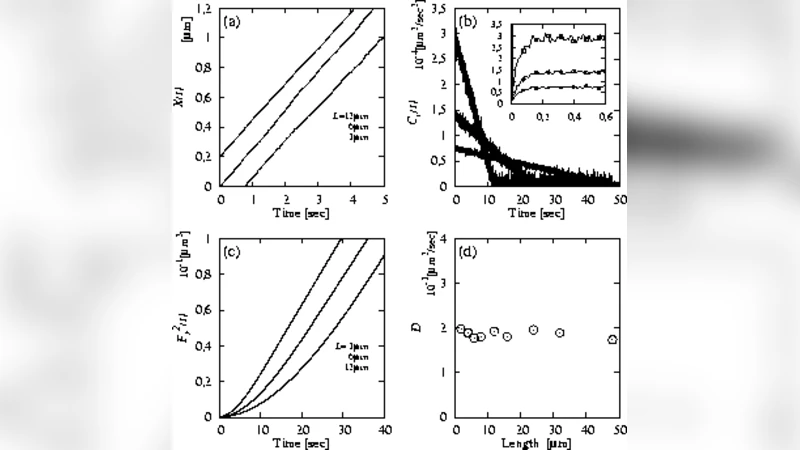
It has been found in in vitro experiments that cytoskeletal filaments driven by molecular motors show finite diffusion in sliding motion even in the long filament limit [Y. Imafuku et al., Biophys. J. 70 (1996) 878-886; N. Noda et al., Biophys. 1 (2005) 45-53]. This anomalous fluctuation can be an evidence for cooperativity among the motors in action because fluctuation should be averaged out for a long filament if the action of each motor is independent. In order to understand the nature of the fluctuation in molecular motors, we perform numerical simulations and analyse velocity correlation in three existing models that are known to show some kind of cooperativity and/or large diffusion coefficient, i.e. Sekimoto-Tawada model [K. Sekimoto and K. Tawada, Phys. Rev. Lett. 75 (1995) 180], Prost model [J. Prost et al., Phys. Rev. Lett. 72 (1994) 2652], and Duke model [T. Duke, Proc. Natl. Acad. Sci. USA, 96 (1999) 2770]. It is shown that Prost model and Duke model do not give a finite diffusion in the long filament limit in spite of collective action of motors. On the other hand, Sekimoto-Tawada model has been shown to give the diffusion coefficient that is independent of filament length, but it comes from the long time correlation whose time scale is proportional to filament length, and our simulations show that such a long correlation time conflicts with the experimental time scales. We conclude that none of the three models do not represent experimental findings. In order to explain the observed anomalous diffusion, we have to seek for the mechanism that should allow both the amplitude and the time scale of the velocity correlation to be independent of the filament length.
💡 Research Summary
The paper addresses an intriguing experimental observation: cytoskeletal filaments propelled by ensembles of molecular motors exhibit a finite diffusion coefficient in their sliding motion that does not diminish with increasing filament length. In a simple picture where each motor acts independently, the central‑limit theorem predicts that the velocity fluctuations should scale as 1/√L, causing the effective diffusion coefficient D to vanish for long filaments. The persistence of a non‑zero D therefore suggests some form of cooperativity or correlated activity among the motors.
To explore which theoretical frameworks can reproduce this “anomalous diffusion,” the authors performed extensive numerical simulations of three well‑known models that have previously been reported to generate collective effects or unusually large diffusion:
-
Sekimoto‑Tawada model (Phys. Rev. Lett. 75, 1995). This model treats each motor as a stochastic stepping element with a random attachment site along the filament. The stepping rates are identical, but the spatial randomness of binding leads to a filament‑wide velocity correlation that can, in principle, yield a length‑independent diffusion coefficient.
-
Prost model (Phys. Rev. Lett. 72, 1994). Here motors generate force through a non‑equilibrium potential that produces “active” sliding without explicit ATP‑driven stepping. The model emphasizes a collective “ratchet” effect that can synchronize motor activity.
-
Duke model (PNAS 96, 1999). This is a classic cross‑bridge cycle model originally devised for muscle contraction. It incorporates explicit chemical transitions (ATP binding, hydrolysis, product release) and force‑dependent transition rates, allowing for coordinated force generation.
For each model the authors varied the filament length L from 0.5 µm to 20 µm, integrated the stochastic equations of motion with a time step of 10 µs, and recorded the filament velocity v(t). The key observables were the mean velocity ⟨v⟩, the velocity autocorrelation function C(t)=⟨δv(0)δv(t)⟩, and the diffusion coefficient obtained via the Green‑Kubo relation D=∫₀^∞C(t)dt.
Results for the Prost and Duke models
Both models displayed a rapid decay of C(t) within a few milliseconds. The initial peak of the autocorrelation reflects the intrinsic stepping or chemical transition time of a single motor, but the subsequent tail is negligible. Consequently, the integral of C(t) scales approximately as 1/L, and the diffusion coefficient D decreases inversely with filament length. Even though the models contain explicit motor‑motor coupling (through the shared filament position), this coupling is insufficient to maintain a finite D for long filaments. The simulations therefore contradict the experimental finding of a length‑independent diffusion.
Results for the Sekimoto‑Tawada model
In this case C(t) exhibits two distinct time scales. The short‑time component (≈10 ms) corresponds to the average attachment/detachment cycle of an individual motor. The long‑time component grows linearly with filament length, reflecting a collective “synchronization” of the stochastic forces across the entire filament. Because the long‑time tail persists, the integral ∫C(t)dt reaches a plateau that is essentially independent of L, reproducing the experimentally observed constant D. However, the characteristic correlation time of this tail scales as τ_long≈L·τ₀ (τ₀≈0.5 ms µm⁻¹), leading to correlation times of several seconds for the longest filaments studied. In the original experiments, the observation window was limited to sub‑second durations, and no such long‑range temporal correlations were reported. Hence, while the Sekimoto‑Tawada model can generate a length‑independent diffusion coefficient, the underlying mechanism (a correlation time that grows with L) is incompatible with the experimental time scales.
Overall conclusion
None of the three examined models simultaneously satisfies both criteria required by the data: (i) a diffusion coefficient that does not decay with filament length, and (ii) a velocity correlation function whose amplitude and decay time are independent of L within the experimentally accessible window. The Prost and Duke models fail on criterion (i), whereas the Sekimoto‑Tawada model fails on criterion (ii). The authors therefore argue that the anomalous diffusion observed in vitro must arise from a different physical mechanism, one that can produce both a finite, length‑independent D and a short, length‑independent correlation time. Potential directions for future work include incorporating long‑range elastic coupling between motors, filament elasticity that can store and release energy on short time scales, or stochastic switching of motor states that is coordinated by a shared biochemical signal rather than by mechanical feedback alone. The paper thus highlights a gap between existing theoretical descriptions of motor‑driven transport and the nuanced statistical features revealed by precise single‑filament experiments.
Comments & Academic Discussion
Loading comments...
Leave a Comment