Steady-State Chemotactic Response in E. coli
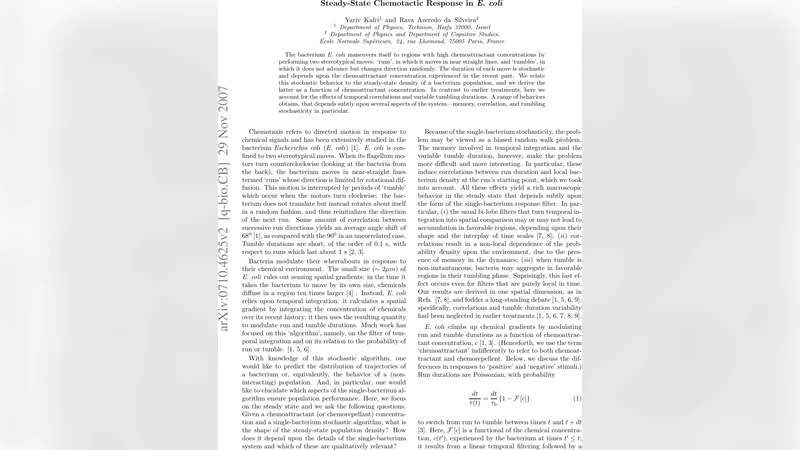
The bacterium E. coli maneuvers itself to regions with high chemoattractant concentrations by performing two stereotypical moves: runs', in which it moves in near straight lines, and tumbles’, in which it does not advance but changes direction randomly. The duration of each move is stochastic and depends upon the chemoattractant concentration experienced in the recent past. We relate this stochastic behavior to the steady-state density of a bacterium population, and we derive the latter as a function of chemoattractant concentration. In contrast to earlier treatments, here we account for the effects of temporal correlations and variable tumbling durations. A range of behaviors obtains, that depends subtly upon several aspects of the system - memory, correlation, and tumbling stochasticity in particular.
💡 Research Summary
This paper presents a comprehensive theoretical framework that links the stochastic run‑tumble dynamics of individual Escherichia coli cells to the steady‑state spatial distribution of a bacterial population in a chemoattractant field. The authors begin by describing the two canonical motile states—runs, during which cells move nearly straight at a constant speed, and tumbles, during which they reorient without net displacement. Unlike earlier models that treat run durations as functions of the instantaneous chemical concentration and assume a fixed average tumble time, this work incorporates three crucial biological features: (1) a memory kernel that integrates the chemoattractant concentration experienced over the recent past, (2) temporal correlations between successive runs and tumbles arising from this memory, and (3) stochastic variability in tumble durations that can itself depend on the sensed concentration.
Mathematically, the sensed concentration (\hat c(t)) is defined as a convolution of the external concentration field (c(x(t))) with a memory kernel (K(s)). The transition rate from run to tumble is modeled as (\lambda(t)=\lambda_0
Comments & Academic Discussion
Loading comments...
Leave a Comment