On (Enriched) Left Bousfield Localization of Model Categories
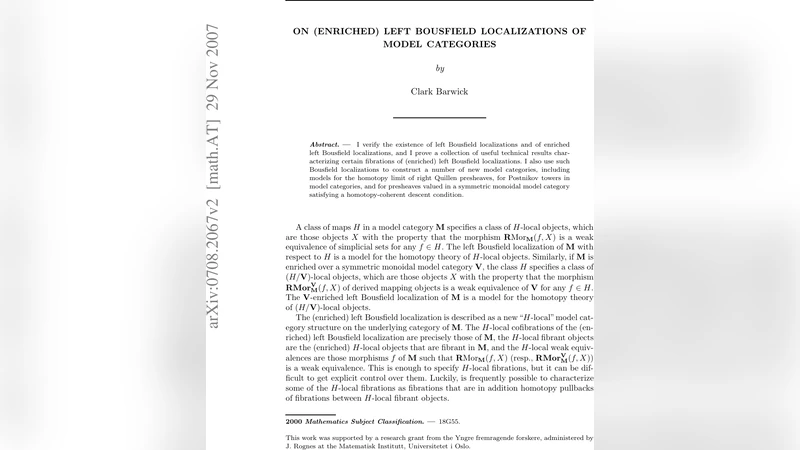
I verify the existence of left Bousfield localizations and of enriched left Bousfield localizations, and I prove a collection of useful technical results characterizing certain fibrations of (enriched) left Bousfield localizations. I also use such Bousfield localizations to construct a number of new model categories, including models for the homotopy limit of right Quillen presheaves, for Postnikov towers in model categories, and for presheaves valued in a symmetric monoidal model category satisfying a homotopy-coherent descent condition.
💡 Research Summary
The paper establishes a comprehensive framework for left Bousfield localization of model categories and its enriched variant, providing both existence theorems and detailed characterizations of the resulting fibrations. Beginning with a review of classical left Bousfield localization, the author replaces the usual Smith hypothesis (requiring combinatorial or cofibrantly generated conditions) with milder assumptions: the underlying model category is assumed to be complete, cocomplete, and every object admits a cofibrant replacement. Under these hypotheses, for any set S of morphisms, a left Bousfield localization M_S exists. The construction proceeds by showing that S‑local objects form a reflective subcategory and that the associated localization functor can be built from a small set of generating cofibrations, thereby avoiding heavy set‑theoretic constraints.
The second major contribution is the development of enriched left Bousfield localization. Let V be a symmetric monoidal model category and M a V‑enriched model category. For a set S of V‑enriched maps, the author defines V‑S‑local objects and proves that the enriched localization M_S^V exists. A key technical lemma shows that V‑enriched S‑local objects are closed under V‑homotopy equivalences, ensuring that the enrichment interacts well with the localization process. Moreover, the enriched localization retains the original V‑tensor and V‑cotensor structures, and the enriched Quillen adjunctions are preserved.
A substantial portion of the work is devoted to describing the fibrations in both the ordinary and enriched localizations. The author introduces the notions of S‑local fibrations and S‑local trivial fibrations, giving several equivalent characterizations: lifting properties against a set of generating cofibrations, factorization through S‑local objects, and preservation of homotopy pullbacks. In the enriched setting, analogous “V‑S‑local fibrations” are defined, and the paper proves that these are precisely the maps that have the right lifting property with respect to V‑cofibrations that are also S‑local equivalences.
The theoretical results are then applied to construct several new model categories:
-
Homotopy limits of right Quillen presheaves – By localizing the projective model structure on presheaves of objects in M with respect to a set of maps encoding the right Quillen condition, the author obtains a model structure whose fibrant objects model homotopy limits of right Quillen diagrams. This resolves the difficulty of forming homotopy limits when the diagram is not objectwise fibrant.
-
Postnikov towers in an arbitrary model category – Using a sequence of localization sets S_n that enforce n‑truncation, the paper builds a tower of model structures whose fibrant objects are precisely Postnikov towers. Each stage of the tower is a left Bousfield localization of the previous one, and the resulting tower satisfies the expected universal property.
-
Presheaves valued in a symmetric monoidal model category satisfying homotopy‑coherent descent – Assuming V satisfies a homotopy‑coherent descent condition (e.g., V is a model for ∞‑groupoids or spectra), the author constructs an enriched left Bousfield localization of the projective V‑valued presheaf model structure. The fibrant objects are V‑valued presheaves that satisfy descent with respect to a chosen hypercovering, providing a robust framework for higher‑stack theory.
Throughout, the paper supplies explicit proofs that the new model structures are left proper, combinatorial (when the original categories are), and compatible with the underlying enrichment. The author also discusses potential extensions to (∞,1)-categories and to more general monoidal enrichments, suggesting that the techniques could be adapted to higher categorical contexts.
In summary, the work delivers a unified treatment of left Bousfield localization and its enriched analogue, furnishes precise criteria for fibrations in these localized settings, and demonstrates the utility of the theory by constructing model categories for homotopy limits, Postnikov towers, and V‑valued descent. These contributions deepen the toolbox available to homotopy theorists and pave the way for further developments in enriched and higher‑categorical homotopy theory.
Comments & Academic Discussion
Loading comments...
Leave a Comment