Flow-correlated dilution of a regular network leads to a percolating network during tumor induced angiogenesis
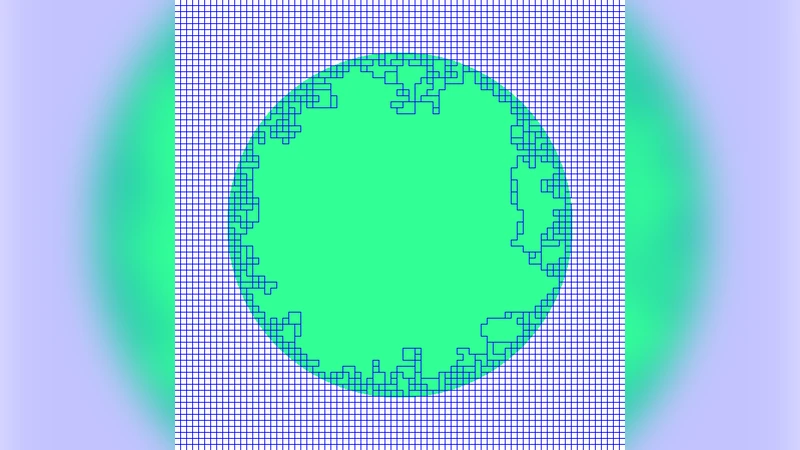
We study a simplified stochastic model for the vascularization of a growing tumor, incorporating the formation of new blood vessels at the tumor periphery as well as their regression in the tumor center. The resulting morphology of the tumor vasculature differs drastically from the original one. We demonstrate that the probabilistic vessel collapse has to be correlated with the blood shear force in order to yield percolating network structures. The resulting tumor vasculature displays fractal properties. Fractal dimension, microvascular density (MVD), blood flow and shear force has been computed for a wide range of parameters.
💡 Research Summary
The paper presents a minimalist stochastic framework to capture the essential dynamics of tumor‑induced angiogenesis, focusing on the simultaneous processes of peripheral vessel sprouting and central vessel regression. Starting from a regular lattice‑based vascular network, the model implements two competing rules: (i) new vessels are added at the tumor periphery with a fixed probability p_new, representing angiogenic sprouting; (ii) existing vessels may collapse in the tumor core, but the collapse probability is not random—it is explicitly linked to the local shear stress τ generated by blood flow. Shear stress is estimated from laminar Poiseuille flow assumptions, τ = 4 η Q / π r³, where η is blood viscosity, Q the volumetric flow through an edge, and r a constant vessel radius. The collapse probability follows an exponential law P_collapse(τ) = 1 − exp(−α τ), so that high‑shear vessels are protected while low‑shear vessels are preferentially removed.
Numerical simulations explore a broad parameter space (varying p_new and the coupling constant α). When vessel collapse is purely random, the network fragments quickly, losing global percolation and dramatically reducing total flow. In contrast, the shear‑dependent collapse yields a self‑organized network that remains percolating at the macroscopic scale while developing intricate, highly branched micro‑structures. The resulting morphology exhibits fractal characteristics; box‑counting analysis gives a fractal dimension D_f ranging from 1.6 to 1.9, consistent with experimental observations of tumor vasculature. Microvascular density (MVD) shows a characteristic “core‑rim” pattern: low density in the tumor interior where vessels are pruned, and high density at the periphery where sprouting dominates. Total flow Q_total stays relatively constant in the shear‑coupled regime, whereas it collapses in the random‑collapse case.
The authors also compute spatial distributions of shear stress and flow, demonstrating that regions with sustained high shear correspond to surviving vessels, providing a mechanistic explanation for the maintenance of perfusion despite extensive remodeling. Sensitivity analysis indicates that stronger coupling (larger α) enhances network robustness but reduces overall branching, while higher sprouting probability p_new increases vessel density but can lead to excessive congestion if not balanced by adequate shear‑dependent pruning.
Limitations are acknowledged: the model is two‑dimensional, assumes uniform vessel radii, and neglects non‑Newtonian blood rheology, endothelial signaling (e.g., VEGF gradients), and mechanical interactions with the extracellular matrix. Nevertheless, the core insight—that linking vessel regression to hemodynamic shear stress is sufficient to generate a percolating, fractal tumor vasculature—offers a parsimonious explanation for many experimentally observed features of tumor blood vessels.
In conclusion, the study provides a clear theoretical demonstration that flow‑correlated vessel dilution can reconcile the paradox of extensive vascular remodeling with the preservation of a functional perfusion network in tumors. This insight has practical implications for anti‑angiogenic therapy design, drug delivery optimization, and the interpretation of imaging biomarkers such as MVD and perfusion heterogeneity in oncology.
Comments & Academic Discussion
Loading comments...
Leave a Comment