A Game-Theoretic Analysis of Updating Sets of Probabilities
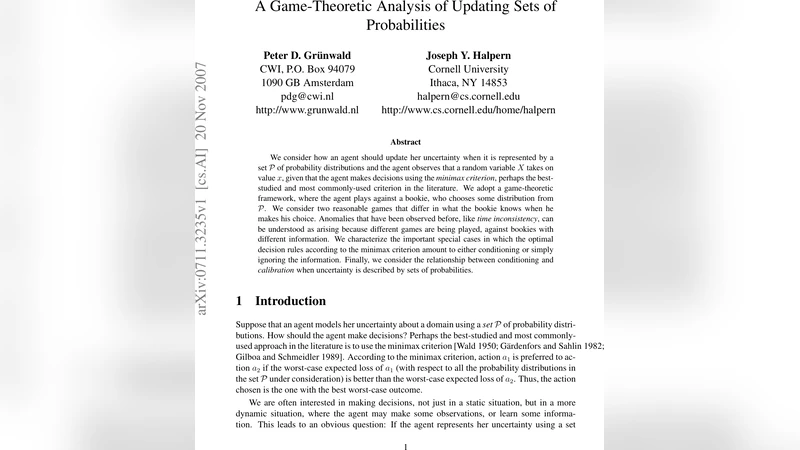
We consider how an agent should update her uncertainty when it is represented by a set $\P$ of probability distributions and the agent observes that a random variable $X$ takes on value $x$, given that the agent makes decisions using the minimax criterion, perhaps the best-studied and most commonly-used criterion in the literature. We adopt a game-theoretic framework, where the agent plays against a bookie, who chooses some distribution from $\P$. We consider two reasonable games that differ in what the bookie knows when he makes his choice. Anomalies that have been observed before, like time inconsistency, can be understood as arising important because different games are being played, against bookies with different information. We characterize the important special cases in which the optimal decision rules according to the minimax criterion amount to either conditioning or simply ignoring the information. Finally, we consider the relationship between conditioning and calibration when uncertainty is described by sets of probabilities.
💡 Research Summary
The paper investigates how an agent should revise a belief that is represented not by a single probability distribution but by a set 𝒫 of distributions when the agent observes that a random variable X takes a particular value x. The analysis is carried out within a game‑theoretic framework in which the agent plays a minimax decision problem against a “bookie” who selects a distribution from 𝒫. Two natural games are defined, differing only in the information available to the bookie at the moment of his choice. In the first game (the “ignorant bookie” game) the bookie commits to a distribution before the agent observes x; in the second game (the “informed bookie” game) the bookie observes x and then picks a distribution conditional on that observation.
The authors show that many of the paradoxes reported in the literature—most prominently time‑inconsistency, where a plan that is optimal before observation ceases to be optimal after observation—can be understood as artifacts of mixing these two games. When the bookie’s information set changes, the minimax optimal strategy for the agent can change dramatically, even though the underlying set 𝒫 remains the same.
A central contribution of the paper is a precise characterization of when the minimax optimal decision rule coincides with ordinary Bayesian conditioning on x, and when it collapses to ignoring the observation altogether. The first situation occurs when 𝒫 satisfies a “conditional consistency” property: every distribution in 𝒫 assigns positive probability to x, and the conditional set 𝒫ₓ = {p(·|X = x) : p ∈ 𝒫} has the same structure as 𝒫 with respect to the minimax criterion. Under this condition, both games lead to the same optimal action, which is the minimax‑optimal action for the conditional set 𝒫ₓ. The second situation arises when X is statistically irrelevant for the loss function (the “complete irrelevance” case). In that case the observation provides no useful information for the decision problem, and the minimax optimal rule is to act exactly as if no observation had been made.
For generic sets 𝒫 that do not satisfy either of these special properties, the paper demonstrates that conditioning can be detrimental under the minimax criterion. Because the bookie in the informed game can select an “extremal” distribution that exploits the agent’s conditioning, the worst‑case expected loss after conditioning can be larger than the worst‑case loss before conditioning. This phenomenon explains why minimax decision makers sometimes prefer to ignore new data—a behavior that would be irrational under a single‑distribution Bayesian framework but is rational under a set‑valued uncertainty model.
The final part of the paper examines the relationship between conditioning and calibration. Calibration requires that, in the long run, the frequencies of observed outcomes match the announced probabilities. When beliefs are represented by a set 𝒫, achieving calibration under the minimax rule imposes an additional structural requirement: the conditional set 𝒫ₓ must be “normalized,” i.e., it must retain the same geometric relationship to 𝒫 as before conditioning. The authors prove that only under this normalization does the minimax rule guarantee calibration; otherwise, the rule can produce systematically biased predictions.
Overall, the paper provides a unified game‑theoretic account of updating imprecise probabilities under minimax decision making. It clarifies when standard Bayesian conditioning is justified, when it should be abandoned, and how the choice of information structure (which game is being played) fundamentally shapes the optimal strategy. The results have practical implications for robust machine‑learning, risk management, and any domain where decision makers deliberately model uncertainty with sets of probabilities rather than a single prior.
Comments & Academic Discussion
Loading comments...
Leave a Comment