The Hunting of the Hopf Ring
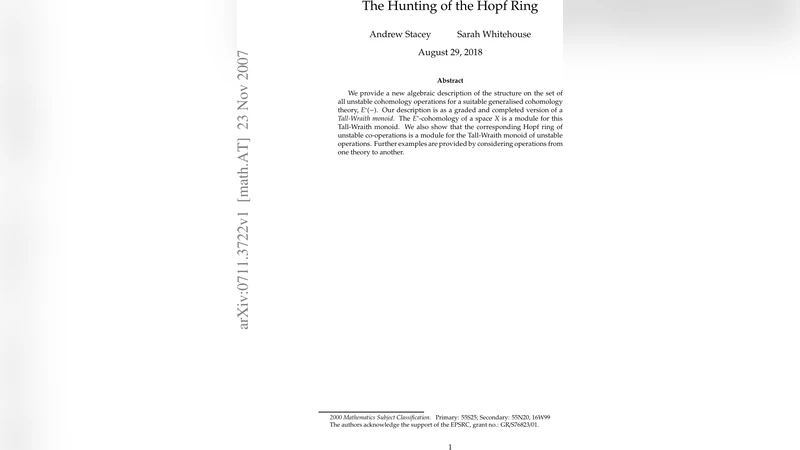
We provide a new algebraic description of the structure on the set of all unstable cohomology operations for a suitable generalised cohomology theory, E^. Our description is as a graded and completed version of a Tall-Wraith monoid. The E^-cohomology of a space X is a module for this Tall-Wraith monoid. We also show that the corresponding Hopf ring of unstable co-operations is a module for the Tall-Wraith monoid of unstable operations. Further examples are provided by considering operations from one theory to another.
💡 Research Summary
The paper introduces a new algebraic framework for describing the full collection of unstable cohomology operations associated with a suitable generalized cohomology theory E⁎. Classical treatments of unstable operations (Steenrod, Adams, etc.) are fragmented and rely on intricate composition rules. The authors propose to view these operations as elements of a graded, completed Tall‑Wraith monoid—a structure equipped with two compatible binary operations: composition (∘) and a tensor‑product‑like operation (⊗). The grading records the cohomological degree, while completion allows infinite sums, making the monoid capable of handling arbitrarily high‑order operations in a unified way.
The first major theorem shows that for any space X, the E‑cohomology E⁎(X) becomes a left module over this Tall‑Wraith monoid. Explicitly, each operation θ acts on a cohomology class x to produce θ·x, satisfying the usual module axioms (linearity in x and compatibility with monoid composition). This recasts the traditional unstable operation algebra as a simple module action, dramatically simplifying many of the familiar Adem‑type relations.
The second central result concerns the Hopf ring of unstable co‑operations. The set of unstable co‑operations carries both a product and a coproduct, forming a Hopf ring. The authors prove that this Hopf ring is naturally a right module over the same Tall‑Wraith monoid. In concrete terms, the Hopf ring multiplication μ and coproduct Δ correspond precisely to the monoid’s composition and tensor product, respectively. Consequently, the often‑cumbersome interaction between product and coproduct in the Hopf ring can be understood through the more transparent monoid‑module formalism.
A further contribution is the treatment of operations between different cohomology theories. Given a natural transformation φ : E → F, the Tall‑Wraith monoid for E can be pushed forward along φ to produce a monoid acting on F‑cohomology. The induced module structure on F‑cohomology respects the original monoid relations, and the associated Hopf ring of E‑to‑F co‑operations becomes a module over the pushed‑forward monoid. The paper supplies explicit calculations for several important cases: complex K‑theory to modular forms, MU to BP, and various Landweber‑exact theories. These examples demonstrate that the framework is not merely abstract but can be employed in concrete computational contexts.
In the discussion, the authors outline several promising applications. In spectral sequence calculations such as the Adams–Novikov spectral sequence, the graded‑completed monoid provides a clean bookkeeping device for higher‑order differentials and hidden extensions. The module viewpoint also suggests new algebraic invariants derived from the interaction of the Tall‑Wraith monoid with existing Hopf rings. Moreover, the theory of inter‑theory operations offers a systematic method for comparing different generalized cohomology theories, potentially leading to new comparison theorems and transfer formulas.
Overall, the paper unifies the algebraic structures governing unstable operations and Hopf rings under a single Tall‑Wraith monoid framework. By doing so it resolves longstanding technical complications, provides a versatile computational tool, and opens avenues for further research in stable and unstable homotopy theory, algebraic topology, and related fields.
Comments & Academic Discussion
Loading comments...
Leave a Comment