Galois theory in bicategories
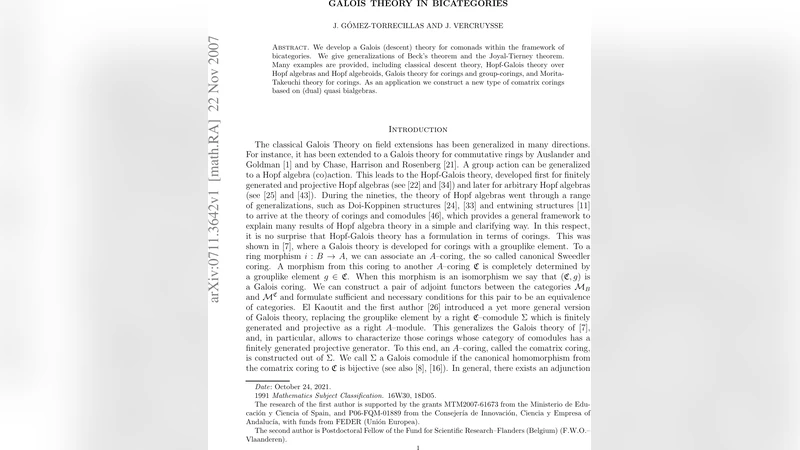
We develop a Galois (descent) theory for comonads within the framework of bicategories. We give generalizations of Beck’s theorem and the Joyal-Tierney theorem. Many examples are provided, including classical descent theory, Hopf-Galois theory over Hopf algebras and Hopf algebroids, Galois theory for corings and group-corings, and Morita-Takeuchi theory for corings. As an application we construct a new type of comatrix corings based on (dual) quasi bialgebras.
💡 Research Summary
The paper develops a comprehensive Galois (descent) theory for comonads situated inside the framework of bicategories, thereby extending classical descent theory beyond the ordinary 1‑categorical setting. The authors begin by recalling the standard notions of comonads, Eilenberg‑Moore categories, and the classical Beck and Joyal‑Tierney theorems, which describe when a functor reflects and creates certain limits and when a morphism yields effective descent. They then observe that these results are insufficient when one works with bicategories, where 1‑cells (objects) and 2‑cells (morphisms between 1‑cells) interact in a richer way.
In Section 1 the authors fix notation for bicategories (\mathcal{B}) and define a comonad ((C,\delta,\varepsilon)) as a 1‑cell (C) equipped with 2‑cell comultiplication (\delta:C\to C\circ C) and counit (\varepsilon:C\to \mathrm{id}) satisfying the usual coassociativity and counit equations expressed via pasting diagrams. They construct the Eilenberg‑Moore bicategory (\mathcal{B}^C) whose objects are (C)-comodules (1‑cells equipped with a coaction 2‑cell) and whose 2‑cells are comodule morphisms. This bicategory comes equipped with a forgetful pseudofunctor (U:\mathcal{B}^C\to\mathcal{B}) that has a right adjoint (F) when certain coequalizers exist.
Section 2 presents a bicategorical version of Beck’s theorem. The main statement (Theorem 2.4) asserts that if the underlying bicategory (\mathcal{B}) admits and the forgetful pseudofunctor (U) preserves all relevant coequalizers, then (U) creates the category of descent data for any pseudofunctor (K:\mathcal{A}\to\mathcal{B}). In other words, a pseudofunctor (K) satisfies effective descent precisely when the induced comparison pseudofunctor (\mathcal{A}\to\mathcal{B}^C) is an equivalence. The proof follows the classical argument but requires careful handling of 2‑cells: one must show that the comparison pseudonatural transformation is fully faithful on 2‑cells and essentially surjective on objects up to equivalence. The authors introduce the notions of preservation and reflection of 2‑cell equalizers to formulate the necessary hypotheses.
Section 3 generalizes the Joyal‑Tierney theorem. Here a 1‑cell (f:A\to B) in a bicategory is called effective descent if the induced pseudofunctor (\mathcal{B}(B,-)) creates descent data. The authors prove that, under the same coequalizer conditions as before, (f) is effective descent if and only if it is both faithful (the induced functor on hom‑categories is faithful) and flat (it preserves certain weighted limits). Moreover, when (f) satisfies these conditions, the associated comonad (C_f = f\circ f^) (where (f^) is a right adjoint of (f) when it exists) becomes a Galois comonad: the canonical comparison (\mathcal{B}^ {C_f}\to \mathcal{B}/B) is an equivalence of bicategories.
Section 4 is devoted to a wide range of examples that illustrate the power of the bicategorical framework.
-
Classical descent for schemes and stacks: By viewing the 2‑category of algebraic stacks as a bicategory, the authors recover Grothendieck’s descent theorem as a special case of their bicategorical Beck theorem.
-
Hopf‑Galois theory: For a Hopf algebra (H) (or a Hopf algebroid) acting on an algebra (A), the associated comonad (C = A\otimes H) lives naturally in the bicategory of bimodules. The authors show that the usual Hopf‑Galois condition (bijectivity of the canonical map) is precisely the Galois condition for the comonad in the bicategorical sense. They also treat quasi‑Hopf algebras, where associativity holds only up to a coherent 3‑cell, and demonstrate that the bicategorical theory still applies after incorporating the associator into the comonad axioms.
-
Corings and group‑corings: A coring (\mathcal{C}) over a ring (R) gives a comonad on the bicategory of (R)-bimodules. The authors prove a Beck‑type theorem for corings, showing that a coring is Galois precisely when the forgetful functor from (\mathcal{C})-comodules creates coequalizers. For group‑corings, the extra group action is encoded as a 2‑cell, and the descent condition translates into a compatibility between the group action and the coring coaction.
-
Morita‑Takeuchi theory: By considering two corings (\mathcal{C}) and (\mathcal{D}) together with a bicategorical bimodule that implements a Morita context, the authors recover the classical Takeuchi equivalence as an equivalence of the corresponding Eilenberg‑Moore bicategories. The Galois condition on the bimodule ensures that the induced comonads are bi‑Galois, leading to a 2‑categorical Morita equivalence.
Section 5 introduces a novel construction: quasi‑comatrix corings built from (dual) quasi‑bialgebras. In the ordinary setting, a comatrix coring is formed from a finite projective bimodule (M) as (M\otimes_R M^*). When the underlying bialgebra is only quasi‑associative, the usual tensor product fails to be strictly associative. The authors resolve this by working inside the bicategory of bimodules equipped with an associator 3‑cell (\alpha). They define a comonad whose comultiplication uses (\alpha) to re‑associate the triple tensor product, and they verify the coassociativity and counit axioms up to coherent 3‑cells. The resulting coring generalizes the classical comatrix coring and provides a natural source of examples in the theory of Drinfeld’s quasi‑Hopf algebras and related quantum groups.
The paper concludes with a discussion of future directions. The authors suggest extending the theory to tricategories and (\infty)-bicategories, where higher coherence data would allow descent for homotopical and derived contexts. They also propose investigating connections with non‑commutative geometry, where Hopf‑Galois extensions over quasi‑bialgebras appear naturally, and with categorical quantum field theory, where bicategorical descent could model gluing of local field data.
In summary, the work achieves three major contributions: (1) a bicategorical generalization of Beck’s and Joyal‑Tierney’s descent theorems; (2) a unifying framework that simultaneously encompasses classical descent, Hopf‑Galois theory, coring theory, and Morita‑Takeuchi equivalences; and (3) the construction of new quasi‑comatrix corings that broaden the landscape of Galois‑type objects in non‑commutative algebra. The results open the door to systematic applications of descent in higher‑categorical algebra and quantum algebra.