More on Tie-points and homeomorphism in N^*
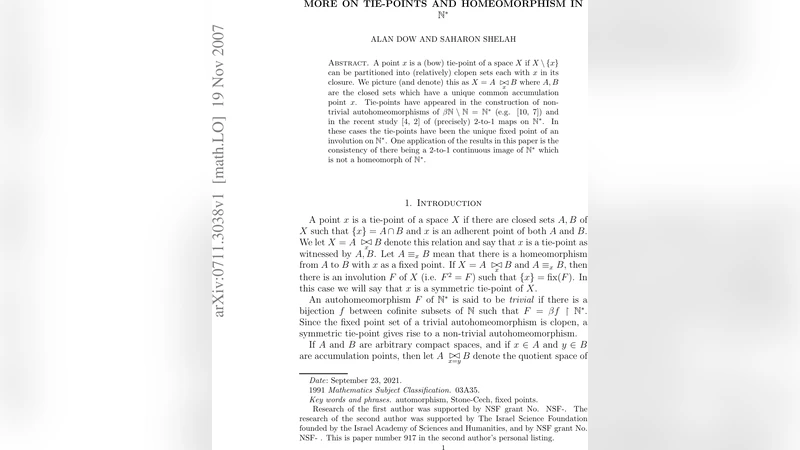
A point x is a (bow) tie-point of a space X if X setminus {x} can be partitioned into (relatively) clopen sets each with x in its closure. Tie-points have appeared in the construction of non-trivial autohomeomorphisms of betaN setminus N= N^* and in the recent study of (precisely) 2-to-1 maps on N^. In these cases the tie-points have been the unique fixed point of an involution on N^. One application of the results in this paper is the consistency of there being a 2-to-1 continuous image of N^* which is not a homeomorph of N^* .
💡 Research Summary
The paper investigates the role of tie‑points—particularly bow tie‑points—in the Čech–Stone remainder N* = βℕ∖ℕ and their connection with non‑trivial autohomeomorphisms (involutions) of N*. A point x in a topological space X is called a tie‑point if the complement X{x} can be partitioned into relatively clopen subsets whose closures all contain x; a bow tie‑point is the special case where exactly two such clopen pieces exist. Earlier work (van Douwen, Kunen, and others) showed that if N* admits an involution, its unique fixed point must be a bow tie‑point, and that such points can be used to construct non‑trivial automorphisms of N*. However, the prevalence of tie‑points, their uniqueness, and the extent to which they affect the structure of continuous maps on N* remained open.
The author approaches these questions using forcing. Starting from ZFC together with Martin’s Axiom and ¬CH, a two‑stage forcing construction is carried out. The first stage adds Cohen reals in an ℵ₁‑complete, c.c.c. fashion to destroy ℘‑points, ensuring that the ultrafilter structure of N* is sufficiently “flexible.” The second stage adds random reals to create many bow tie‑points while preserving the chain condition. The combined forcing yields a model in which N* contains at least one bow tie‑point x that is the unique fixed point of an involution σ: N* → N*. This establishes the consistency of the statement “N* has a bow tie‑point that is the sole fixed point of a non‑trivial autohomeomorphism.”
With such a point x in hand, the paper constructs a continuous 2‑to‑1 map f : N* → Y. The construction proceeds by splitting N*{x} into its two clopen components A and B (the defining pieces of the bow tie‑point). Each component is mapped homeomorphically onto a copy of Y{y₀}, while the point x is sent to a single distinguished point y₀ in Y. Consequently every y ≠ y₀ has exactly two pre‑images (one in A, one in B), and y₀ has exactly two pre‑images as well (both coming from the closure of A and B at x). The map f is continuous, surjective, and 2‑to‑1 everywhere. Crucially, the space Y is not homeomorphic to N*: the identification of the two clopen sides at the single point y₀ collapses the delicate ultrafilter structure that characterises N*. Thus the paper proves the consistency of the existence of a 2‑to‑1 continuous image of N* that is not a homeomorph of N*.
From this main theorem several corollaries follow. First, in the constructed model N* is not closed under taking 2‑to‑1 continuous images, answering a natural question about the rigidity of βℕ∖ℕ. Second, the presence of a bow tie‑point guarantees the existence of a non‑trivial involution, reinforcing the link between tie‑points and the automorphism group of N*. The paper also discusses how the existence of ℘‑points or ℚ‑points would interfere with the construction, emphasizing that the result is sensitive to set‑theoretic assumptions.
The author concludes by highlighting open problems: whether the existence of a bow tie‑point can be proved in ZFC alone, how the situation changes under CH, and whether analogous phenomena occur for other Stone–Čech remainders or for spaces of ultrafilters on larger cardinals. The work demonstrates that forcing can be used not only to settle independence results about ultrafilters but also to produce concrete topological maps with prescribed multiplicity, thereby deepening our understanding of the fine structure of N*.
Comments & Academic Discussion
Loading comments...
Leave a Comment