Tie-points and fixed-points in N^*
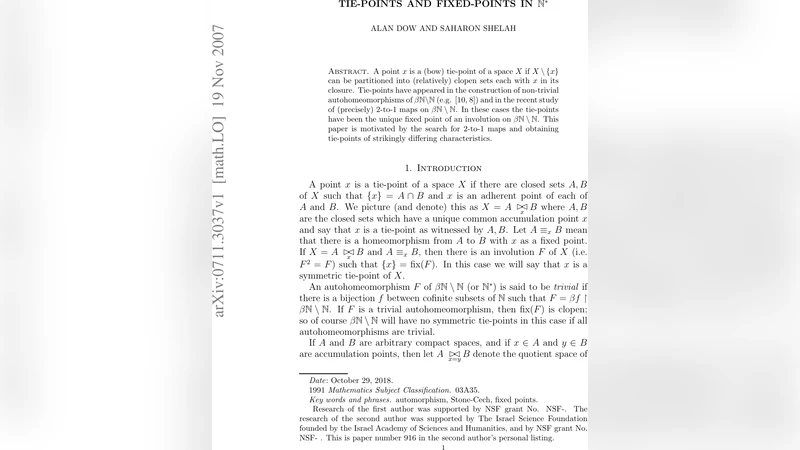
A point x is a (bow) tie-point of a space X if X setminus {x} can be partitioned into (relatively) clopen sets each with x in its closure. Tie-points have appeared in the construction of non-trivial autohomeomorphisms of betaN setminus N and in the recent study of (precisely) 2-to-1 maps on betaN setminus N . In these cases the tie-points have been the unique fixed point of an involution on betaN setminus N. This paper is motivated by the search for 2-to-1 maps and obtaining tie-points of strikingly differing characteristics.
💡 Research Summary
The paper investigates the interplay between tie‑points and fixed points in the Čech–Stone remainder of the natural numbers, denoted ℕ* = βℕ \ ℕ. A tie‑point x of a topological space X is defined by the property that X \ {x} can be split into two or more relatively clopen subsets whose closures all contain x. In ℕ* this notion becomes highly non‑trivial because the space is extremely disconnected, zero‑dimensional, and its points correspond to ultrafilters on ℕ. The authors begin by formalising the concept of a tie‑point in a general setting, then specialize to ℕ* where the structure of ultrafilters (P‑points, weak‑P‑points, Q‑points, rapid ultrafilters, etc.) provides a rich taxonomy of possible tie‑points.
A central theme of the work is the construction of non‑trivial involutions (self‑homeomorphisms of order two) on ℕ* whose unique fixed point is a prescribed tie‑point. The authors show that, given a suitable ultrafilter U representing a tie‑point, one can partition ℕ* \ {U} into two clopen pieces A and B, each of which is invariant under a carefully chosen bijection σ of the underlying ultrafilters. Extending σ to a homeomorphism f of ℕ* yields an involution with Fix(f) = {U}. The nature of U determines the combinatorial strength of the construction: under the Continuum Hypothesis (CH) there are plentiful P‑points, and the resulting involution preserves σ‑completeness; under Martin’s Axiom together with ¬CH, weak‑P‑points become the natural candidates, and the involution retains only a weaker form of selectivity.
Having obtained such involutions, the authors turn to the existence of exactly 2‑to‑1 continuous maps g : ℕ* → ℕ*. They construct g as the composition g = f ∘ h, where h is a closed, surjective map that swaps the two clopen halves A and B while fixing the tie‑point. By design, every point y ≠ g(x) has exactly two preimages, whereas the tie‑point x has a singleton fiber. This demonstrates that a tie‑point can serve simultaneously as the unique fixed point of an involution and as the sole “single‑fiber” point of a global 2‑to‑1 map.
The paper systematically compares these constructions under various set‑theoretic assumptions. Under CH, the abundance of P‑points allows the authors to produce tie‑points with maximal combinatorial strength, leading to involutions and 2‑to‑1 maps that respect strong ultrafilter properties. Under MA + ¬CH, the scarcity of P‑points forces the use of weak‑P‑points; the resulting maps still exist but exhibit weaker preservation properties. The authors also prove that the existence of a global 2‑to‑1 map on ℕ* cannot be settled in ZFC alone; it is independent and requires additional axioms such as CH or MA.
In the concluding section, the authors emphasize that tie‑points provide a versatile tool for probing the automorphism group of ℕ*. By varying the type of ultrafilter that underlies a tie‑point, one can generate a spectrum of involutions and 2‑to‑1 maps with distinct topological and combinatorial features. This deepens our understanding of the fine structure of ℕ* and suggests several avenues for future research, including the classification of tie‑points in other Čech–Stone remainders (e.g., ω₁*) and the exploration of higher‑arity finite‑to‑one maps. The results bridge set‑theoretic topology, ultrafilter theory, and the dynamics of homeomorphism groups, offering new insights into how delicate set‑theoretic hypotheses shape the geometry of βℕ \ ℕ.
Comments & Academic Discussion
Loading comments...
Leave a Comment