On the universal weight function for the quantum affine algebra U_q(hat{mathfrak{gl}}_N)
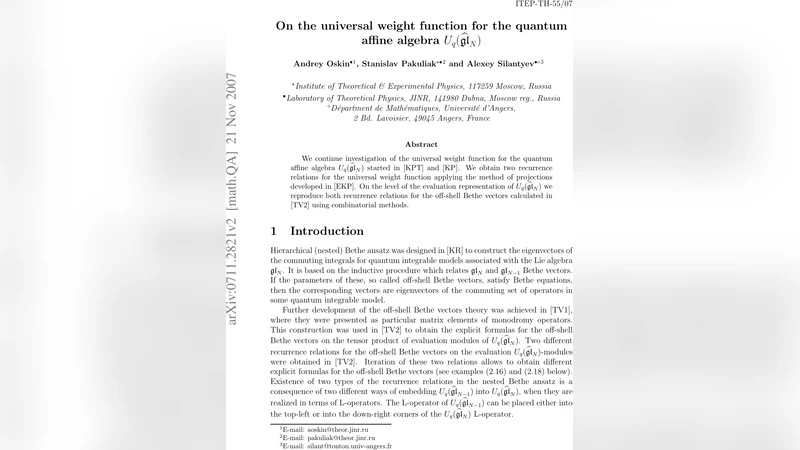
We continue investigation of the universal weight function for the quantum affine algebra $U_q(\hat{\mathfrak{gl}}_N)$ started in arXiv:math/0610517 and arXiv:0711.2819. We obtain two recurrence relations for the universal weight function applying the method of projections developed in arXiv:math/0610398. On the level of the evaluation representation of $U_q(\hat{\mathfrak{gl}}_N)$ we reproduce both recurrence relations for the off-shell Bethe vectors calculated in arXiv:math/0702277 using combinatorial methods.
💡 Research Summary
The paper investigates the universal weight function associated with the quantum affine algebra U₍q₎(Ĝ𝔩_N), extending the authors’ earlier work (arXiv:math/0610517 and arXiv:0711.2819). The universal weight function is a central object in the representation theory of quantum affine algebras and plays a pivotal role in the construction of off‑shell Bethe vectors for integrable models. The authors apply the projection method, originally developed in arXiv:math/0610398, to derive two distinct recurrence relations for this weight function.
The first recurrence relation, often referred to as the “degree‑lowering” recursion, expresses the weight function for the N‑dimensional algebra in terms of the weight function for the (N‑1)‑dimensional sub‑algebra. This is achieved by fixing one of the spectral parameters and projecting the remaining part of the function onto the Borel subalgebra. The recursion reflects the underlying Drinfeld current realization and shows how the hierarchical structure of the quantum affine algebra can be exploited to reduce the complexity of the weight function.
The second recurrence relation deals with permutations of the spectral parameters. It captures the symmetry of the universal weight function under reordering of its arguments and provides an explicit transformation rule that relates weight functions with different parameter orderings. This permutation‑type recursion is essential for handling the combinatorial intricacies that arise in the construction of multi‑parameter Bethe vectors.
To validate these algebraic results, the authors specialize to the evaluation representation of U₍q₎(Ĝ𝔩_N). In this representation the universal weight function becomes a concrete matrix‑valued object, allowing a direct comparison with the off‑shell Bethe vectors previously obtained by combinatorial means in arXiv:math/0702277. The paper demonstrates that the two recurrence relations derived via the projection method exactly reproduce the recurrence formulas found for the off‑shell Bethe vectors, thereby confirming the consistency of the algebraic and combinatorial approaches.
The work also clarifies the relationship between the Drinfeld current realization and the RTT realization of the quantum affine algebra, showing how the projection method bridges these two frameworks. By establishing explicit recurrence relations, the authors provide a powerful tool for constructing higher‑rank Bethe vectors without resorting to cumbersome combinatorial calculations. This has significant implications for the study of integrable models, as it facilitates the systematic generation of eigenvectors for quantum spin chains and related systems.
In the concluding section, the authors discuss potential extensions of their methodology. They suggest that the projection technique and the derived recursions could be adapted to other quantum affine algebras, such as U₍q₎(Ĝ𝔰𝔭_{2n}), and to models with multiple deformation parameters. Moreover, they hint at possible applications to the study of correlation functions and form factors, where the universal weight function serves as a building block. Overall, the paper provides a rigorous algebraic foundation for the universal weight function, enriches the toolbox for quantum integrable systems, and opens avenues for future research in quantum algebra and mathematical physics.
Comments & Academic Discussion
Loading comments...
Leave a Comment