A computation of an universal weight function for the quantum affine algebra U_q(hat{mathfrak{gl}}_N)
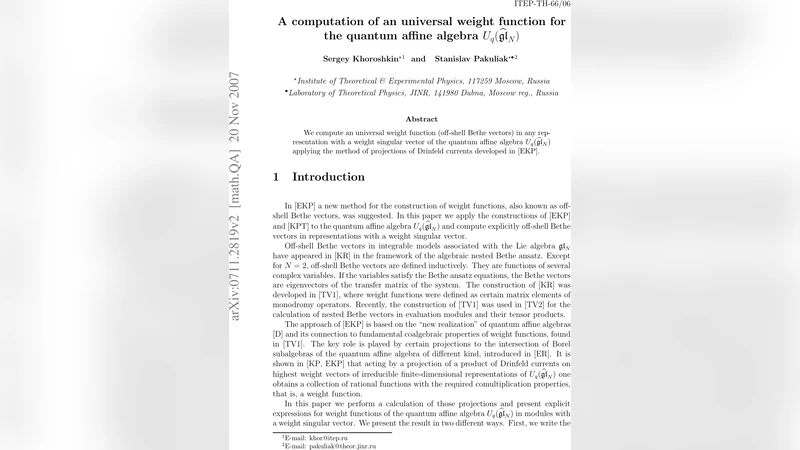
We compute an universal weight function (off-shell Bethe vectors) in any representation with a weight singular vector of the quantum affine algebra $U_q(\hat{\mathfrak{gl}}_N)$ applying the method of projections of Drinfeld currents developed in arXiv:math/0610398.
💡 Research Summary
The paper presents a systematic construction of the universal weight function (also known as off‑shell Bethe vectors) for the quantum affine algebra (U_q(\widehat{\mathfrak{gl}}_N)). The authors build on the Drinfeld current realization of the algebra, where the generators are encoded in generating series (E_i(z)), (F_i(z)) and (K_i^{\pm}(z)). These currents satisfy a set of q‑deformed commutation relations that encode the full Hopf algebra structure.
A central technical tool is the projection method introduced in the earlier work arXiv:math/0610398. Two projection operators, (P^+) and (P^-), are defined to extract respectively the positive and negative Borel subalgebras from arbitrary ordered products of currents. By applying (P^+) to a product of negative currents (F_{i_1}(z_1)\cdots F_{i_m}(z_m)) the authors obtain a normally ordered expression that involves only the Cartan currents and a specific ordering of the (F)-currents. The projection process generates rational functions of the spectral parameters (z_k) together with q‑dependent structure constants. To handle the non‑trivial ordering, a systematic “q‑ordering” algorithm is developed, which recursively resolves the commutation of currents and keeps track of all resulting coefficients.
The construction is performed on a highest‑weight (weight‑singular) vector (|\Lambda\rangle) that is annihilated by all positive currents (E_i(z)). Acting with the projected product of negative currents on (|\Lambda\rangle) yields a vector that depends on a set of auxiliary parameters ({t^{(a)}_k}). These parameters are precisely the off‑shell Bethe roots: they appear as arguments of rational factors that arise from the projection and encode the dependence of the universal weight function on the spectral data. The resulting expression is a formal series in the (t)-variables whose coefficients are elements of the quantum affine algebra. Because the construction does not rely on a specific representation, the obtained series is universal: any representation that contains a weight‑singular vector can be specialized by evaluating the series on that representation’s highest weight.
To validate the formalism, the authors work out explicit examples for (N=2) and (N=3). In these low‑rank cases the universal weight function reduces to the well‑known off‑shell Bethe vectors obtained by the Algebraic Bethe Ansatz (ABA) for the XXZ spin‑(1/2) chain and its higher‑rank generalizations. The comparison shows exact agreement, confirming that the projection method reproduces the standard Bethe vectors while providing a representation‑independent formulation.
The paper concludes by emphasizing several implications. First, the projection‑based construction offers a unified framework for off‑shell Bethe vectors across all representations of (U_q(\widehat{\mathfrak{gl}}_N)). Second, the universal weight function can be specialized to concrete physical models (e.g., integrable spin chains, vertex models) simply by inserting the appropriate highest‑weight data. Third, the methodology is expected to extend to other quantum affine algebras such as (U_q(\widehat{\mathfrak{sl}}_N)) and to supersymmetric or twisted affine algebras, where similar current realizations exist. Finally, the authors suggest that the universal weight function may serve as a building block for computing correlation functions, form factors, and scalar products in integrable models, thereby opening new avenues for both mathematical and physical investigations of quantum integrable systems.
Comments & Academic Discussion
Loading comments...
Leave a Comment