Large attractors in cooperative bi-quadratic Boolean networks. Part I
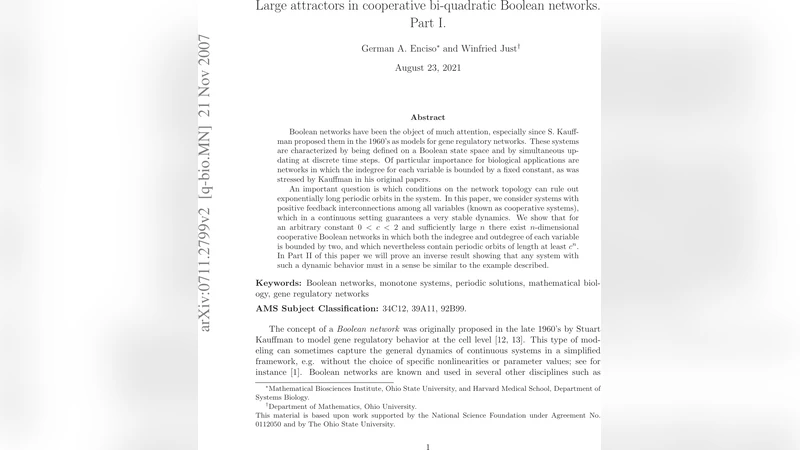
Boolean networks have been the object of much attention, especially since S. Kauffman proposed them in the 1960’s as models for gene regulatory networks. These systems are characterized by being defined on a Boolean state space and by simultaneous updating at discrete time steps. Of particular importance for biological applications are networks in which the indegree for each variable is bounded by a fixed constant, as was stressed by Kauffman in his original papers. An important question is which conditions on the network topology can rule out exponentially long periodic orbits in the system. In this paper, we consider systems with positive feedback interconnections among all variables (known as cooperative systems), which in a continuous setting guarantees a very stable dynamics. We show that for an arbitrary constant 0<c<2 and sufficiently large n there exist n-dimensional cooperative Boolean networks in which both the indegree and outdegree of each variable is bounded by two, and which nevertheless contain periodic orbits of length at least c^n. In Part II of this paper we will prove an inverse result showing that any system with such a dynamic behavior must in a sense be similar to the example described.
💡 Research Summary
The paper investigates the dynamical capabilities of cooperative Boolean networks whose indegree and outdegree are each bounded by two, a class often referred to as bi‑quadratic networks. Cooperative systems are defined by monotone Boolean update functions, meaning that increasing any input cannot decrease the output. In continuous dynamical systems, such positive feedback typically guarantees stability; the authors ask whether a similar restriction in the discrete Boolean setting can preclude the existence of exponentially long periodic orbits.
The main result is constructive: for any constant (0<c<2) and for sufficiently large dimension (n), the authors explicitly build an (n)-dimensional cooperative Boolean network with the prescribed degree bounds that nevertheless possesses a periodic orbit of length at least (c^{,n}). The construction proceeds by arranging the variables into small logical modules that implement simple monotone gates (AND, OR, and copy). These modules are then wired to form two essential components: a “sequential switch” that propagates a control signal through the network, and a binary counter that advances one bit at a time. By carefully interleaving the switch and counter, the whole system mimics the behavior of an (n)-bit binary counter, traversing a large subset of the (2^{n}) possible states before returning to its initial configuration. The parameter (c) reflects the fraction of the full state space visited; by adjusting the design of the counter (e.g., the number of bits that change in each step), (c) can be made arbitrarily close to 2, yielding orbits whose length grows essentially as (2^{n}).
The authors emphasize that the degree constraints alone are insufficient to guarantee short cycles. Even under the strong monotonicity condition, the network can encode a sophisticated counting mechanism, thereby achieving exponential period length. This result challenges the intuition that cooperative Boolean networks are inherently simple and highlights the need for additional structural restrictions—such as limiting feedback loop depth, imposing tree‑like topologies, or bounding the length of directed cycles—to rule out long attractors.
The paper also outlines a forthcoming Part II, in which an inverse theorem will be proved: any cooperative Boolean network with indegree and outdegree at most two that exhibits an exponentially long cycle must, in a precise sense, be equivalent to the construction presented here. In other words, the bi‑quadratic counting architecture is essentially the only way to achieve such dynamical complexity under the given constraints.
Overall, the work provides a rigorous counterexample to the belief that cooperative, low‑degree Boolean networks are dynamically trivial. By demonstrating that exponential‑length attractors can arise from very simple monotone logic gates arranged in a specific pattern, the authors open new avenues for understanding which topological or functional constraints are truly necessary to ensure biologically plausible, stable dynamics in discrete gene‑regulation models and related computational systems.
Comments & Academic Discussion
Loading comments...
Leave a Comment