Complexity of the conditional colorability of graphs
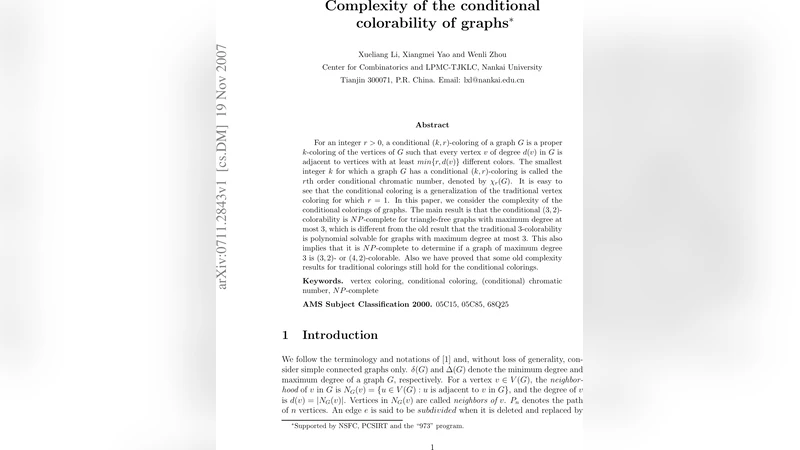
For an integer $r>0$, a conditional $(k,r)$-coloring of a graph $G$ is a proper $k$-coloring of the vertices of $G$ such that every vertex $v$ of degree $d(v)$ in $G$ is adjacent to vertices with at least $min{r, d(v)}$ different colors. The smallest integer $k$ for which a graph $G$ has a conditional $(k,r)$-coloring is called the $r$th order conditional chromatic number, denoted by $\chi_r(G)$. It is easy to see that the conditional coloring is a generalization of the traditional vertex coloring for which $r=1$. In this paper, we consider the complexity of the conditional colorings of graphs. The main result is that the conditional $(3,2)$-colorability is $NP$-complete for triangle-free graphs with maximum degree at most 3, which is different from the old result that the traditional 3-colorability is polynomial solvable for graphs with maximum degree at most 3. This also implies that it is $NP$-complete to determine if a graph of maximum degree 3 is $(3,2)$- or $(4,2)$-colorable. Also we have proved that some old complexity results for traditional colorings still hold for the conditional colorings.
💡 Research Summary
The paper investigates the computational complexity of conditional vertex colorings, a natural extension of the classic graph coloring problem. For a positive integer (r), a conditional ((k,r))-coloring of a graph (G) is a proper (k)-coloring in which every vertex (v) of degree (d(v)) is adjacent to at least (\min{r,d(v)}) distinct colors. The smallest (k) for which such a coloring exists is denoted (\chi_r(G)); when (r=1) this coincides with the ordinary chromatic number. The authors first formalize these definitions, discuss basic properties, and relate them to previously studied variants of graph coloring.
The central contribution is a hardness result that sharply contrasts with known polynomial‑time algorithms for ordinary 3‑colorability on low‑degree graphs. By a careful reduction from the NP‑complete 1‑in‑3‑SAT problem, the authors construct, for any instance of 1‑in‑3‑SAT, a triangle‑free graph whose maximum degree is three such that the graph admits a conditional ((3,2))-coloring if and only if the original formula is satisfiable. The construction uses small “gadgets’’ to represent variables and clauses, connects them while preserving the degree bound, and guarantees the absence of triangles. This establishes that deciding whether a triangle‑free, subcubic graph is ((3,2))-colorable is NP‑complete.
Because the same reduction can be adapted to require four colors instead of three, the paper also shows that determining ((4,2))-colorability for the same class of graphs remains NP‑complete. Consequently, for graphs of maximum degree three it is computationally hard to decide either ((3,2))- or ((4,2))-colorability.
Beyond these specific results, the authors demonstrate that many classic complexity theorems for ordinary colorings carry over to the conditional setting. By suitably modifying existing reductions (for example, those proving NP‑completeness of 3‑colorability on graphs of degree four or of 4‑colorability on planar graphs), they show that the additional “neighbour‑color diversity’’ constraint does not simplify the problem; rather, it often preserves or even amplifies the difficulty.
The paper concludes with a discussion of open problems. It suggests investigating approximation algorithms for (\chi_r(G)), exploring fixed‑parameter tractability with respect to parameters such as treewidth or the value of (r), and studying special graph families (trees, outerplanar graphs, etc.) where conditional colorings might be easier. The authors also hint at potential applications in network design and scheduling, where ensuring a diversity of neighbouring resources can be crucial. Overall, the work establishes that conditional colorability introduces a genuinely harder computational landscape, even on graph classes that are tractable for ordinary coloring.
Comments & Academic Discussion
Loading comments...
Leave a Comment