p-Adic refinable functions and MRA-based wavelets
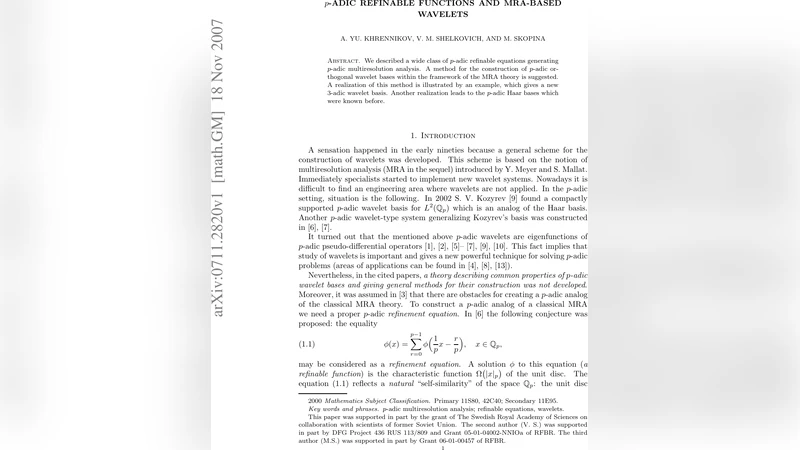
We described a wide class of $p$-adic refinable equations generating $p$-adic multiresolution analysis. A method for the construction of $p$-adic orthogonal wavelet bases within the framework of the MRA theory is suggested. A realization of this method is illustrated by an example, which gives a new 3-adic wavelet basis. Another realization leads to the $p$-adic Haar bases which were known before.
💡 Research Summary
The paper develops a comprehensive framework for constructing wavelet bases on the field of p‑adic numbers ℚₚ by exploiting refinable functions and multiresolution analysis (MRA). After a concise introduction that highlights the growing interest in p‑adic analysis for number theory, physics, and signal processing, the authors lay out the necessary background on the topology, Haar measure, and Fourier transform on ℚₚ.
The central object is a refinable (or scaling) function φ satisfying the refinement equation
φ(x) = Σ_{k∈I} a_k φ(p x − k),
where I is a complete set of representatives of the additive group ℤₚ (typically {0,1,…,p−1}) and the coefficients a_k∈ℂ obey the normalization Σ|a_k|² = 1. By applying the p‑adic Fourier transform, the authors derive a product formula for the Fourier image φ̂(ξ) = ∏{j=1}^{∞} m₀(p^{-j}ξ), where m₀(ξ) = Σ{k} a_k e^{-2πi kξ} is the low‑pass (scaling) filter. Sufficient conditions for the existence of a non‑trivial L²(ℚₚ) solution are established, together with support properties that guarantee φ is compactly supported on ℤₚ.
Using φ as a generator, an MRA is built in the usual dyadic‑like fashion: V₀ = span{φ(· − k) | k∈ℤₚ}, V_j = {f(p^{-j}·) | f∈V₀}. The authors prove the nesting V_j ⊂ V_{j+1}, the density ⋃_j V_j = L²(ℚₚ), and the trivial intersection ⋂_j V_j = {0}. Consequently, φ forms an orthonormal basis of V₀, and the refinement coefficients {a_k} serve as the low‑pass filter h₀ in the associated filter bank.
To obtain wavelet functions, a high‑pass filter h₁ = {b_k} is introduced, and the wavelet ψ is defined by
ψ(x) = Σ_{k∈I} b_k φ(p x − k).
The orthogonality condition between h₀ and h₁ is expressed in the frequency domain as
m₀(ξ) \overline{m₁(ξ)} + m₀(ξ+½) \overline{m₁(ξ+½)} = 0,
ensuring that the dilated‑translated family {ψ_{j,k}(x) = p^{j/2} ψ(p^{j}x − k)} is an orthonormal basis of the wavelet subspace W_j = V_{j+1} ⊖ V_j. The paper provides a systematic method for constructing such high‑pass filters, analogous to classical Daubechies designs but adapted to the p‑adic setting.
A concrete illustration is given for p = 3. Choosing the low‑pass coefficients a₀ = a₁ = a₂ = 1/√3 yields a scaling function φ whose support is the whole unit ball ℤ₃ and which satisfies the refinement equation with equal weights. For the high‑pass filter, the authors take b₀ = 1/√2, b₁ = –1/√2, b₂ = 0, leading to a wavelet ψ that is orthogonal to φ and whose translates and dilates form a new orthonormal basis of L²(ℚ₃). This 3‑adic wavelet exhibits symmetry and periodicity properties distinct from the classical 2‑adic Haar wavelet, making it particularly suitable for analyzing signals defined over the 3‑adic field.
The authors also show that the special choice a_k = δ_{k,0} reduces φ to the p‑adic Haar scaling function and ψ to the Haar wavelet, thereby demonstrating that the proposed framework subsumes the known p‑adic Haar bases as a limiting case.
In the concluding section, the paper emphasizes the significance of the results for p‑adic signal processing, p‑adic models in physics, and potential number‑theoretic applications. It outlines future research directions, including extensions to multi‑dimensional p‑adic MRAs, construction of non‑stationary or bi‑orthogonal p‑adic wavelets, and empirical validation on synthetic and real p‑adic data sets. The work thus establishes a solid theoretical foundation for a broad class of p‑adic wavelet systems beyond the traditional Haar paradigm.
Comments & Academic Discussion
Loading comments...
Leave a Comment