Parity Forwarding for Multiple-Relay Networks
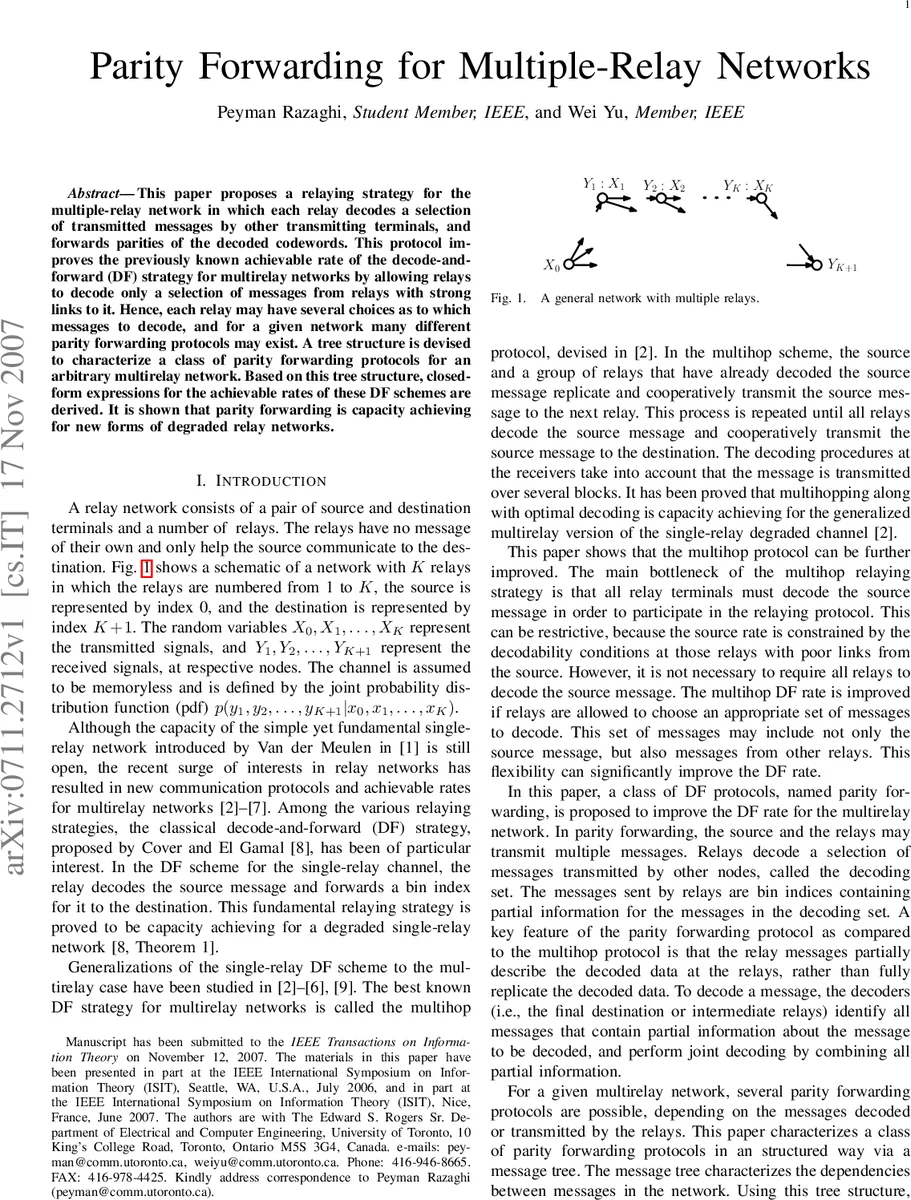
This paper proposes a relaying strategy for the multiple-relay network in which each relay decodes a selection of transmitted messages by other transmitting terminals, and forwards parities of the decoded codewords. This protocol improves the previously known achievable rate of the decode-and-forward (DF) strategy for multirelay networks by allowing relays to decode only a selection of messages from relays with strong links to it. Hence, each relay may have several choices as to which messages to decode, and for a given network many different parity forwarding protocols may exist. A tree structure is devised to characterize a class of parity forwarding protocols for an arbitrary multirelay network. Based on this tree structure, closed-form expressions for the achievable rates of these DF schemes are derived. It is shown that parity forwarding is capacity achieving for new forms of degraded relay networks.
💡 Research Summary
This paper introduces a novel decode‑and‑forward (DF) strategy for general multi‑relay networks called “parity forwarding.” Traditional multi‑hop DF requires every relay to fully decode the source message before it can assist downstream nodes, which limits the overall rate when some source‑to‑relay links are weak. Parity forwarding relaxes this requirement: each relay decodes only a selected subset of messages (the decoding set) that are most reliably received, and then forwards a bin index (parity) of the decoded codeword rather than the entire message.
The authors first revisit the single‑relay DF scheme, contrasting regular encoding (where the relay’s message rate equals the source rate) with irregular encoding (where the relay forwards a random bin index of the source message). They show that when irregular encoding is combined with joint decoding at the destination—i.e., the destination simultaneously decodes the source and relay messages over two consecutive blocks—the relay’s transmission rate becomes unrestricted by the downstream channel capacities. This joint‑decoding insight is the key to extending DF beyond the conventional multi‑hop approach.
Two concrete protocols for a two‑relay network illustrate the concept. Protocol A replicates the classic multi‑hop DF: Relay 1 decodes the source, forwards a bin index m₁; Relay 2 decodes the source (using m₁) and forwards a bin index m₂; the destination uses both m₁ and m₂ to recover the source. Protocol B improves upon this by allowing Relay 2 to skip direct decoding of the source. Instead, Relay 2 only decodes the bin index m₁ from Relay 1, forwards its own bin index m₂, and the destination jointly uses m₁ and m₂ (both functions of the source) to decode. Protocol B achieves a higher rate and, under a specific degradedness condition (a Markov chain Y₁ → Y₂ → Y₃), attains the network capacity—something not possible with the earlier multi‑hop DF.
To handle arbitrary numbers of relays, the paper introduces a “message tree” that captures the dependencies among source messages, relay decodings, and parity transmissions. Each node in the tree represents a message; edges indicate that a child message is a bin index (parity) of its parent. The tree uniquely determines the decoding sets for every relay and the joint‑decoding requirements at each downstream node. Using this structure, the authors derive closed‑form achievable‑rate expressions for any parity‑forwarding scheme. The rate constraints involve mutual informations of the form I(X_S; Y_D | X_{others}) and are notably independent of the weakest downstream link, thanks to the flexibility of irregular encoding and joint decoding.
The paper further identifies several new classes of degraded relay networks for which parity forwarding is provably capacity‑achieving. In chain‑type degraded networks, where each relay’s observation is a degraded version of the previous one, the message‑tree construction yields a simple linear chain of parity messages that exactly matches the cut‑set bound. Similar results hold for certain branched topologies under deterministic or degraded conditions.
Beyond theoretical contributions, the authors note the close relationship between parity forwarding and network coding: relays transmit linear combinations (parities) of previously decoded information, and receivers recover the original data by solving the resulting linear system. This perspective suggests practical code designs (e.g., LDPC‑based binning) and opens avenues for extending the scheme to MIMO relays, time‑varying channels, and adaptive tree optimization based on channel state information.
In summary, the paper provides a unified framework—irregular encoding, joint decoding, and message‑tree representation—that generalizes DF to a much broader set of multi‑relay configurations, yields higher achievable rates than traditional multi‑hop DF, and achieves capacity for several new degraded network models. The work bridges concepts from classic relay theory and modern network coding, offering both deep theoretical insights and practical pathways for future wireless relay system designs.
Comments & Academic Discussion
Loading comments...
Leave a Comment