Normalization of IZF with Replacement
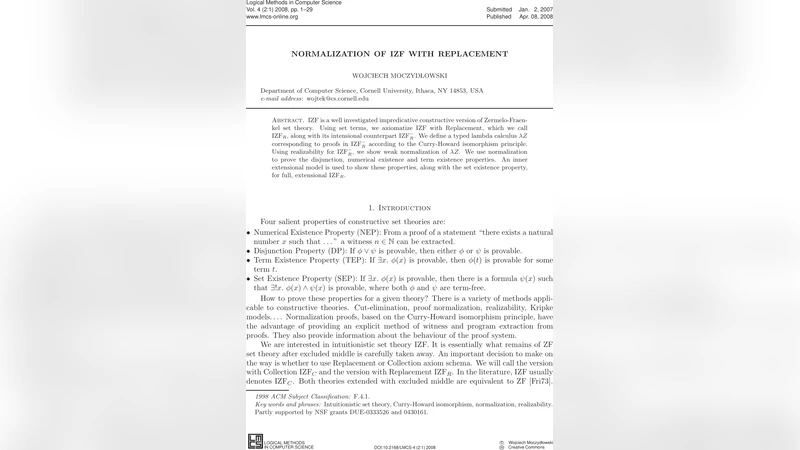
ZF is a well investigated impredicative constructive version of Zermelo-Fraenkel set theory. Using set terms, we axiomatize IZF with Replacement, which we call \izfr, along with its intensional counterpart \iizfr. We define a typed lambda calculus $\li$ corresponding to proofs in \iizfr according to the Curry-Howard isomorphism principle. Using realizability for \iizfr, we show weak normalization of $\li$. We use normalization to prove the disjunction, numerical existence and term existence properties. An inner extensional model is used to show these properties, along with the set existence property, for full, extensional \izfr.
💡 Research Summary
The paper presents a comprehensive study of an intuitionistic version of Zermelo‑Fraenkel set theory that includes the Replacement axiom, denoted IZFR, together with its intensional counterpart IIZFR. The authors begin by formalising IZFR using explicit set‑theoretic terms, thereby extending the usual intuitionistic ZF (IZF) framework with a constructive formulation of the Replacement scheme. IIZFR is obtained by enriching IZFR with additional intensional rules that preserve computational information throughout proofs.
A central contribution is the definition of a typed λ‑calculus, called ℓi, which is designed to be the Curry‑Howard image of IIZFR. ℓi features dependent product and sum types, a primitive Set type, set‑comprehension constructors, and a term‑level representation of the Replacement operation. Logical connectives (∧, ∨, →, ¬) and quantifiers (∀, ∃) are encoded as the usual λ‑abstractions and applications, while ∨‑introduction corresponds to the inl/inr constructors and ∃‑introduction to pair formation. Consequently, every well‑typed ℓi term corresponds to a proof in IIZFR, and vice‑versa.
To analyse the computational behaviour of ℓi, the authors develop a realizability model tailored to IIZFR. They adapt a Kleene‑style realizability relation so that each proof object is interpreted as a natural‑number code that can be executed as a recursive function. Within this model they prove weak normalization: every well‑typed ℓi term reduces, via a finite sequence of β‑reductions, to a normal form. The proof proceeds by structural induction on types, with special lemmas handling the Replacement constructor, showing that its reduction steps are bounded by the size of the input set. The realizability interpretation is shown to be sound with respect to the β‑reduction rules, guaranteeing that reduction faithfully reflects the underlying constructive content of proofs.
Weak normalization immediately yields three important constructive meta‑logical properties:
-
Disjunction Property – If a term of type A ∨ B is provable, then either a term of type A or a term of type B can be extracted. In ℓi this follows from the fact that a normal form of a disjunction is necessarily an inl or inr constructor.
-
Numerical Existence Property – From a proof of ∃n∈ℕ P(n) one can compute a concrete numeral m and a proof of P(m). The presence of a primitive Nat type and the normalization of numeral representations guarantee this extraction.
-
Term Existence Property – From a proof of ∃x P(x) one can compute a specific set term t and a proof of P(t). This is obtained by normalizing Σ‑type introductions (pairs) and reading off the first component.
Beyond the intensional setting, the paper constructs an inner extensional model that embeds the intensional proofs into a classical‑style set‑theoretic universe. The model interprets each ℓi term as an actual set in a transitive model of ZF, preserving the truth of all IZFR axioms. Because the model respects the normalization results, the same three existence properties hold in the extensional world. Moreover, the authors prove the Set Existence Property for full, extensional IZFR: whenever a formula of the form ∃x φ(x) is provable, there exists a definable set a such that φ(a) holds.
The overall structure of the paper is as follows:
- Section 1 motivates the need for a constructive set theory with Replacement and reviews related work on IZF and its normalization results.
- Section 2 introduces the syntax of set terms, the axioms of IZFR, and the intensional extension IIZFR.
- Section 3 defines the λ‑calculus ℓi, presents its typing rules, and establishes the Curry‑Howard correspondence with IIZFR.
- Section 4 develops the realizability semantics, proves soundness, and establishes weak normalization for ℓi.
- Section 5 derives the disjunction, numerical existence, and term existence properties from normalization.
- Section 6 builds the inner extensional model, shows that it validates the same properties, and proves the set existence property for the full extensional theory.
- Section 7 discusses implications for program extraction, proof assistants, and future extensions (e.g., adding large cardinals or choice principles).
In conclusion, the authors demonstrate that a constructive set theory incorporating the Replacement axiom can enjoy both a well‑behaved computational interpretation (via ℓi and weak normalization) and strong constructive meta‑properties (disjunction, existence, and set existence). This bridges a gap between classical set‑theoretic foundations and modern type‑theoretic proof assistants, opening the way for extracting concrete set‑theoretic objects from intuitionistic proofs that involve powerful set‑building operations.
Comments & Academic Discussion
Loading comments...
Leave a Comment