The M"obius transform on symmetric ordered structures and its application to capacities on finite sets
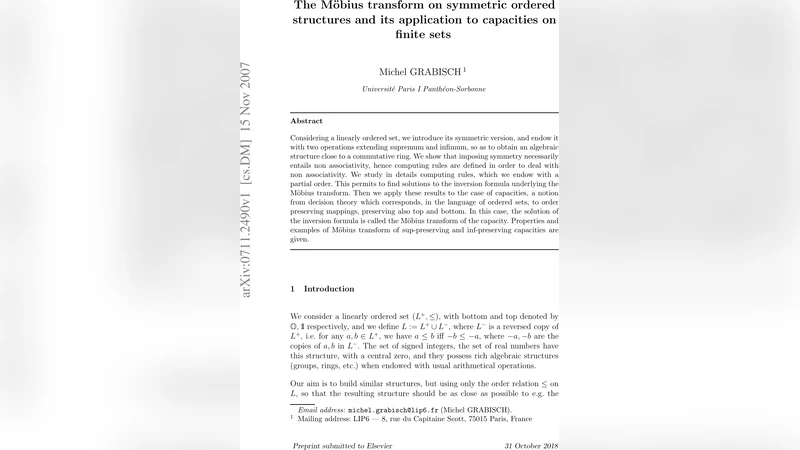
Considering a linearly ordered set, we introduce its symmetric version, and endow it with two operations extending supremum and infimum, so as to obtain an algebraic structure close to a commutative ring. We show that imposing symmetry necessarily entails non associativity, hence computing rules are defined in order to deal with non associativity. We study in details computing rules, which we endow with a partial order. This permits to find solutions to the inversion formula underlying the M"obius transform. Then we apply these results to the case of capacities, a notion from decision theory which corresponds, in the language of ordered sets, to order preserving mappings, preserving also top and bottom. In this case, the solution of the inversion formula is called the M"obius transform of the capacity. Properties and examples of M"obius transform of sup-preserving and inf-preserving capacities are given.
💡 Research Summary
The paper starts by taking a linearly ordered set L and constructing a symmetric version of it. For each element x a counterpart –x is introduced, and the usual supremum and infimum operations are extended to two new binary operations, denoted ⊕ and ⊗. These operations are defined so that x ⊕ (–x)=0 (the bottom element) and x ⊗ (–x)=1 (the top element), thereby enforcing a global symmetry. The authors prove that imposing this symmetry inevitably breaks associativity: in general (a⊕b)⊕c≠a⊕(b⊕c) and similarly for ⊗. To cope with non‑associativity they introduce a family of “computing rules”. A rule specifies a particular bracketing and order of evaluation for a finite expression built from ⊕ or ⊗. The set of rules is equipped with a natural partial order ≤ R, where a rule r₁ ≤ R r₂ means that r₁ is weaker (i.e., yields a result that is less informative) than r₂. This ordering allows the authors to compare and select among competing evaluation strategies.
With the rule‑based algebra in place, the paper turns to the Möbius transform. For a finite set X, a capacity v is a monotone map from the power set 2^X to the interval
Comments & Academic Discussion
Loading comments...
Leave a Comment