Groupo"ides de Lie et Feuilletages
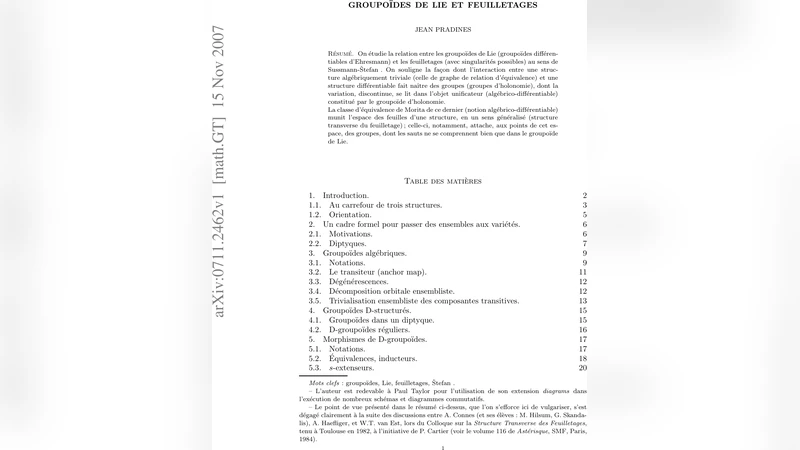
This is a survey concerning the relationship between Lie Groupoids (and their morphisms) and singular foliations in the sense of Sussmann-Stefan (considered from a purely geometrical point of view). We focus on the interaction between the algebraic and differentiable structures underlying Lie groupoids, and between groups and graphs of equivalence relations, regarded as two basic degeneracies for groupoids. Historical remarks, motivations and examples are developed in five appendices.
💡 Research Summary
The paper “Groupoids of Lie and Foliations” offers a comprehensive survey of the deep relationship between Lie groupoids and singular foliations in the sense of Sussmann‑Stefan, approached from a purely geometric standpoint. It begins by recalling the definition of a Lie groupoid: a pair of smooth manifolds (the object manifold M and the arrow manifold G) equipped with smooth source and target maps, a smooth multiplication defined on the fibered product, and smooth inversion and unit sections. This categorical structure simultaneously carries an algebraic composition law and a differential structure, making it a natural generalization of both Lie groups and equivalence‑relation graphs.
The authors emphasize two fundamental “degeneracies’’ of a groupoid. When the arrow manifold coincides with the object manifold, the groupoid collapses to an ordinary Lie group, inheriting a global symmetry. When the arrow manifold is diffeomorphic to the product M × M, the groupoid reduces to the graph of an equivalence relation, encoding only set‑theoretic identifications without any non‑trivial isotropy. By contrasting these extremes, the paper illustrates how a Lie groupoid can interpolate between a highly symmetric algebraic object and a purely relational structure.
Next, the survey turns to singular foliations. Given a possibly non‑regular distribution 𝔇 ⊂ TM, the Sussmann‑Stefan construction produces the smallest integrable, possibly singular, foliation ℱ that contains 𝔇. Unlike regular foliations, the leaves of ℱ may have varying dimensions and may fail to be embedded submanifolds. The authors show that the holonomy groupoid ℋ(ℱ) — the groupoid generated by germs of leafwise holonomy transformations — provides a canonical Lie groupoid associated with ℱ, provided certain smoothness conditions hold.
A central technical contribution is the identification of precise criteria under which the holonomy groupoid becomes a genuine Lie groupoid. The paper lists conditions such as: (i) the holonomy maps vary smoothly with the base point, (ii) the space of arrows is Hausdorff (or can be made so by a suitable quotient), and (iii) the foliation is “regular enough’’ in the sense of having locally finitely generated modules of vector fields. When these are satisfied, the foliation is said to be integrable by a Lie groupoid, and the holonomy groupoid serves as its integration. Conversely, any Lie groupoid integrating a singular foliation yields a holonomy groupoid that is Morita‑equivalent to the original one.
The paper is enriched by five detailed appendices. Appendix A treats the classical case of Lie groups as degenerate groupoids, illustrating how the general theory recovers familiar results. Appendix B discusses equivalence‑relation graphs, highlighting their role as the opposite extreme of symmetry. Appendix C presents a concrete example: the foliation generated by the flow of a planar vector field with a saddle‑node singularity, showing how the associated holonomy groupoid acquires non‑Hausdorff features. Appendix D explores singular foliations arising from complex analytic distributions on non‑compact complex manifolds, linking them to non‑regular Cauchy‑Riemann groupoids. Appendix E sketches a speculative connection with higher‑categorical structures such as co‑stacks, suggesting that Lie groupoids may serve as 1‑level objects in a broader “stacky’’ quantization program.
Historically, the authors situate their work within the lineage of Pradines, Weinstein, and the more recent contributions of Androulidakis‑Skandalis, emphasizing how the modern viewpoint treats Lie groupoids as the natural language for integrating singular geometric data.
In conclusion, the survey demonstrates that Lie groupoids provide a unifying framework for encoding both algebraic symmetries and singular leafwise dynamics. By elucidating the conditions for integration, the paper opens pathways for applying groupoid techniques to control theory, non‑commutative geometry, and even quantum field theory, where singular foliations frequently appear. Future directions highlighted include classification of holonomy groupoids, their deformation quantization, and the extension of the theory to higher groupoids and stacks.