Algebraic $K$-theory Spectra and Factorisations of Analytic Assembly Maps
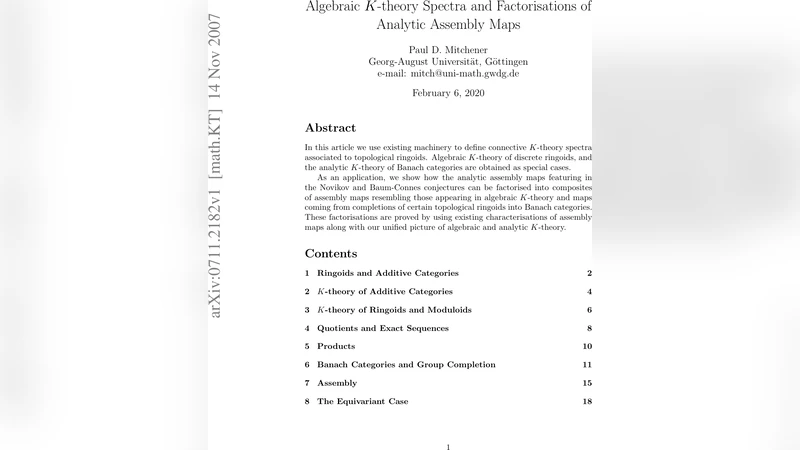
In this article we use existing machinery to define connective $K$-theory spectra associated to topological ringoids. Algebraic $K$-theory of discrete ringoids, and the analytic $K$-theory of Banach categories are obtained as special cases. As an application, we show how the analytic assembly maps featuring in the Novikov and Baum-Connes conjectures can be factorised into composites of assembly maps resembling those appearing in algebraic $K$-theory and maps coming from completions of certain topological ringoids into Banach categories. These factorisations are proved by using existing characterisations of assembly maps along with our unified picture of algebraic and analytic $K$-theory.
💡 Research Summary
The paper develops a unified framework that simultaneously captures algebraic K‑theory of discrete ringoids and analytic K‑theory of Banach categories by constructing connective K‑theory spectra for topological ringoids. A “ringoid” is a category whose objects and morphisms carry a ring‑like structure; the authors extend this notion to the topological setting, allowing morphism spaces to be equipped with continuous or normed structures. Using a hybrid of Waldhausen’s S‑construction and Segal’s Γ‑space machinery, they associate to any topological ringoid 𝓡 a connective spectrum K(𝓡). The construction enforces a connectivity condition that eliminates non‑trivial homotopy below degree zero, ensuring that the resulting spectrum behaves like a genuine K‑theory object.
Two key specializations are examined. First, when 𝓡 is a discrete ringoid with finitely many objects, K(𝓡) coincides with the classical algebraic K‑theory spectrum obtained via Quillen’s Q‑construction. Second, when 𝓡 is a Banach category—objects are Banach spaces and morphisms are bounded linear maps preserving the norm—K(𝓡) agrees with the analytic K‑theory spectrum introduced by Meyer‑Nest for C∗‑algebras. These identifications show that the new construction subsumes both the algebraic and analytic theories, providing a single homotopical object that interpolates between them.
The central application concerns the assembly maps that appear in the Novikov conjecture and the Baum–Connes conjecture. Traditionally, these maps are analytic in nature: they send geometric K‑homology classes to the K‑theory of reduced group C∗‑algebras or to the K‑theory of C∗‑algebras associated with manifolds. The authors prove a factorisation theorem that expresses any such analytic assembly map as a composite of two more elementary maps. The first factor, α, is an algebraic assembly map arising from the inclusion of a discrete sub‑ringoid into the topological ringoid; it is precisely the map that appears in algebraic K‑theory when one passes from a ring to its group ring or from a space to its cellular chain complex. The second factor, β, is a completion map induced by the canonical norm‑preserving functor that sends the topological ringoid to its Banach completion. In symbols, for a given analytic assembly map γ we have γ ≃ β ∘ α.
The proof relies on existing characterisations of assembly maps. The algebraic factor α is shown to satisfy the “regularised commuting square” condition identified by Lurie in the context of higher algebra, guaranteeing that it behaves like a genuine assembly map on the level of spectra. The completion factor β is handled using Meyer‑Nest’s analysis of Banach completions: the functor from a topological ringoid to its Banach envelope induces a stable equivalence of the associated K‑theory spectra, and thus β is a homotopy equivalence after suitable localisation. By composing these two steps, the authors recover the original analytic assembly map, thereby revealing its hidden algebraic structure.
Several concrete examples illustrate the theory. For a discrete group G, taking the group ring ℤ
Comments & Academic Discussion
Loading comments...
Leave a Comment