In Ehresmanns footsteps: from Group Geometries to Groupoid Geometries
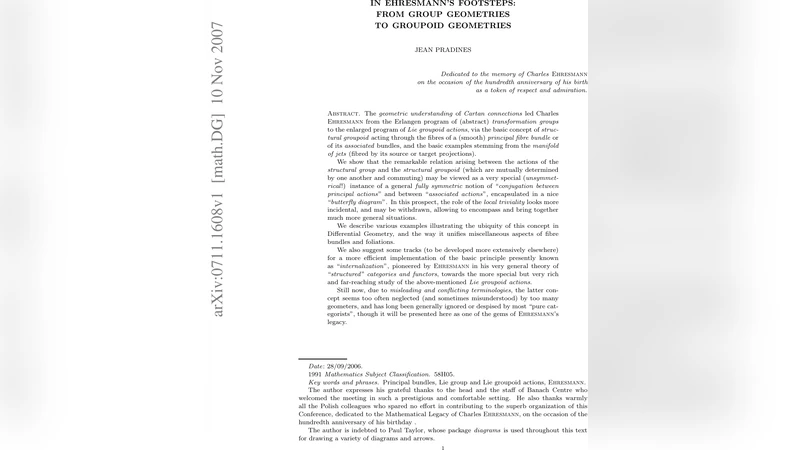
For a smooth (locally trivial) principal bundle in Ehresmann’s sense, the relation between the commuting vertical and horizontal actions of the structural Lie group and the structural Lie groupoid (isomorphisms between vertical fibers) is regarded as a special case of a symmetrical concept of conjugation between “principal” Lie groupoid actions, allowing possibly non-locally trivial bundles. A diagrammatic description of this concept via a symmetric “butterfly diagram” allows its “internalization” in a wide class of categories (used by “working mathematicians”) whenever they are endowed with two distinguished classes of monomorphisms and epimorphisms mimicking the properties of embeddings and surjective submersions. As an application, a general theorem of “universal activation” encompasses in a unified way such various situations as Palais’ theory of globalization for partial action laws, the realization of non-abelian cocycles (including Haefliger cocycles for foliations) or the description of the “homogeneous space” attached to an embedding of Lie groups (still valid for Lie groupoids).
💡 Research Summary
The paper revisits Ehresmann’s classical picture of a smooth principal bundle, where the vertical and horizontal actions of the structure Lie group G commute, and shows that this picture is a special case of a far more general symmetric conjugation between two “principal” actions: one of a Lie group and the other of a Lie groupoid that encodes the isomorphisms between the vertical fibers. The authors introduce the notion of a principal Lie groupoid action and define a conjugation between a G‑action and a groupoid action as a pair of mutually commuting actions on the same total space. This relationship is captured diagrammatically by a symmetric “butterfly diagram”. The diagram consists of four objects (the total space, the base, the group, and the groupoid) and four arrows arranged so that the two diagonal arrows are surjective submersions (the actions) while the vertical arrows are embeddings (the inclusions of the group and the groupoid into a common ambient structure). The butterfly makes the conjugation condition completely explicit: moving along one diagonal and then down equals moving down and then along the other diagonal.
A major contribution of the paper is the internalization of this construction in any category that carries two distinguished classes of monomorphisms and epimorphisms mimicking embeddings and surjective submersions. The authors formulate precise stability conditions (pull‑back stability for the “embedding” class and push‑out stability for the “surjection” class) and show that under these hypotheses the butterfly diagram can be defined entirely inside the category. Consequently, the theory applies not only to smooth manifolds but also to algebraic varieties, schemes, topological stacks, and even higher‑categorical contexts where appropriate notions of monomorphism/epimorphism exist.
The central technical result is the Universal Activation Theorem. Given a partial action of a Lie group (or more generally a partial groupoid action) or a non‑abelian 1‑cocycle (including Haefliger cocycles for foliations), the theorem guarantees the existence of a universal activation: a larger Lie groupoid together with a surjective morphism from the original groupoid and an embedding of the original group such that the partial data become a global action of the larger groupoid. The construction proceeds by first extracting a partial groupoid that records the domain of definition of the partial action, then extending it by a universal “transversal” that supplies missing arrows, and finally embedding the original group via a monomorphism that respects the butterfly conjugation. The result is a canonical, functorial activation that works uniformly across all the examples considered.
The paper illustrates the power of this framework through three substantial applications. First, it recovers Palais’ globalization theorem for partial group actions, but now without the need for additional topological hypotheses; the butterfly diagram supplies the necessary glue. Second, it unifies the realization of non‑abelian cocycles, showing that any Haefliger cocycle defining a foliation can be viewed as a principal groupoid bundle that is universally activated to a genuine principal bundle over a possibly larger base. Third, it treats the homogeneous space associated to an inclusion of Lie groups (i: H \hookrightarrow G). By regarding the inclusion as a morphism of groupoids, the butterfly diagram produces a canonical homogeneous space (G/H) that remains well‑defined even when the inclusion fails to be locally trivial, thereby extending the classical construction to non‑locally trivial settings.
In the concluding section the authors discuss future directions. They suggest extending the theory to higher groupoids and ∞‑groupoids, exploring connections with non‑abelian cohomology in derived algebraic geometry, and applying the butterfly‑conjugation machinery to gauge theories in physics, where local symmetries are naturally described by groupoids rather than groups. Overall, the paper provides a robust categorical language that elevates Ehresmann’s original insight to a universal principle governing the interplay between groups, groupoids, and their actions, opening new avenues for both pure mathematics and theoretical physics.
Comments & Academic Discussion
Loading comments...
Leave a Comment