In this paper, we analyze the electrotactic movement of Dictyostelium discoideum from the viewpoint of non-equilibrium statistical mechanics. Because we can observe fluctuating behavior of cellular trajectories, we analyze the probability distribution of the trajectories with the aid of the fluctuation theorem. Recently, the validity of the fluctuation theorem was verified in a colloidal system, and it has also been applied to granular systems, turbulent systems and chemical oscillatory waves to investigate some of their statistical properties that are not yet completely understood. Noting that the fluctuation theorem is potentially applicable to cellular electrotaxis, here we employ it to help us obtain a phenomenological model of this biological system.
Deep Dive into Fluctuation theorem applied to Dictyostelium discoideum system.
In this paper, we analyze the electrotactic movement of Dictyostelium discoideum from the viewpoint of non-equilibrium statistical mechanics. Because we can observe fluctuating behavior of cellular trajectories, we analyze the probability distribution of the trajectories with the aid of the fluctuation theorem. Recently, the validity of the fluctuation theorem was verified in a colloidal system, and it has also been applied to granular systems, turbulent systems and chemical oscillatory waves to investigate some of their statistical properties that are not yet completely understood. Noting that the fluctuation theorem is potentially applicable to cellular electrotaxis, here we employ it to help us obtain a phenomenological model of this biological system.
Directional cell movement is a fundamental phenomenon exhibited by many biological processes. It has been known that an electric field exists on the surfaces of the tissues of organisms and that it acts as a directional cue for the type of the cell migration known as electrotaxis. Electrotaxis is thought to play important roles in various physiological processes including embryogenesis and wound healing, and the underlying molecular mechanisms of electrotaxis are now extensively studied. 1) In order to elucidate the mechanisms of the electrotactic responses of cells, the cellular slime mold Dictyostelium discoideum (see Fig. 1 (Left)) is a suitable organism to study, because of its high motility and strong electrotactic response. With well-established genetic engineering techniques and advanced microscopic techniques, the input-output relationship in the electrotactic response of Dictyostelium cells has been investigated to elucidate the stochastic processes involved in the signaling systems responsible for cell motility and their regulations. 2) In this paper, we analyze the electrotactic movement of Dictyostelium discoideum from the viewpoint of nonequilibrium statistical mechanics. Because we can observe fluctuating behavior of cellular trajectories, we analyze the probability distribution of the trajectories with the aid of the fluctuation theorem. Recently, the validity of the fluctuation theorem was verified in a colloidal system, 3) and it has also been applied to granular systems, 4) turbulent systems 5) and chemical oscillatory waves 6) to investigate some of their statistical properties that are not yet completely understood. Noting that the fluctuation theorem is potentially applicable to cellular electrotaxis, here we employ it to help us obtain a phenomenological model of this biological system.
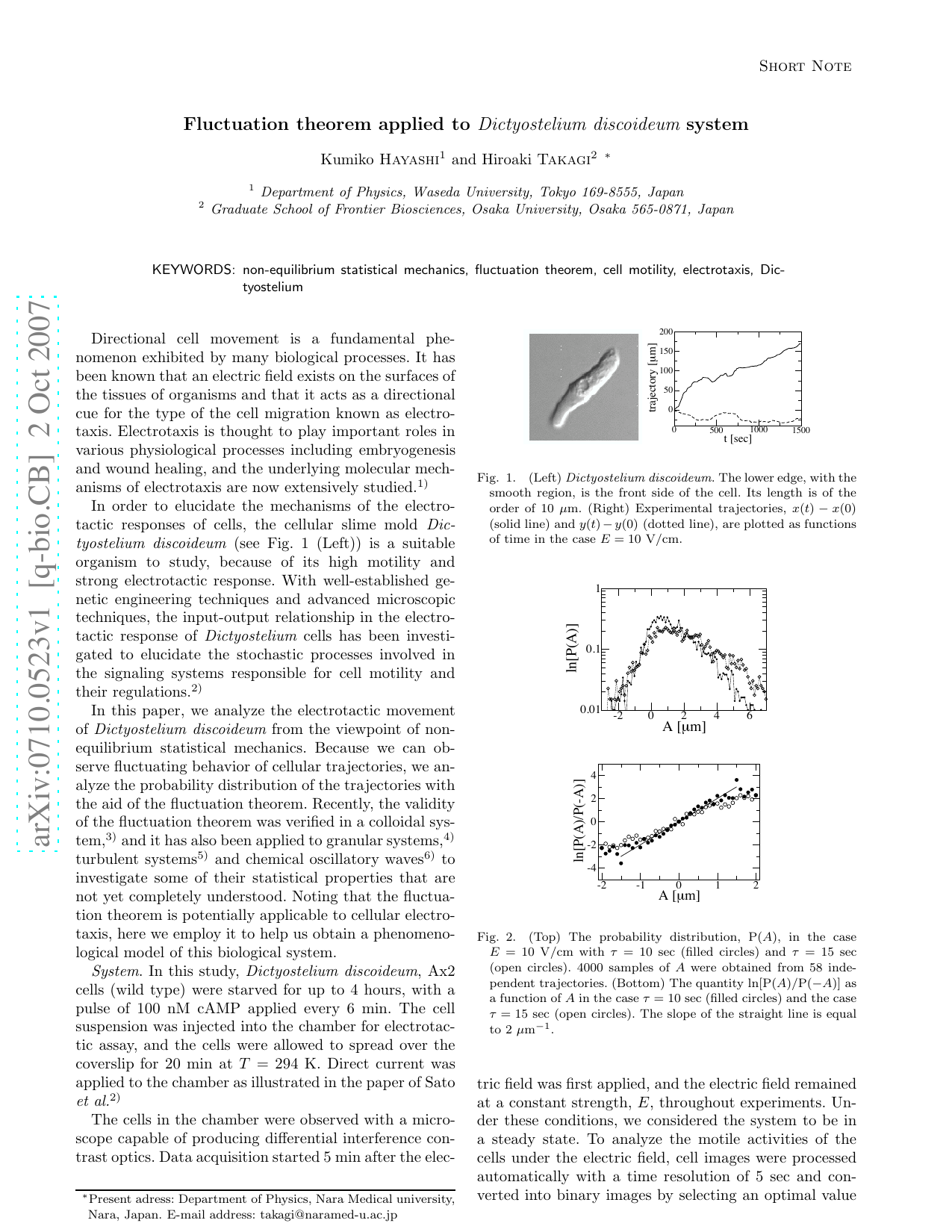
System. In this study, Dictyostelium discoideum, Ax2 cells (wild type) were starved for up to 4 hours, with a pulse of 100 nM cAMP applied every 6 min. The cell suspension was injected into the chamber for electrotactic assay, and the cells were allowed to spread over the coverslip for 20 min at T = 294 K. Direct current was applied to the chamber as illustrated in the paper of Sato et al. 2) The cells in the chamber were observed with a microscope capable of producing differential interference contrast optics. Data acquisition started 5 min after the elec- * Present adress: Department of Physics, Nara Medical university, Nara, Japan. E-mail address: takagi@naramed-u.ac.jp tric field was first applied, and the electric field remained at a constant strength, E, throughout experiments. Under these conditions, we considered the system to be in a steady state. To analyze the motile activities of the cells under the electric field, cell images were processed automatically with a time resolution of 5 sec and converted into binary images by selecting an optimal value of the brightness threshold. In this way, the trajectory of the center position of the observed cellular region, (x(t), y(t)), was determined. Because the gradient of the electric field is non-zero only along the x direction, we particularly investigate the trajectories in the x direction for the case that E = 10 V/cm, which is sufficiently large for the response saturation of the cell. 2) Fluctuation theorem. When the electric field is turned on, Dictyostelium cells begin to migrate toward the cathode (the +x direction). In Fig. 1 (Right), we plot example trajectories, x(t) -x(0) and y(t) -y(0), as functions of time in the case E = 10 V/cm. The fluctuating behavior of the cell movement was observed. Then, using these fluctuating trajectories and setting A ≡ x(τ ) -x(0), we investigate the probability density for the realization of the value A. In Fig. 2 (Top), we plot the probability density, P(A), in the case E = 10 V/cm with τ = 10 sec and τ = 15 sec. We find that the graphs have exponential tails.
In a colloidal system under a non-equilibrium condition, an entropy production, Σ, of the system was measured experimentally, 3) and the probability distribution, P(Σ), was analyzed. This P(Σ) also has exponential tails, and it is known that the entropy production fluctuation theorem ln[P(Σ)/P(-Σ)] = Σ holds in the system. Because the forms of the graphs in Fig. 2 (Top) are similar to those observed in the colloidal system, we plot ln[P(A)/P(-A)] as a function of A in Fig. 2 (Bottom). In Fig. 2 (Bottom), we obtain the linear slopes in the cases τ = 10 sec and τ = 15 sec, and they differ slightly. We thus conclude that the value of the slopes is almost independent of τ at least to the extent of this rough treatment. From the fitting of the data to a linear function, we obtain the value of the slopes 2 µm -1 .
In order to understand a physical meaning of the value 2 µm -1 , we employ a model simplified enough, noting that τ is less than the persistence time of the cell movement. We consider that a description of the cell movement is roughly describ
…(Full text truncated)…
This content is AI-processed based on ArXiv data.