Two Bessel Bridges Conditioned Never to Collide, Double Dirichlet Series, and Jacobi Theta Function
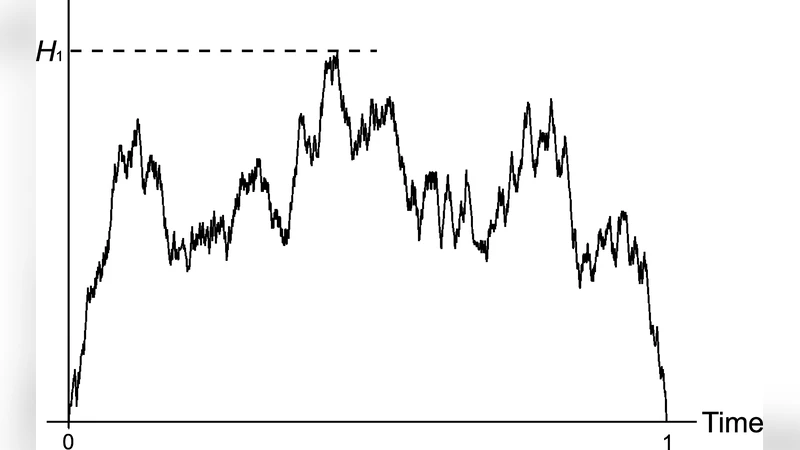
It is known that the moments of the maximum value of a one-dimensional conditional Brownian motion, the three-dimensional Bessel bridge with duration 1 started from the origin, are expressed using the Riemann zeta function. We consider a system of two Bessel bridges, in which noncolliding condition is imposed. We show that the moments of the maximum value is then expressed using the double Dirichlet series, or using the integrals of products of the Jacobi theta functions and its derivatives. Since the present system will be provided as a diffusion scaling limit of a version of vicious walker model, the ensemble of 2-watermelons with a wall, the dominant terms in long-time asymptotics of moments of height of 2-watermelons are completely determined. For the height of 2-watermelons with a wall, the average value was recently studied by Fulmek by a method of enumerative combinatorics.
💡 Research Summary
The paper investigates the statistical properties of the maximum height attained by a pair of three‑dimensional Bessel bridges (i.e., one‑dimensional Brownian motions conditioned to stay positive) when a non‑colliding constraint is imposed. The authors begin by recalling the well‑known result that for a single Bessel bridge of duration 1 started at the origin, the moments of its maximum are expressed in terms of the Riemann zeta function ζ(2k). They then consider two such bridges simultaneously and require that the two paths never intersect. This non‑collision condition is mathematically equivalent to the “watermelon” configuration studied in random matrix theory and non‑intersecting lattice path models.
Using the Karlin–McGregor formula, the joint transition density of the two bridges can be written as a determinant whose entries are the single‑bridge transition kernels. By Fourier‑transforming these kernels, the authors express them as series of the Jacobi theta function θ₃(z,q). The determinant structure together with the theta‑function representation leads to a compact expression for the k‑th moment of the maximum, Mₖ, in the form of a double Dirichlet series:
\
Comments & Academic Discussion
Loading comments...
Leave a Comment