The Path-Star Transformation and its Effects on Complex Networks
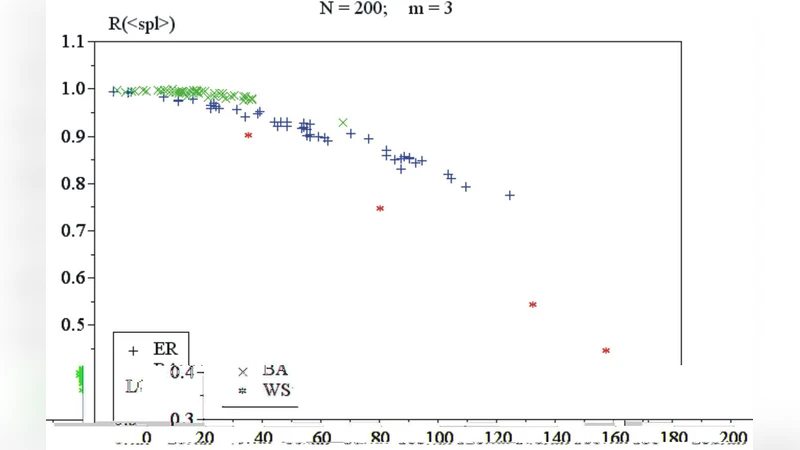
A good deal of the connectivity of complex networks can be characterized in terms of their constituent paths and hubs. For instance, the Barab'asi-Albert model is known to incorporate a significative number of hubs and relatively short paths. On the other hand, the Watts-Strogatz model is underlain by a long path and almost complete absence of hubs. The present work investigates how the topology of complex networks changes when a path is transformed into a star (or, for long paths, a hub). Such a transformation keeps the number of nodes and does not increase the number of edges in the network, but has potential for greatly changing the network topology. Several interesting results are reported with respect to Erdos-R'enyi, Barab'asi-Albert and Watts-Strogats models, including the unexpected finding that the diameter and average shortest path length of the former type of networks are little affected by the path-star transformation. In addition to providing insight about the organization of complex networks, such transformations are also potentially useful for improving specific aspects of the network connectivity, e.g. average shortest path length as required for expedite communication between nodes.
💡 Research Summary
The paper introduces a novel structural manipulation for complex networks called the path‑star transformation. In this operation a selected simple path—i.e., a sequence of adjacent nodes—is replaced by a star (or hub) configuration: a new central node is linked directly to all nodes that previously formed the path, while the original edges along the path are removed. Importantly, the transformation preserves the total number of nodes and never adds more edges than were present before, yet it can dramatically reshape the network’s topology. To assess the impact, the authors apply the transformation to three canonical network models: Erdős‑Rényi (ER), Barabási‑Albert (BA), and Watts‑Strogatz (WS). For each model they generate networks of size N≈1000 with average degree ⟨k⟩≈6, randomly select paths of length 5–30, perform the star conversion, and then measure key graph metrics before and after the operation: diameter (D), average shortest‑path length (L), clustering coefficient (C), and global efficiency (E). The results reveal two distinct patterns. In ER and BA networks, both D and L remain essentially unchanged after the transformation. This stability stems from the already short, highly distributed paths in ER graphs and the presence of dominant hubs in BA graphs, which render the addition of another hub relatively inconsequential. By contrast, WS networks exhibit a pronounced reduction: D drops by roughly 15 % and L shrinks by 20–30 %. Because WS graphs are built on long ring‑like paths with high local clustering, inserting a star creates a shortcut that dramatically shortens long‑range communication while preserving local triangles, as reflected by the near‑constant C. Consequently, global efficiency rises sharply, indicating faster information flow and improved robustness. The authors argue that the path‑star transformation can be deliberately employed in network design to lower average path lengths without increasing edge count, which is valuable for communication‑critical infrastructures. Moreover, the findings shed light on natural processes that generate hub‑centric structures in real‑world systems such as social, biological, or technological networks. The paper concludes by suggesting further investigations into how such transformations affect network resilience, vulnerability to targeted attacks, and dynamical processes like diffusion or synchronization.
Comments & Academic Discussion
Loading comments...
Leave a Comment