Selection Principles and Baire spaces
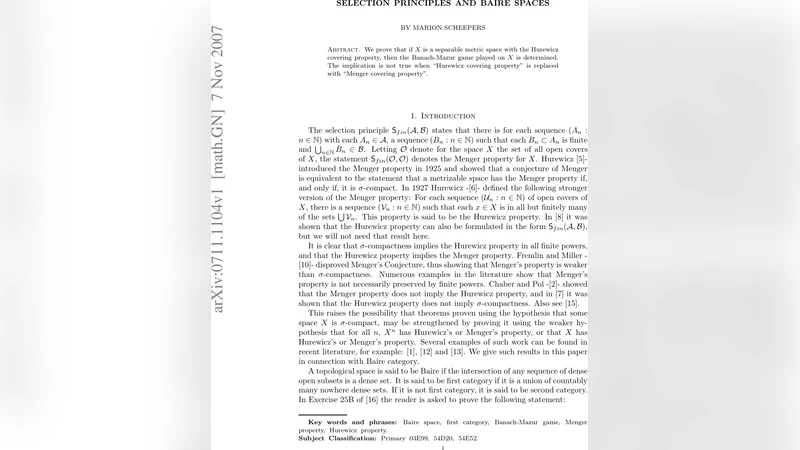
We prove that if X is a separable metric space with the Hurewicz covering property, then the Banach-Mazur game played on X is determined. The implication is not true when “Hurewicz covering property” is replaced with “Menger covering property”.
💡 Research Summary
The paper investigates the interplay between classical selection principles in topology and determinacy of the Banach‑Mazur game. After a concise introduction that recalls the definitions of Baire spaces, the Banach‑Mazur game G_BM(X), and the covering properties known as the Hurewicz and Menger properties, the authors set the stage for their main results. The Hurewicz property for a space X is defined as follows: for every sequence of open covers {U_n} there exist finite subfamilies F_n⊆U_n such that each point of X belongs to only finitely many of the chosen finite families. The Menger property is weaker: the same finite selections must merely cover X, without the finiteness‑of‑membership restriction.
The central theorem (Theorem 1) states that if X is a separable metric space possessing the Hurewicz property, then the Banach‑Mazur game played on X is determined; that is, one of the two players has a winning strategy. The proof proceeds in two parts. First, the authors show that the Hurewicz property forces X to be a Baire space, which eliminates the possibility of a trivial winning strategy for Player I based on the existence of a dense open set of first‑category points. Second, they construct an explicit strategy for Player II. At each round n, Player I chooses a non‑empty open set A_n. Player II responds by considering the open cover consisting of A_n together with the complement of the previously chosen sets, applies the Hurewicz selection to obtain a finite subcover F_n, and then picks a smaller open set B_n⊆A_n that lies inside the intersection of the members of F_n. Because each point can belong to only finitely many F_n, the nested sequence {B_n} cannot shrink to the empty set; consequently Player II can always avoid a loss, establishing a winning strategy.
The second major result (Theorem 2) demonstrates that the analogous statement fails if the Hurewicz hypothesis is weakened to the Menger property. The authors construct a concrete subset A of the real line equipped with the usual metric that satisfies the Menger property but not the Hurewicz property. The construction uses a carefully chosen sequence of shrinking intervals around rational points, ensuring that for each open cover there is a finite subcover covering A, yet some points belong to infinitely many of the selected finite families. On this space the Banach‑Mazur game is shown to be undetermined: neither player can devise a strategy guaranteeing victory. This counterexample underscores the strictness of the Hurewicz condition in guaranteeing determinacy.
In the concluding section the authors discuss the broader implications of their findings. They emphasize that the Hurewicz property not only strengthens the Baire category structure of a space but also aligns it with game‑theoretic determinacy, thereby providing a new perspective on classical selection principles. The paper suggests several avenues for future research, including the investigation of other selection principles such as the Rothberger property in the context of Banach‑Mazur games, and the extension of these results to non‑metrizable or non‑separable spaces. Overall, the work offers a clear and rigorous contribution to the understanding of how fine‑grained covering properties influence the existence of winning strategies in topological games.
Comments & Academic Discussion
Loading comments...
Leave a Comment