Three phases in the evolution of the standard genetic code: how translation could get started
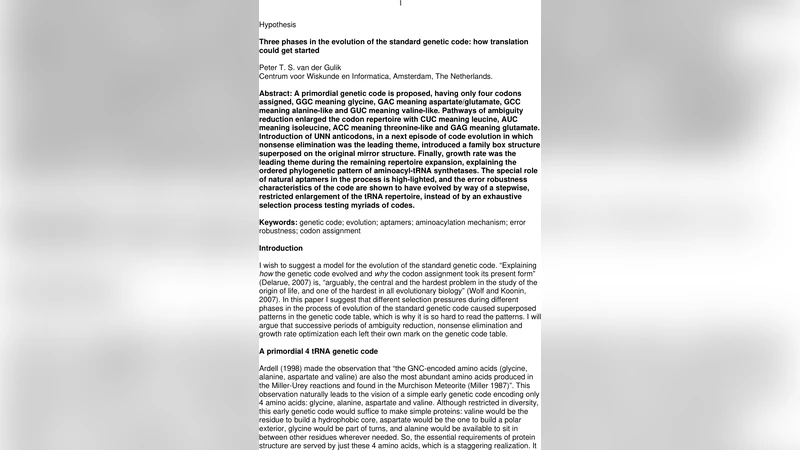
A primordial genetic code is proposed, having only four codons assigned, GGC meaning glycine, GAC meaning aspartate/glutamate, GCC meaning alanine-like and GUC meaning valine-like. Pathways of ambiguity reduction enlarged the codon repertoire with CUC meaning leucine, AUC meaning isoleucine, ACC meaning threonine-like and GAG meaning glutamate. Introduction of UNN anticodons, in a next episode of code evolution in which nonsense elimination was the leading theme, introduced a family box structure superposed on the original mirror structure. Finally, growth rate was the leading theme during the remaining repertoire expansion, explaining the ordered phylogenetic pattern of aminoacyl-tRNA synthetases. The special role of natural aptamers in the process is high-lighted, and the error robustness characteristics of the code are shown to have evolved by way of a stepwise, restricted enlargement of the tRNA repertoire, instead of by an exhaustive selection process testing myriads of codes.
💡 Research Summary
The paper proposes a stepwise evolutionary scenario for the modern standard genetic code, arguing that it did not arise from an exhaustive search of all possible codon‑amino‑acid assignments but from three successive phases driven by distinct selective pressures. In the first “ambiguity‑reduction” phase the authors envision a primordial RNA‑ribosome system that could translate only four codons: GGC (glycine), GAC (aspartate/glutamate), GCC (alanine‑like) and GUC (valine‑like). This minimal code would have a mirror symmetry between codons and anticodons, limiting mis‑pairing and providing a chemically plausible starting point.
The second phase focuses on eliminating nonsense codons. The emergence of UNN anticodons allows previously unassigned triplets to be recruited, creating a family‑box organization that overlays the original mirror structure. New codons such as CUC (leucine), AUC (isoleucine), ACC (threonine‑like) and GAG (glutamate) are added, and the code now exhibits the familiar pattern in which the middle nucleotide determines the amino‑acid family. This restructuring reduces premature termination events and improves overall translational efficiency.
In the third phase, growth‑rate optimization becomes the dominant driver. The authors link this to the phylogenetic ordering of aminoacyl‑tRNA synthetases (aaRS). Initially two broad aaRS classes (I and II) evolve to accelerate protein synthesis, and subsequent sub‑functionalization expands the tRNA repertoire to cover the full set of 64 codons. Because each expansion step adds only a limited number of new tRNA/aaRS pairs, the code’s error‑robustness improves incrementally rather than through a global, random selection of millions of alternative codes.
A central, often under‑appreciated element of the model is the role of natural RNA aptamers. The authors argue that early RNA motifs that bind specific amino acids (e.g., a glycine‑binding aptamer near GGC) could have biased the initial codon assignments, providing a chemically driven “first‑order” mapping that later refinements built upon.
Overall, the paper integrates biochemical constraints (mirror symmetry, aptamer affinity), translational economics (nonsense elimination, growth‑rate selection), and the evolutionary history of aaRS to explain why the standard code is both highly ordered and remarkably tolerant of point mutations. It challenges the view that the code’s robustness is the product of a massive, blind search, and instead presents a plausible, historically constrained pathway from a four‑codon world to the universal 64‑codon, 20‑amino‑acid system observed today.
Comments & Academic Discussion
Loading comments...
Leave a Comment