A note on pairs of metrics in a three-dimensional linear vector space
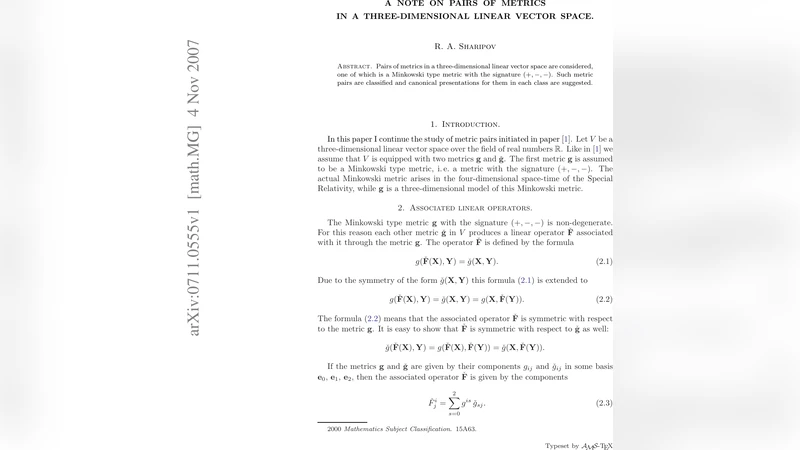
Pairs of metrics in a three-dimensional linear vector space are considered, one of which is a Minkowski type metric with the signature (+,-,-). Such metric pairs are classified and canonical presentations for them in each class are suggested.
💡 Research Summary
The paper investigates pairs of symmetric bilinear forms (metrics) defined on a three‑dimensional real vector space (V). One of the metrics, denoted (g), is fixed to be of Minkowski type with signature ((+,-,-)); the second metric, (h), is an arbitrary non‑degenerate (or possibly degenerate) symmetric form. The central problem is to classify all possible ordered pairs ((g,h)) up to linear change of basis and to provide a canonical matrix representation for each equivalence class.
Framework and Key Invariant
The authors introduce the linear operator (A = g^{-1}h), which maps vectors via (g) to the (h)-inner product. Since (g) is non‑degenerate, (A) is well defined and its algebraic properties encode the relative geometry of the two metrics. The characteristic polynomial (\chi_A(\lambda)=\det(\lambda I - A)) and the minimal polynomial of (A) are invariant under simultaneous change of basis in (V). Consequently, the eigenvalue spectrum of (A) (including multiplicities and possible complex conjugate pairs) and the Jordan canonical form of (A) become the primary classification data.
Classification Scheme
Four mutually exclusive spectral scenarios are identified:
- Three distinct real eigenvalues (\lambda_1,\lambda_2,\lambda_3).
- One repeated real eigenvalue (double root) and a third distinct real eigenvalue.
- All three eigenvalues equal (triple root).
- One complex conjugate pair (\alpha\pm i\beta) together with a real eigenvalue (\mu).
Each scenario is further split according to whether (h) is non‑degenerate (full rank) or degenerate (rank ≤ 2). Degeneracy forces at least one eigenvalue of (A) to be zero, which is reflected in the canonical matrices.
Canonical Bases and Matrix Forms
A (g)-orthonormal basis ({e_0,e_1,e_2}) is chosen so that
\
Comments & Academic Discussion
Loading comments...
Leave a Comment