Working with Bill Kruskal: From 1950 Onward
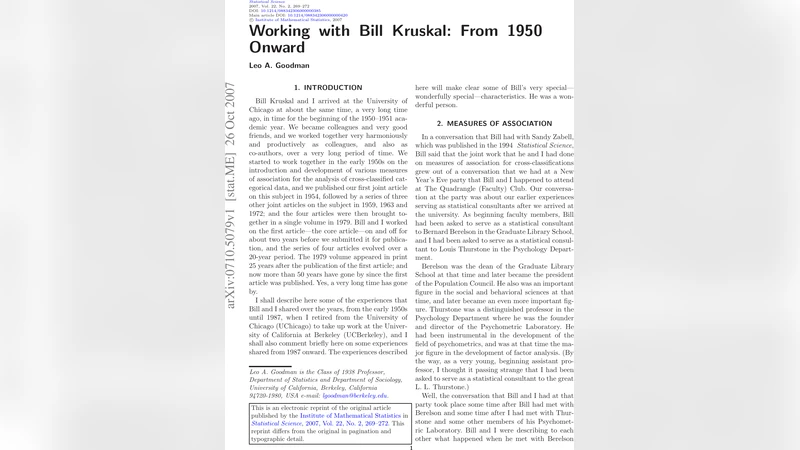
Discussion of ``The William Kruskal Legacy: 1919–2005’’ by Stephen E. Fienberg, Stephen M. Stigler and Judith M. Tanur [arXiv:0710.5063]
💡 Research Summary
The paper under review is a discussion piece that comments on “The William Kruskal Legacy: 1919‑2005,” a commemorative article authored by Stephen E. Fienberg, Stephen M. Stigler, and Judith M. Tanur. Rather than presenting new empirical findings, the authors use the discussion format to provide a panoramic view of Bill Kruskal’s intellectual trajectory from the early 1950s through his death in 2005, emphasizing how his work reshaped the field of statistics and its relationship to the social sciences.
The narrative begins with a brief biographical sketch: Kruskal was born in 1919, earned his Ph.D. at the University of Chicago, and entered a statistical community that, at the time, prioritized abstract probability theory over applied problem solving. Kruskal’s early career is portrayed as a deliberate departure from that norm. He insisted that every statistical analysis start with a clear, substantive research question—“Why are we looking at this data?”—and that the statistical model be a faithful translation of that question rather than a purely mathematical exercise.
A central technical contribution highlighted is the development of the Kruskal–Wallis test (originally co‑authored with Wallis) and the related chi‑square extensions that bear his name. The discussion explains how these tools were designed to address real‑world cross‑tabulation problems in sociology and demography, providing a concrete illustration of Kruskal’s philosophy: rigorous mathematics coupled with immediate applicability. The authors cite several historical case studies—election‑turnout surveys, occupational mobility tables, and early public‑health data—showing how Kruskal’s methods enabled researchers to extract substantive insights that were previously obscured by inadequate analytical techniques.
Beyond methodological innovation, the paper devotes considerable attention to Kruskal’s collaborative style. He cultivated an informal “Kruskal Circle” that brought together statisticians, economists, historians, and political scientists for regular seminars. In these meetings, Kruskal would pose open‑ended questions such as “How might we formalize this qualitative observation?” and then guide participants through the process of constructing a statistical representation. This dialogic approach is credited with accelerating the integration of statistical thinking into the social sciences during the 1960s and 1970s, a period when disciplinary boundaries were otherwise rigid.
The discussion also examines Kruskal’s impact as a mentor and educator. He is remembered for translating complex probability concepts into everyday language, encouraging students to focus on the formulation of the problem before diving into algebraic derivations. His graduate‑level seminars emphasized the importance of “question definition” and the social relevance of statistical findings, prefiguring modern data‑science curricula that stress business problem framing and ethical considerations. The authors quote Kruskal’s maxim, “Data tell a story; the statistician is the listener,” to illustrate his pedagogical ethos.
Even after his death in 2005, Kruskal’s intellectual legacy persisted through the continued activities of his former students and collaborators. The discussion notes the establishment of the “Kruskal Data Archive” in 2008, an open‑access repository that houses the raw data sets used in many of his classic studies. This archive has become a valuable resource for reproducibility research and for scholars seeking to extend Kruskal’s original analyses with modern computational tools. The authors argue that this posthumous infrastructure anticipates today’s open‑science movement and underscores Kruskal’s forward‑looking attitude toward data sharing.
Finally, the paper reflects on Kruskal’s personal qualities—humility, curiosity, and a relentless commitment to intellectual honesty. Anecdotes describe how he would willingly collect his own data to test a hypothesis, how he treated dissenting opinions with respect, and how he prioritized the clarity of his arguments over personal prestige. These traits, the authors contend, helped forge a collaborative culture in which statistical reasoning is viewed as a conversational bridge between disciplines rather than a solitary, technical pursuit.
In sum, the discussion offers a comprehensive appraisal of Bill Kruskal’s contributions: methodological breakthroughs that married rigor with relevance, a collaborative ethos that broke down disciplinary silos, and a mentorship philosophy that continues to shape how statistics is taught and applied. By situating his work within the broader evolution of social‑science research, the authors demonstrate that Kruskal’s legacy is not merely historical but remains a living framework for contemporary data‑driven inquiry.