William H. Kruskal and the Development of Coordinate-Free Methods
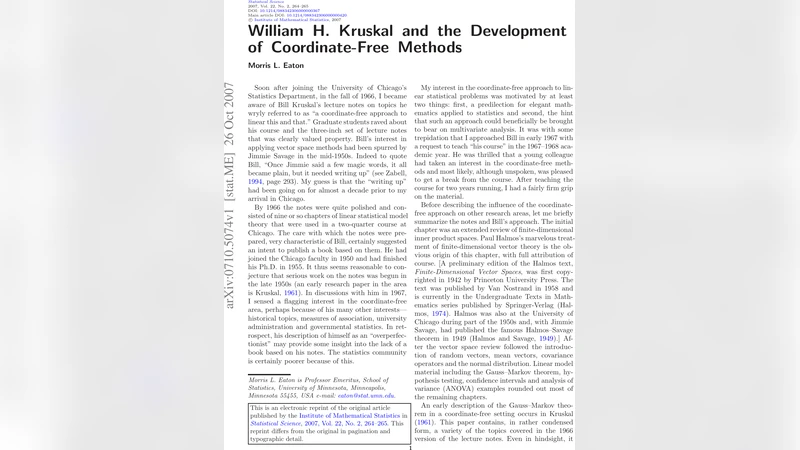
Discussion of ``The William Kruskal Legacy: 1919–2005’’ by Stephen E. Fienberg, Stephen M. Stigler and Judith M. Tanur [arXiv:0710.5063]
💡 Research Summary
The paper under review is a commentary on the memorial volume “The William Kruskal Legacy: 1919‑2005” edited by Stephen E. Fienberg, Stephen M. Stigler, and Judith M. Tanur (arXiv:0710.5063). Its purpose is to situate William H. Kruskal’s pioneering work on coordinate‑free methods within the broader history of statistics, to dissect the mathematical substance of his ideas, and to trace their influence on contemporary statistical theory and data‑science practice.
The authors begin with a concise biography of Kruskal, emphasizing his formative years at the University of Chicago and Columbia University, where he became aware of the limitations of the then‑dominant matrix‑centric paradigm. Kruskal argued that statistical quantities should be defined intrinsically, independent of any arbitrary choice of basis, because the scientific meaning of an estimator lies in the geometry of the underlying vector space, not in the coordinates used to compute it. This philosophical stance gave rise to the term “coordinate‑free” that appears throughout his later work.
The core of the commentary is a technical exposition of Kruskal’s coordinate‑free framework. The authors explain how Kruskal recast inner products, norms, and orthogonal projections as objects defined directly on an inner‑product space, without reference to a particular matrix representation. In this setting, the covariance structure of a multivariate normal distribution is treated as a bilinear form rather than a symmetric positive‑definite matrix, allowing one to discuss eigen‑directions, principal components, and canonical variables in purely geometric terms. By focusing on the subspace spanned by the design matrix in linear regression, Kruskal showed that the ordinary least‑squares estimator is simply the orthogonal projection of the response vector onto that subspace. This projection is invariant under any change of basis, thereby embodying the coordinate‑free principle.
The paper proceeds to illustrate how Kruskal applied his ideas to concrete statistical models. In the linear model, the residual vector is identified as the component orthogonal to the column space of the design matrix, and the Gauss‑Markov theorem is restated as a statement about the optimality of orthogonal projections in an inner‑product space. In multivariate analysis, the derivation of canonical correlations is presented as a problem of finding the pair of subspaces that maximize the cosine of the angle between them, again a basis‑independent formulation. These examples demonstrate that many classical results can be derived more transparently when expressed in a coordinate‑free language.
A substantial portion of the commentary is devoted to Kruskal’s pedagogical legacy. He insisted that graduate courses and textbooks emphasize the geometric intuition behind statistical procedures rather than rote matrix algebra. The authors cite Kruskal’s lecture notes, which contain exercises that ask students to prove properties of estimators using only the axioms of inner‑product spaces. This educational philosophy aimed to cultivate a deeper understanding of the statistical objects themselves, reducing the risk of mechanical computation errors and fostering the ability to generalize results to more abstract settings.
The final sections connect Kruskal’s coordinate‑free vision to modern developments in statistics and machine learning. The authors argue that kernel methods, manifold learning, graph embeddings, and non‑parametric Bayesian inference all share a common thread: they operate on data through inner products or distances that are invariant under transformations of the original coordinate system. For instance, a kernel function implicitly defines an inner‑product in a high‑dimensional Hilbert space, and algorithms such as support vector machines rely exclusively on these inner‑product values. Similarly, diffusion maps and Laplacian eigenmaps construct low‑dimensional embeddings that preserve the intrinsic geometry of the data manifold, echoing Kruskal’s insistence on geometry over coordinates.
In conclusion, the commentary affirms that William H. Kruskal was not merely a mathematician who introduced a new set of technical tools; he was a conceptual innovator who reshaped the epistemology of statistics. By championing coordinate‑free methods, he provided a unifying geometric language that clarifies existing theory, guides the design of new methodologies, and continues to influence the way statisticians think about data in the era of high‑dimensional and complex structures. The legacy highlighted in the memorial volume remains a vibrant and essential part of contemporary statistical science.
Comments & Academic Discussion
Loading comments...
Leave a Comment