Some information-theoretic computations related to the distribution of prime numbers
Notice: This research summary and analysis were automatically generated using AI technology. For absolute accuracy, please refer to the [Original Paper Viewer] below or the Original ArXiv Source.
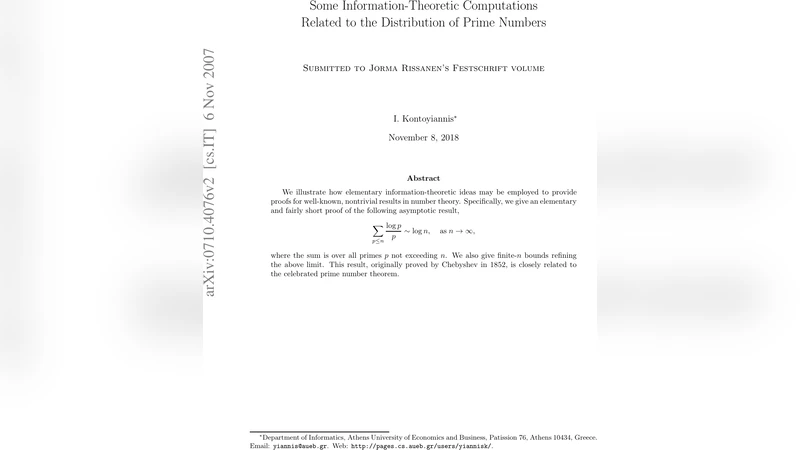
We illustrate how elementary information-theoretic ideas may be employed to provide proofs for well-known, nontrivial results in number theory. Specifically, we give an elementary and fairly short proof of the following asymptotic result: The sum of (log p)/p, taken over all primes p not exceeding n, is asymptotic to log n as n tends to infinity. We also give finite-n bounds refining the above limit. This result, originally proved by Chebyshev in 1852, is closely related to the celebrated prime number theorem.
💡 Research Summary
The paper presents an unconventional proof of a classic number‑theoretic result by exploiting elementary concepts from information theory. The target theorem, originally due to Chebyshev in 1852, states that
\
Comments & Academic Discussion
Loading comments...
Leave a Comment