On proper and exterior sequentiality
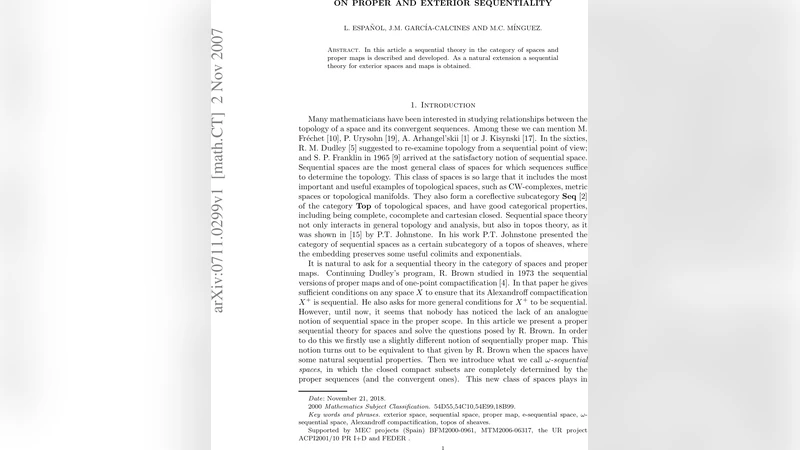
In this article a sequential theory in the category of spaces and proper maps is described and developed. As a natural extension a sequential theory for exterior spaces and maps is obtained.
💡 Research Summary
The paper develops a sequential theory tailored to the category of topological spaces equipped with proper maps and then extends this framework to exterior spaces and exterior maps. It begins by recalling that a proper map is a continuous function whose inverse image of every compact set is compact. Within this setting the authors introduce the notion of a “proper sequence”: a sequence (xₙ) in a space X such that each compact subset of X contains only finitely many terms of the sequence. This restriction mirrors the behavior of proper maps and allows one to speak of convergence that respects properness.
A space is called proper‑sequential if every proper sequence that converges in the usual topological sense has its limit point in X and, conversely, every proper sequence that is eventually contained in any neighbourhood of a point actually converges to that point. The authors prove that proper‑sequential spaces are automatically k‑spaces, because the finiteness condition on compact sets forces the closure of a set to be determined by its intersections with compact subsets. Moreover, they show that a k‑space becomes proper‑sequential precisely when every compact closed set is sequentially closed. This yields a clean characterization linking proper sequentiality to classical sequential and k‑space properties.
The paper then constructs a coreflection (i.e., a left adjoint to the inclusion functor) that assigns to any topological space its “proper‑sequential coreflection”, the smallest proper‑sequential topology finer than the original one. This coreflection is obtained by declaring a set open exactly when its intersection with every compact set is open in the subspace topology. Consequently, proper‑sequential spaces form a reflective subcategory of the category of all spaces with proper maps.
Having established the proper‑sequential theory, the authors turn to exterior spaces. An exterior space is a pair (X, ε) where X is a topological space and ε is a family of subsets of X (the exterior sets) satisfying the axioms of a filter that is closed under supersets and finite intersections, and which contains all complements of compact subsets. An exterior map f : (X, ε) → (Y, η) is a continuous map such that the pre‑image of any exterior set in Y is an exterior set in X. This framework generalizes proper maps: a proper map can be seen as an exterior map where the exterior structure is generated by complements of compact sets.
Within this context the authors define an “exterior sequence” as a sequence (xₙ) for which there exists an exterior set E ∈ ε that contains all but finitely many terms. An exterior space is exterior‑sequential if every exterior sequence that converges topologically also converges with respect to the exterior structure, i.e., its limit belongs to every exterior set that eventually contains the sequence. The main results parallel those for proper‑sequential spaces: (1) there exists an exterior‑sequential coreflection assigning to any exterior space the largest exterior‑sequential structure coarser than the given one; (2) every proper‑sequential space is an exterior‑sequential space, and the converse holds when the exterior structure is generated by compact complements; (3) in the exterior‑sequential setting, proper continuity and exterior continuity coincide, so the two notions of morphism become indistinguishable.
The authors illustrate the theory with several examples and counter‑examples. For instance, the real line with the usual topology and the exterior structure consisting of complements of all bounded intervals is exterior‑sequential but not proper‑sequential, showing that the exterior framework is genuinely broader. Conversely, any compact Hausdorff space is automatically proper‑sequential (hence exterior‑sequential). They also exhibit a non‑k‑space (“the infinite ladder”) that fails to be proper‑sequential, underscoring the necessity of the k‑space condition.
Finally, the paper investigates the relationship between exterior homeomorphisms and proper homeomorphisms. While an exterior homeomorphism need only preserve the exterior families, a proper homeomorphism must preserve compactness. The authors prove that on exterior‑sequential spaces these two notions collapse: any exterior homeomorphism is automatically proper. This result provides a new invariant for classifying spaces up to proper homotopy, as exterior‑sequential structures retain enough information to recover proper homotopy types.
In summary, the article builds a robust sequential framework first for proper maps and then for exterior maps, establishing coreflections, characterizations, and illustrative examples. By doing so it bridges classical sequential topology, proper homotopy theory, and the more recent exterior calculus, offering tools that are likely to impact the study of non‑compact spaces, proper homology, and related areas of algebraic topology.
Comments & Academic Discussion
Loading comments...
Leave a Comment