On extremely amenable groups of homeomorphisms
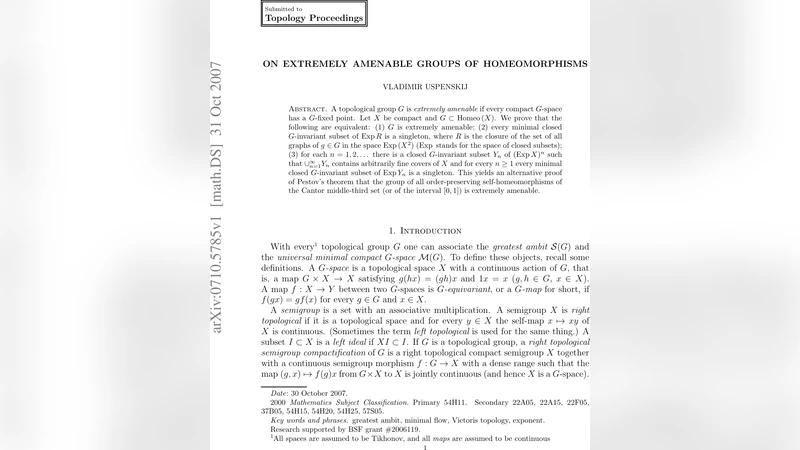
A topological group $G$ is {\em extremely amenable} if every compact $G$-space has a $G$-fixed point. Let $X$ be compact and $G\subset{\mathrm{Homeo}} (X)$. We prove that the following are equivalent: (1) $G$ is extremely amenable; (2) every minimal closed $G$-invariant subset of $\exp R$ is a singleton, where $R$ is the closure of the set of all graphs of $g\in G$ in the space $\exp (X^2)$ ($\exp$ stands for the space of closed subsets); (3) for each $n=1,2,…$ there is a closed $G$-invariant subset $Y_n$ of $(\exp X)^n$ such that $\cup_{n=1}^\infty Y_n$ contains arbitrarily fine covers of $X$ and for every $n\ge 1$ every minimal closed $G$-invariant subset of $\exp Y_n$ is a singleton. This yields an alternative proof of Pestov’s theorem that the group of all order-preserving self-homeomorphisms of the Cantor middle-third set (or of the interval $[0,1]$) is extremely amenable.
💡 Research Summary
The paper investigates the notion of extreme amenability for topological groups, focusing on groups of homeomorphisms of a compact space (X). A group (G) is called extremely amenable if every compact (G)-space admits a fixed point. The authors establish three equivalent characterisations of this property for a subgroup (G\subset\mathrm{Homeo}(X)).
-
Standard definition – (G) is extremely amenable, i.e. every compact (G)-space has a fixed point.
-
Graph‑hyperspace condition – Consider the set of graphs (\Gamma_g={(x,gx):x\in X}) for all (g\in G). Let (R) be the closure of ({\Gamma_g:g\in G}) inside the hyperspace (\exp (X^2)) (the space of closed subsets of (X^2) equipped with the Vietoris topology). The group (G) acts naturally on (\exp R) by sending a closed subset (F\subset R) to ({(x,g y): (x,y)\in F}). The second condition states that every minimal closed (G)-invariant subset of (\exp R) is a singleton. The proof shows that if (G) fails to be extremely amenable then (\exp R) contains a minimal invariant set without a fixed point; conversely, if all minimal invariant sets in (\exp R) are points, one can construct a fixed point in any compact (G)-space by a standard Ellis–Numakura argument.
-
Cover‑based condition – For each integer (n\ge1) there exists a closed (G)-invariant subset (Y_n\subset(\exp X)^n) such that the union (\bigcup_{n\ge1}Y_n) contains arbitrarily fine covers of (X). Moreover, for each (n) every minimal closed (G)-invariant subset of (\exp Y_n) is a singleton. The authors prove that this family of subsets encodes the same dynamical information as the graph closure (R). The direction (2) ⇒ (3) uses the fact that finite families of closed subsets can be identified with points of ((\exp X)^n); the converse builds a suitable (R) from the family ({Y_n}) and shows that minimal invariant sets in (\exp R) must be points.
The equivalence of (1)–(3) provides a new, purely topological framework for studying extreme amenability of homeomorphism groups, avoiding measure‑theoretic or combinatorial arguments traditionally employed.
As an application, the authors give an alternative proof of Pestov’s theorem that the group of order‑preserving self‑homeomorphisms of the Cantor middle‑third set (and, similarly, of the interval (
Comments & Academic Discussion
Loading comments...
Leave a Comment