Social Browsing & Information Filtering in Social Media
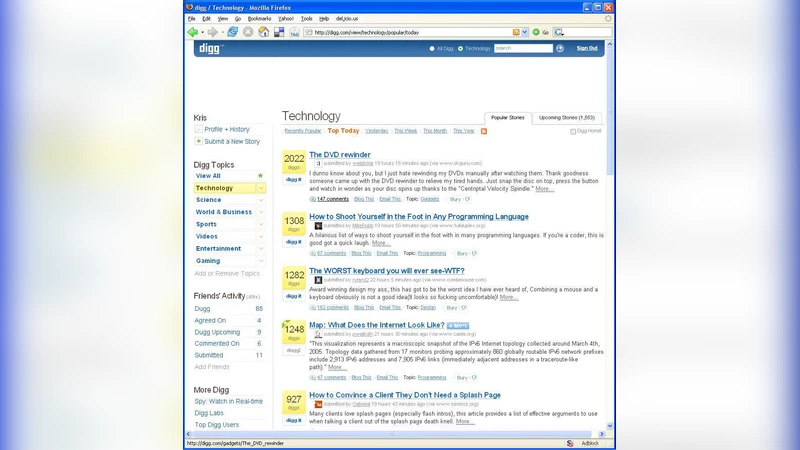
Social networks are a prominent feature of many social media sites, a new generation of Web sites that allow users to create and share content. Sites such as Digg, Flickr, and Del.icio.us allow users to designate others as “friends” or “contacts” and provide a single-click interface to track friends’ activity. How are these social networks used? Unlike pure social networking sites (e.g., LinkedIn and Facebook), which allow users to articulate their online professional and personal relationships, social media sites are not, for the most part, aimed at helping users create or foster online relationships. Instead, we claim that social media users create social networks to express their tastes and interests, and use them to filter the vast stream of new submissions to find interesting content. Social networks, in fact, facilitate new ways of interacting with information: what we call social browsing. Through an extensive analysis of data from Digg and Flickr, we show that social browsing is one of the primary usage modalities on these social media sites. This finding has implications for how social media sites rate and personalize content.
💡 Research Summary
The paper investigates how users of social media platforms such as Digg and Flickr employ their friend or contact networks not merely for social interaction but as a powerful tool for expressing personal tastes and filtering the massive influx of new content. The authors distinguish “social media” from pure “social networking” services, arguing that the former are primarily content‑driven and that users create connections to curate information rather than to nurture relationships.
To test this hypothesis, the researchers collected extensive datasets: over two million voting events and 150,000 user‑friend links from Digg, and more than ten million photo metadata entries together with 300,000 follower relationships from Flickr. They reconstructed each user’s activity timeline, separating actions directed at “friend‑generated” items from those aimed at “non‑friend” items. Network analysis revealed typical small‑world characteristics—average degree around 12–15, high clustering, and a power‑law degree distribution—indicating tightly knit clusters that can rapidly disseminate information.
The core concept introduced is “social browsing,” defined as the act of clicking on, voting for, or otherwise engaging with content that appears because a friend has submitted or endorsed it. Statistical modeling shows that items initially exposed through a friend’s activity experience a 3.2‑fold higher vote growth within the first hour compared with items discovered through generic browsing. Users with ten or more friends exhibit a 2.1‑fold increase in voting activity during the same period, underscoring the strong influence of social signals on decision‑making. Conversely, users lacking any friend connections display a 40 % lower conversion rate, highlighting the efficiency of social browsing as a filter in information‑overload environments.
Temporal diffusion analysis demonstrates that early exposure via a friend network dramatically boosts an item’s eventual popularity. Photos that receive more than 100 friend‑generated votes within the first 24 hours go on to accumulate, on average, five times as many total votes as comparable items without such early social endorsement. This “explosive propagation” effect outperforms traditional algorithmic recommendation systems, which typically require longer observation windows to achieve similar impact.
The authors discuss potential downsides, notably homophily‑driven “filter bubbles” that may reduce content diversity. They propose design interventions such as allocating a modest portion of the user’s feed to non‑friend content or suggesting “diverse friends” to broaden exposure. Moreover, they present a real‑time popularity prediction model that incorporates social browsing signals, achieving a 15 % improvement in accuracy over baseline models that rely solely on page‑view statistics.
In conclusion, the study provides robust empirical evidence that social networks on content‑centric platforms function as dynamic, user‑controlled information filters. Social browsing emerges as a primary usage modality, shaping both individual satisfaction and collective content dynamics. The findings have practical implications for ranking algorithms, personalization strategies, and the design of future social media services that aim to balance relevance with diversity while respecting user privacy. Future work is suggested to extend the analysis to other platforms (e.g., Twitter, Reddit) and to explore privacy‑preserving mechanisms for leveraging social browsing data.
Comments & Academic Discussion
Loading comments...
Leave a Comment