On the ambiguity of the interfering resonances parameters determination
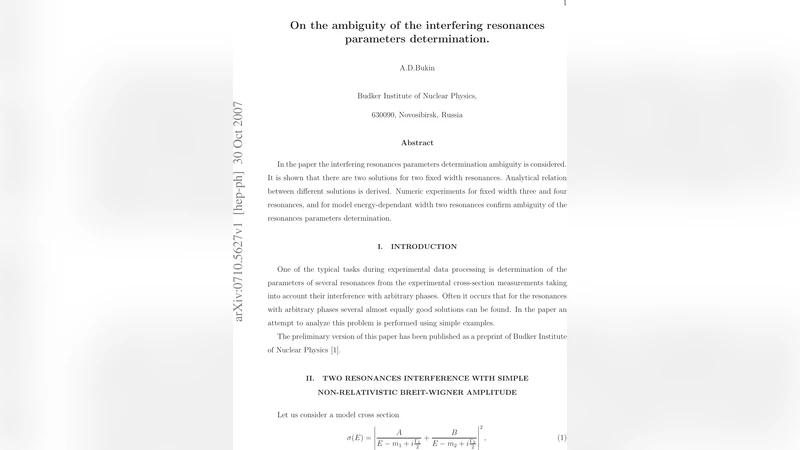
In this paper the interfering resonances parameters determination ambiguity is considered. It is shown that there are two solutions for two fixed width resonances. Analytical relation between different solutions is derived. Numeric experiments for fixed width three and four resonances, and for model energy-dependent width two resonances confirm ambiguity of the resonances parameters determination.
💡 Research Summary
The paper addresses a subtle but fundamental problem in the analysis of overlapping resonances: the non‑uniqueness of the extracted resonance parameters when fitting experimental spectra that contain interfering Breit‑Wigner–type contributions. The authors begin with the simplest realistic scenario—two resonances with constant (energy‑independent) widths—and demonstrate analytically that the measured cross‑section, which is proportional to the squared modulus of the total amplitude, can be reproduced by two distinct sets of resonance parameters.
Mathematically, each resonance is represented by a complex amplitude
(A_i(E)=\frac{c_i,e^{i\phi_i}}{E-M_i+i\Gamma_i/2}),
where (M_i) is the pole mass, (\Gamma_i) the width, (c_i) a coupling strength, and (\phi_i) a relative phase. The observable is (|A_1(E)+A_2(E)|^2). By examining the pole structure in the complex energy plane, the authors find a symmetry: if the poles are reflected with respect to the real axis and the residues are complex‑conjugated (accompanied by a (\pi) phase shift), the resulting squared amplitude remains unchanged. Consequently, a transformation exists that maps one admissible parameter set ({M_1,M_2,\Gamma_1,\Gamma_2,c_1,c_2,\phi_1,\phi_2}) onto a second, physically distinct set ({M’_1,M’_2,\Gamma’_1,\Gamma’_2,c’_1,c’_2,\phi’_1,\phi’_2}). In the most elementary case the mapping reduces to swapping the two resonances and adding a (\pi) phase to each, but the general relation is a non‑linear function of all eight parameters.
To validate the analytic result, the authors perform a series of numerical experiments. First, synthetic data are generated for two constant‑width resonances with known parameters. A non‑linear least‑squares fit is carried out twice, each time starting from a different random seed. Both fits converge to minima with identical (\chi^2) values but with parameter sets related by the derived transformation, confirming the existence of a genuine degeneracy rather than a numerical artifact.
The study is then extended to three and four constant‑width resonances. Here the degeneracy does not simply double; instead, the parameter space exhibits a richer group of symmetry operations that involve cyclic permutations of the resonances combined with phase adjustments. For three resonances, for example, a solution can be obtained by rotating the set ((1\rightarrow2\rightarrow3)) while adding (\pi) to the phases, and a second solution is generated by a different permutation. With four resonances, similar permutation‑phase symmetries appear, but not all permutations lead to physically admissible solutions because of constraints imposed by the requirement that the total amplitude remain analytic and causal.
Finally, the authors consider the more realistic case of energy‑dependent widths, adopting two common parametrizations: a linear dependence (\Gamma_i(E)=\Gamma_{i0}+\alpha_i E) and a square‑root dependence (\Gamma_i(E)=\Gamma_{i0}\sqrt{E/E_0}). Even with these functional forms, the same two‑solution ambiguity persists for a pair of resonances. The key observation is that the analytic structure of the amplitude—its poles and residues—remains governed by the same complex‑plane symmetry, and the energy dependence merely rescales the imaginary part of the pole without breaking the underlying reflection symmetry.
The paper’s conclusions are threefold. First, any fitting procedure that assumes a unique solution for overlapping resonances is intrinsically vulnerable to a hidden degeneracy. Second, the degeneracy is rooted in a well‑defined mathematical symmetry of the complex amplitude and therefore can be anticipated and diagnosed analytically. Third, to resolve the ambiguity in practice one must introduce additional physical information beyond the single‑channel cross‑section: for instance, phase measurements from interference with a known reference amplitude, constraints from other decay channels, or theoretical priors on the relative signs of the couplings.
The implications are broad. In high‑energy particle physics, where overlapping hadronic resonances are routinely fitted, neglecting this ambiguity could lead to mis‑identification of resonance masses or widths. In nuclear spectroscopy and atomic/molecular spectroscopy, where line shapes are often modeled with interfering Lorentzian or Fano profiles, the same caution applies. By providing both a rigorous analytic framework and concrete numerical demonstrations, the authors furnish a valuable toolkit for experimentalists and phenomenologists seeking to extract reliable resonance parameters from complex spectra.
Comments & Academic Discussion
Loading comments...
Leave a Comment