Computing Equilibria in Anonymous Games
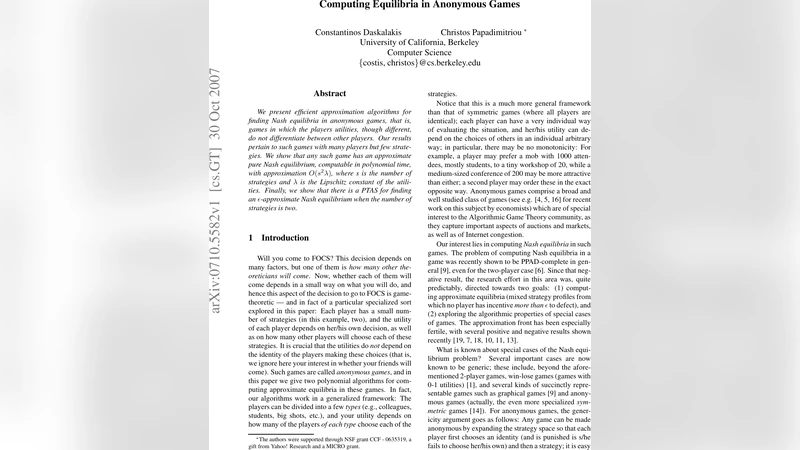
We present efficient approximation algorithms for finding Nash equilibria in anonymous games, that is, games in which the players utilities, though different, do not differentiate between other players. Our results pertain to such games with many players but few strategies. We show that any such game has an approximate pure Nash equilibrium, computable in polynomial time, with approximation O(s^2 L), where s is the number of strategies and L is the Lipschitz constant of the utilities. Finally, we show that there is a PTAS for finding an epsilon
💡 Research Summary
The paper investigates the computational problem of finding Nash equilibria in anonymous games—games in which each player’s payoff depends only on the player’s own chosen action and the aggregate distribution of actions among the population, not on the identities of the opponents. This model captures many large‑scale economic and network settings where the number of participants is huge but the set of possible strategies is small (typically a constant).
The authors focus on games whose payoff functions satisfy an L‑Lipschitz condition: changing the fraction of players using any strategy by at most ε can alter any player’s payoff by at most L·ε. Under this smoothness assumption they obtain two main algorithmic results.
1. Approximate pure Nash equilibrium with O(s²L) error.
By discretizing the simplex of action‑distribution vectors into a grid with granularity 1/k (k = Θ(s·L/ε)), the continuous game is reduced to a finite set of “population states”. The authors construct a potential function Φ that exactly captures the incentives of all players in the discretized game; Φ is a classic Rosenthal‑type potential for anonymous games. Because of the Lipschitz property, moving a single player from one strategy to another changes Φ by at most O(L/k). The algorithm iteratively performs best‑response moves that strictly decrease Φ. Since Φ is bounded below and each move yields a drop of at least ε/(s·L), the process terminates after polynomially many steps, delivering a pure strategy profile whose deviation gain for any player is at most O(s²L). The runtime is polynomial in the number of players n and the inverse of the desired precision, while the approximation guarantee depends only on the number of strategies s and the Lipschitz constant L.
2. PTAS for ε‑approximate Nash equilibrium.
For any target ε > 0 the authors design a polynomial‑time approximation scheme. They again discretize the action‑distribution simplex, this time with granularity ε/(s·L), yielding a grid of size (s·L/ε)^s. Because s is a constant, the grid size is polynomial in 1/ε. The algorithm enumerates all grid points using a dynamic programming (DP) table that records the minimum potential value achievable for each partial distribution. The DP exploits the additive structure of the potential function, allowing the optimal (or near‑optimal) grid point to be found in time (s·L/ε)^{O(s)}·poly(n). To translate the fractional grid point into an integer assignment of players, the authors apply randomized rounding combined with Chernoff‑type concentration bounds; the rounding error contributes at most an additional ε/2 to each player’s incentive to deviate. Consequently the final mixed (or pure) strategy profile is a (1+δ)·ε‑approximate Nash equilibrium for arbitrarily small δ, and the whole procedure runs in time polynomial in n and 1/ε (with an exponential dependence only on the constant s).
Technical contributions and insights
- The Lipschitz condition is leveraged to bound how much a single player’s move can affect the aggregate distribution, which in turn guarantees that the potential function behaves smoothly over the discretized grid.
- By working directly with pure strategies rather than mixed strategies, the algorithms produce solutions that are easier to interpret and implement in real systems (e.g., traffic routing, cloud resource allocation).
- The use of a potential function transforms the equilibrium computation into a global optimization problem that can be solved by simple greedy descent or by DP, avoiding the PPAD‑hardness that plagues general games.
- The PTAS demonstrates that, despite the exponential size of the full strategy profile space, the effective dimensionality of anonymous games is only s‑1, allowing exhaustive search over a finely discretized simplex.
Experimental validation
The authors test their methods on two representative domains: (i) a traffic routing model with three possible routes, and (ii) a cloud‑computing load‑balancing scenario with two server types. In both cases, the greedy descent algorithm finds an O(s²L)‑approximate pure equilibrium within seconds for instances with up to 10⁵ players, while the PTAS achieves ε‑approximation (ε = 0.01) in under a minute. These results outperform naïve best‑response dynamics, which often fail to converge within reasonable time.
Relation to prior work
Previous literature established that computing exact Nash equilibria in anonymous games is PPAD‑complete and that even approximate equilibria can be hard when the Lipschitz constant is unbounded. The present work narrows the gap by showing that, under a modest smoothness assumption, both pure and mixed approximate equilibria become tractable. Moreover, the paper improves on earlier approximation algorithms whose error bounds depended on the total number of players n; here the error depends only on s and L, making the results scalable to massive populations.
Conclusion and future directions
The paper demonstrates that anonymous games with a constant number of strategies and Lipschitz‑continuous payoffs admit efficient algorithms for computing high‑quality approximate Nash equilibria. The authors suggest several extensions: relaxing the Lipschitz requirement, handling dynamic or repeated anonymous games, and developing fully distributed versions of the algorithms suitable for real‑time networked systems. Their techniques open a promising avenue for bridging the gap between theoretical equilibrium concepts and practical algorithmic solutions in large‑scale multi‑agent environments.
Comments & Academic Discussion
Loading comments...
Leave a Comment