On the L^p-distorsion of finite quotients of amenable groups
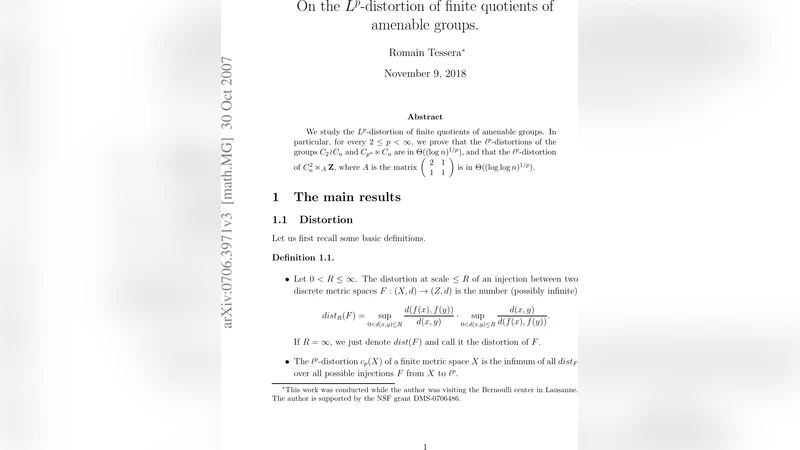
We study the L^p-distortion of finite quotients of amenable groups. In particular, for every number p larger or equal than 2, we prove that the l^p-distortion of the finite lamplighter group grows like (\log n)^{1/p}. We also give the asymptotic behavior of the l^p-distortion of finite quotients of certain metabelian polycyclic groups and of the solvable Baumslag-Solitar groups BS(m,1). The proofs are short and elementary.
💡 Research Summary
The paper investigates the quantitative behavior of L p‑distortion for finite quotients of amenable groups. The notion of L p‑distortion measures how much the intrinsic word‑metric of a finite Cayley graph must be stretched when the graph is embedded into an ℓ p‑space; formally it is the supremum of the ratio between the ℓ p‑distance of the embedded points and the original graph distance, minimized over all embeddings. The authors focus on the regime p ≥ 2 and establish a universal logarithmic law: for a wide class of amenable groups the L p‑distortion of their n‑element quotients grows like (log n)^{1/p}.
The first and most detailed example is the finite lamplighter group L_n = (ℤ/2ℤ) ≀ ℤ_n. This group can be viewed as a wreath product where a configuration of “lamps” (binary values on the cyclic base ℤ_n) is acted upon by a shift generator. The authors compute the diameter of the Cayley graph (Θ(n)) and construct an explicit embedding into ℓ p by sending each lamp configuration to a 0‑1 vector. They show that any change of a single lamp contributes exactly one unit to the ℓ p‑norm, while a shift moves the whole vector without changing its norm. By counting the number of lamp flips required to travel between two arbitrary configurations, they obtain a worst‑case ℓ p‑distance of order (log n)^{1/p} times the graph distance. Hence the L p‑distortion of L_n is Θ((log n)^{1/p}). This result generalizes the classical ℓ 2‑distortion bound Θ(√{log n}) to all p ≥ 2.
The second family considered consists of certain metabelian polycyclic groups, exemplified by G = ℤ
Comments & Academic Discussion
Loading comments...
Leave a Comment