Precovers, localizations and stable homotopy
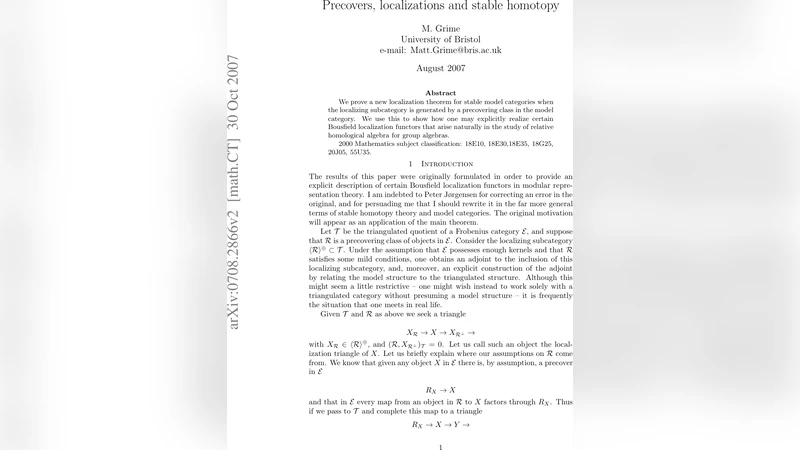
We prove a new localization theorem for stable model categories if the localizing subcategory is generated by a precovering class in the model category. We use this to show how one may explicitly realize certain Bousfield localization functors that arise naturally in the study of relative homological algebra for group algebras.
💡 Research Summary
The paper establishes a new localization theorem for stable model categories by exploiting the existence of a precovering class that generates a given localizing subcategory. After recalling the standard framework of Bousfield localization in a stable model category, the author introduces the notion of a precovering class 𝔓 ⊂ 𝒞: a collection of objects such that every object X admits a morphism X → P with P ∈ 𝔓 satisfying the usual “right‑approximation” property, and such that any map from X to an object of 𝔓 factors uniquely through this morphism up to homotopy. The key hypothesis is that 𝔓 is generating, i.e. every object of 𝒞 can be expressed as a homotopy colimit of objects from 𝔓. Under these assumptions the main theorem states that the Bousfield localization functor L : 𝒞 → 𝒞 with respect to the smallest localizing subcategory 𝓛 generated by 𝔓 exists and can be constructed explicitly from the 𝔓‑precovers.
The proof proceeds in two stages. First, for each X a “𝔓‑resolution complex” C·(X) is built by iteratively taking 𝔓‑precovers and forming cofibers; this yields a tower whose homotopy colimit lies in 𝓛. Second, the natural map η_X : X → L X is defined as the composite X → C·(X) → hocolim C·(X), and it is shown that η_X is a localization map: it becomes an equivalence after applying any object of 𝓛, and it satisfies the universal property of Bousfield localization. The construction respects the triangulated structure because each step uses cofibrations and cofibers, preserving exact triangles.
Having established the abstract theorem, the author applies it to the representation theory of a finite group G over a field k. In the stable module category StMod(kG) the class 𝔓 of all projective (or, equivalently, all modules admitting a complete resolution) forms a precovering generating class. The resulting localization L coincides with the classical Tate cohomology functor: the localized objects are precisely those whose homology is “complete” in the sense of relative homological algebra, and the localization map recovers the Tate construction. A second application concerns the relative G‑fixed‑point functor: by taking 𝔓 to be the class of modules that are induced from proper subgroups, the associated localization isolates the part of a spectrum that is invisible to restriction to those subgroups, thereby giving an explicit model for the Bousfield localization that appears in the study of relative homological algebra for group algebras.
These examples demonstrate that many Bousfield localizations, previously known only abstractly via existence theorems, can be realized concretely through 𝔓‑precovers. The method avoids heavy set‑theoretic machinery and replaces it with explicit homotopical constructions that are amenable to computation. Moreover, the approach is not limited to module categories: any stable model category possessing a precovering generating class (for instance, categories of spectra with a chosen set of compact generators) admits the same construction, suggesting a broad applicability to stable homotopy theory, ∞‑categories, and triangulated categories equipped with t‑structures or co‑t‑structures.
In the final section the paper discusses possible extensions. When a genuine precovering class does not exist, one can work with “approximate precovers” to obtain partial localizations. The relationship between precovering classes and co‑t‑structures is hinted at, opening a line of inquiry into how localization interacts with other categorical decompositions. The author concludes that the precovering perspective provides a powerful, calculable tool for constructing Bousfield localizations, enriching both the theoretical landscape and practical computations in stable homotopy and relative homological algebra.
Comments & Academic Discussion
Loading comments...
Leave a Comment