CANE: The Content Addressed Network Environment
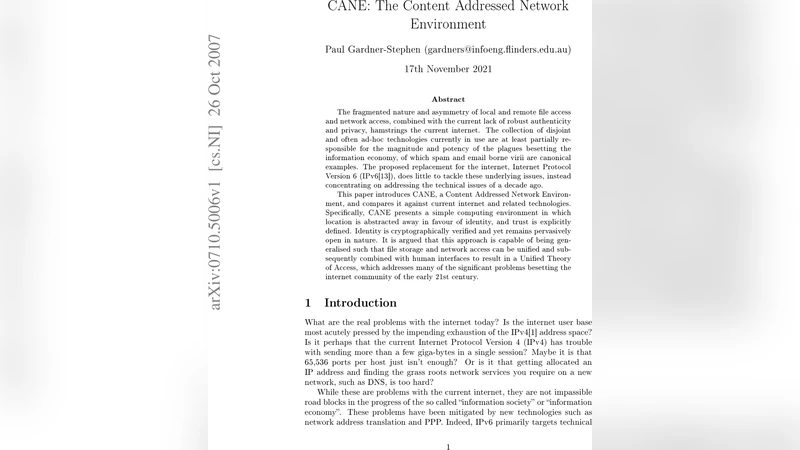
The fragmented nature and asymmetry of local and remote file access and network access, combined with the current lack of robust authenticity and privacy, hamstrings the current internet. The collection of disjoint and often ad-hoc technologies currently in use are at least partially responsible for the magnitude and potency of the plagues besetting the information economy, of which spam and email borne virii are canonical examples. The proposed replacement for the internet, Internet Protocol Version 6 (IPv6), does little to tackle these underlying issues, instead concentrating on addressing the technical issues of a decade ago. This paper introduces CANE, a Content Addressed Network Environment, and compares it against current internet and related technologies. Specifically, CANE presents a simple computing environment in which location is abstracted away in favour of identity, and trust is explicitly defined. Identity is cryptographically verified and yet remains pervasively open in nature. It is argued that this approach is capable of being generalised such that file storage and network access can be unified and subsequently combined with human interfaces to result in a Unified Theory of Access, which addresses many of the significant problems besetting the internet community of the early 21st century.
💡 Research Summary
The paper begins by diagnosing the structural weaknesses of today’s Internet: fragmented file and network access, weak authentication, pervasive privacy breaches, and the resulting explosion of spam, malware, and other abuses. It argues that the current “address‑based” paradigm—where IP addresses and ports locate resources—exposes physical topology, makes services brittle when addresses change, and forces authentication onto separate, often centralized, mechanisms. IPv6, while expanding the address space, does not address these deeper issues.
In response, the authors propose CANE (Content Addressed Network Environment), a unified framework that replaces location with cryptographically verified identity. Every object—whether a file, a service endpoint, or a user—is assigned a unique content address derived from a strong hash function (e.g., SHA‑256, BLAKE3). The hash serves as the immutable identifier; any modification to the object automatically changes its address, guaranteeing integrity by construction.
Identity is bound to a public‑key pair: the public key itself becomes the entity’s identifier. Trust relationships are expressed through signed “trust statements,” which declare that one identifier trusts another. These statements are stored in a distributed ledger, allowing any participant to verify the trust chain without relying on a central certificate authority. This model enables peer‑to‑peer trust propagation and eliminates the single point of failure inherent in traditional PKI.
Storage is organized as a global Distributed Hash Table (DHT). Nodes are responsible for specific hash ranges and store replicas of objects whose content addresses fall within those ranges. Retrieval works by looking up the hash in the DHT, contacting the nearest node, and downloading the data over an encrypted channel that also carries a hash‑based integrity check. Because the address is the hash, the network can verify that the received payload matches the requested object, thwarting man‑in‑the‑middle attacks and silent tampering.
Network routing follows the same principle: instead of routing packets to an IP address, the network routes “content requests” to the node responsible for the target hash. This “content routing” unifies file transfer, streaming, and remote procedure calls under a single mechanism, simplifying protocol stacks and reducing overhead.
The authors also address usability. Users can assign human‑readable aliases (e.g., “my‑resume”) to content addresses, storing the alias‑to‑hash mapping in the trust statements. Applications such as file explorers or browsers can resolve these aliases locally or via the global ledger, providing a familiar name‑based navigation experience while preserving the underlying content‑addressed semantics. A “cane://” URI scheme is suggested for backward compatibility, allowing existing web infrastructure to act as a proxy during migration.
A comparative analysis shows that while systems like IPFS, DAT, or blockchain‑based storage provide content addressing, they treat authentication and trust as add‑on layers. CANE integrates these concerns directly into the network fabric, offering a more cohesive solution. The paper acknowledges practical challenges: scaling the DHT, bootstrapping an initial trust graph, interoperability with legacy services, and regulatory considerations. It proposes a phased rollout—starting with intra‑enterprise file sharing and identity verification—before extending to the public Internet.
In conclusion, CANE represents a paradigm shift from “where” to “what.” By making cryptographic identity the primary addressing primitive and embedding trust statements into the network’s core, it promises to resolve many of the security, privacy, and reliability problems that have plagued the early‑21st‑century Internet, while also providing a scalable path toward a unified access model for both storage and communication.
Comments & Academic Discussion
Loading comments...
Leave a Comment