Social Media as Windows on the Social Life of the Mind
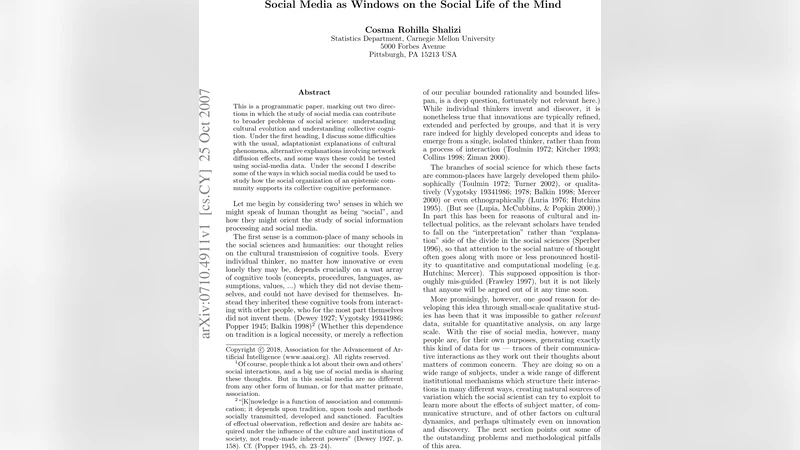
This is a programmatic paper, marking out two directions in which the study of social media can contribute to broader problems of social science: understanding cultural evolution and understanding collective cognition. Under the first heading, I discuss some difficulties with the usual, adaptationist explanations of cultural phenomena, alternative explanations involving network diffusion effects, and some ways these could be tested using social-media data. Under the second I describe some of the ways in which social media could be used to study how the social organization of an epistemic community supports its collective cognitive performance.
💡 Research Summary
The paper positions social‑media platforms as a unique empirical window into two grand challenges for the social sciences: the dynamics of cultural evolution and the mechanisms of collective cognition. In the first part the author critiques the dominant adaptationist view that cultural traits are primarily the product of individual‑level utility maximisation and selection. Instead, the argument is that cultural change is heavily mediated by network‑level diffusion processes—replication (imitation), contagion (viral spread), and structural conformity (homophily‑driven clustering). These processes generate patterns of cultural “waves” and “jumps” that cannot be captured by purely individual‑centric models. To test these ideas, the paper proposes a research agenda that exploits publicly available streams from Twitter, Instagram, TikTok, and similar services. The suggested methodology includes (1) constructing directed follower/mention/retweet graphs, (2) tracking the temporal trajectory of hashtags, memes, or lexical items, and (3) applying regression models that treat network centrality, modularity, and bridge‑node metrics as predictors of diffusion speed. In addition, agent‑based simulations of cultural transmission are recommended, with model outputs compared against observed diffusion curves to assess fit. This approach promises a data‑driven, network‑centric re‑examination of cultural evolution theory.
The second major theme shifts focus to collective cognition, specifically how the social organisation of an epistemic community supports its “group mind.” The author defines an epistemic community as a heterogeneous assemblage of scientists, journalists, hobbyists, and lay users who interact on platforms such as Wikipedia, Reddit, and scholarly citation databases. Three core mechanisms are highlighted: (a) crowd‑based reputation and trust assessment, (b) deliberative discussion that drives consensus formation, and (c) the use of tags, metadata, and version histories as a distributed memory system. When these mechanisms operate in concert, the community can exhibit a form of collective intelligence that exceeds the sum of its parts. To operationalise this claim, the paper outlines a multi‑layered analytic framework. First, edit‑conflict and revert logs on Wikipedia are used to quantify the efficiency of information verification. Second, sentiment‑aware discourse analysis of Reddit threads measures the speed and robustness of consensus building. Third, structural properties of citation networks (centrality, clustering, bridge nodes) are linked to the emergence of novel ideas, measured through the appearance of new keywords or research topics. Performance metrics such as problem‑solving latency, error‑reduction rate, and innovative idea generation frequency are proposed as quantitative proxies for collective cognitive performance.
Overall, the manuscript argues that the massive, real‑time, and richly connected data streams generated by modern social media provide an unprecedented laboratory for testing and extending theories of cultural change and collective cognition. By integrating network analysis, time‑series modeling, and agent‑based simulation, researchers can move beyond speculative narratives toward empirically grounded explanations of how societies think, learn, and evolve together. This integration, the author contends, will not only sharpen existing theories but also open new avenues for interdisciplinary research at the intersection of sociology, anthropology, cognitive science, and computational social science.
Comments & Academic Discussion
Loading comments...
Leave a Comment