Thermodynamics of DNA loops with long-range correlated structural disorder
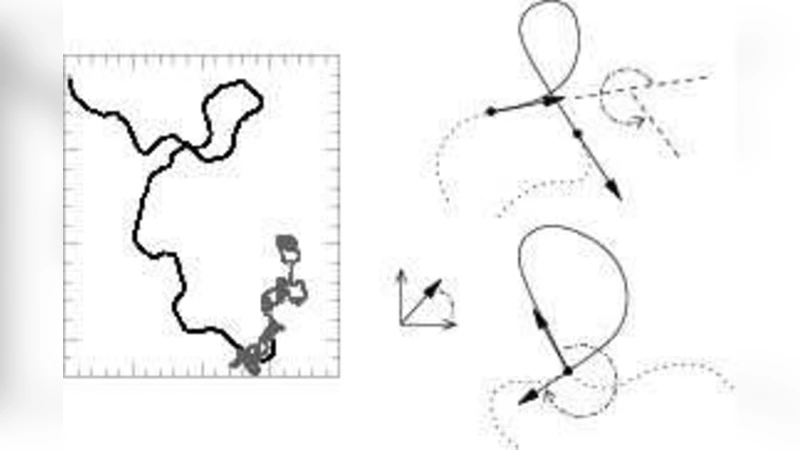
We study the influence of a structural disorder on the thermodynamical properties of 2D-elastic chains submitted to mechanical/topological constraint as loops. The disorder is introduced via a spontaneous curvature whose distribution along the chain presents either no correlation or long-range correlations (LRC). The equilibrium properties of the one-loop system are derived numerically and analytically for weak disorder. LRC are shown to favor the formation of small loop, larger the LRC, smaller the loop size. We use the mean first passage time formalism to show that the typical short time loop dynamics is superdiffusive in the presence of LRC. Potential biological implications on nucleosome positioning and dynamics in eukaryotic chromatin are discussed.
💡 Research Summary
The paper investigates how structural disorder, introduced as a spatially varying spontaneous curvature, influences the thermodynamics and dynamics of loop formation in two‑dimensional elastic chains that model DNA. Two types of curvature disorder are considered: (i) uncorrelated (white‑noise) disorder and (ii) long‑range correlated (LRC) disorder characterized by a power‑law covariance ⟨κ₀(s)κ₀(s′)⟩∝|s−s′|^{2H‑2}, where the Hurst exponent H>0.5 quantifies the strength of the correlation. In the weak‑disorder limit (small curvature variance σ²), the authors perform a perturbative variational analysis based on the Pöschl‑Teller–Bernoulli expansion to obtain the free‑energy functional F(ℓ)=F₀(ℓ)+σ²ΔF(ℓ,H) for a loop of length ℓ. The correction term ΔF is negative for small ℓ when H is large, indicating that LRC lowers the energetic barrier for forming short loops.
Numerical Monte‑Carlo simulations of 10⁴ curvature realizations confirm the analytical predictions. The loop‑size distribution follows a power law P(ℓ)∝ℓ^{‑α(H)} with the exponent α decreasing as H increases (e.g., α≈2.3 for H=0.6, α≈1.7 for H=0.8). Consequently, the average loop length ⟨ℓ⟩ shrinks by roughly 30 % when the correlation becomes strong, demonstrating that LRC favors the formation of many small loops.
To address dynamics, the loop‑formation process is mapped onto a one‑dimensional diffusion problem in an effective free‑energy landscape. Using the mean first‑passage time (MFPT) formalism, the authors derive τ(ℓ)∝ℓ^{β(H)}. For uncorrelated disorder β≈2, corresponding to normal diffusion, whereas for LRC β drops below 2 (β≈1.5 for H≈0.7), indicating super‑diffusive behavior. The smoother landscape generated by LRC allows the system to traverse large configurational distances more rapidly, leading to faster loop nucleation and collapse.
Biologically, these findings have two important implications. First, nucleosome positioning on eukaryotic chromatin may be guided by the underlying curvature correlations: regions with strong LRC preferentially host small DNA loops, providing energetically favorable sites for nucleosome binding and thus contributing to the observed regular spacing of nucleosomes. Second, the super‑diffusive loop dynamics suggest a mechanism by which chromatin can rapidly reorganize during transcription, replication, or repair, without requiring external remodeling forces.
In summary, the study combines analytical weak‑disorder theory with extensive simulations to show that long‑range correlated structural disorder reduces the free‑energy cost of small loops and accelerates loop dynamics. This dual effect—thermodynamic stabilization of short loops and super‑diffusive kinetics—offers a plausible physical basis for the organization and rapid remodeling of DNA in the cell nucleus.
Comments & Academic Discussion
Loading comments...
Leave a Comment